Originally posted as a Twitter thread on August 17, 2017
I’m at a restaurant where the waitress is talking to the bartender about the best law firm for an ICO
Bartender recommended Cooley (I’m not making this up)
Originally posted as a Twitter thread on August 17, 2017
I’m at a restaurant where the waitress is talking to the bartender about the best law firm for an ICO
Bartender recommended Cooley (I’m not making this up)
Originally posted as a Twitter thread on July 09, 2017
Medicine feels like the taxi industry pre Lyft/Uber — no price transparency, no real reviews, “once and done” for all but primary care
And it’s much worse for procedures…want controlled longitudinal data for, say, allograft vs autograft in ACL repair? Good luck
For me, it’s personal – need major ankle surgery, data do not exist, many surgeons are offended when asked, all “reviews” adversely selected
And stakes are till-death-do-us-part permanent. The consensus, when scientific method applied, is often dead wrong:
http://www.nejm.org/doi/full/10.1056/NEJMoa1305189
Past data = *qualitative* observations and musings. Post-op data = adversely selected, sparse, and also qualitative
The battle between every startup and incumbent comes down to whether the startup gets distribution before the incumbent gets innovation.
The TiVo Problem
In 1999, ReplayTV and TiVo invented the Digital Video Recorder (DVR). It was an incredible innovation — allowing you to “pause” live television.
But TiVo had no value without “content” to pause. That content, by and large, was distributed via cable and satellite TV networks.
And because TiVo was separate from your cable box, using it was far from simple. If you wanted your TiVo to “know” what shows were on (and consequently record them), you’d have to have it connect (via modem/phone line — remember, TVs were not placed near phone jacks) to a TiVo server to download them.
Clearly TiVo had an enormous channel opportunity. What if Comcast, Adelphia, Cox, and other large cable companies simply distributed TiVo to their customers? Wouldn’t that be a home run for TiVo and the cable companies — a new service that would delight customers with a massive new revenue stream to boot? And, integrated with the cable box, the TiVo product itself would get better, too.
But — and this is what I call the TiVo problem — that doesn’t normally work out well, and if you look at your cable box today (with a generic DVR function, I would bet, built-in), you know how this story ends.
If you’re TiVo trying to cut a deal with a Comcast, one of the below normally happens:
TiVo did not fail, but it became a patent troll of sorts. It has a market cap of less than $1B today, despite having collected more than $1.6B in patent settlement funds from the “Comcasts” of the world.
The Winning Strategy: Go Boring
Given that the common outcome to the “TiVo problem” is getting clobbered by Comcast, how do you deal with this situation?
The answer is often to “go boring“ and be patient. This was a big mistake I made at TrialPay, which put relevant offers around the payment flow. We built a great product/service/business on top of payments, but it wasn’t core — merchants didn’t start off looking for or needing our product. They started off looking for what I thought was boring, cheap, commoditized payment processing. Going back to the analogy: Consumers want/need Comcast more than they want/need TiVo. Or at the very least, the chronology starts off with Comcast.
In 2006, I thought “Why build a ‘boring’ commodity payment business like Stripe or Square (that did not yet exist), when we could build the lucrative feature missing from all the commoditized payment processors?” We had insanely better unit economics than they did.
But these payment processors had the customer relationships, and they had the starting product that the customer wanted. Eventually we sold TrialPay to Visa, and I think a lot of value will be created for Visa from that deal, but not nearly as much for TrialPay shareholders had we owned the channel.
This is the flaw with looking at Square and Stripe and calling them commodity players. They have the distribution. They have the engineering talent. They can build their own TiVo. It doesn’t mean they will, but their success hinges on their own product and engineering prowess, not on an improbable deal with an oligopoly or utility.
There are two ways somebody can interpret this video.
-“I’m much better than that kid at golf! [says a 33 year old]. I have a 12 handicap and can outdrive that joker by 200 yards!”
-“Wow, that’s remarkable for somebody of that age…if he continues like that, he could someday win 14 Majors.”
Both assessments are logically correct. But as a young company selling into enterprises, you will often get the first reaction.
In my experience, a lot of larger corporations (and people who work at them) can generally only see the present — the present capabilities, the present revenue (or trajectory), the present limitations. In startups, you need to see the future. Not as a fortuneteller would (impossible) but to judge teams and ideas on their future potential / adjacencies.
There is a natural lesson here for an entrepreneur — which is to beware showing “leanness” of product when interacting with a large company. Saying “we can/will add that later” unfortunately lacks credibility, because large companies are often incapable of building anything quickly, and hence their employees tend to doubt this statement. “Blockers” in the large organization will try to scrap any deal with a “deficient” startup.
The right way to build a typical startup is “lean.” Overbuilding before product-market fit can be catastrophic; building sophisticated management and operational processes before you need them is normally a vast misallocation of resources and actually prevents learning of what the market wants.
But present your lean startup to a large company and you’ll hear “where’s the beef?” When selling a product to a large company, or even selling your OWN company to a large company, you’ll be thoroughly evaluated on the present — which sometimes is good in, say, M&A when you are on an unsustainably high growth rate. The hard part of a company is generally making the whole thing work; it’s not the sophistication of a set of algorithms, but having the whole product perform at scale with an organization that can support it.
I saw this firsthand at TrialPay, which was, at its simplest level, an advertising technology company. An early potential deal with a large company did not materialize because said company was displeased with our optimization systems, even though we could add a better optimization algorithm in a few days (GitHub shows 329 collaborative filtering projects). But we were judged on the present, and if we had the opportunity to do it over, I would have actually invested those few days to look “fatter” — even if it had no impact on our business.
This is an update to a post I originally wrote in 2008 on Seeking Alpha.
The internet has witnessed the conversion of analog advertising dollars into digital advertising pennies (credit due to Jeff Zucker when at NBC for “coining” that metaphor). Despite the fact that a viewer is always just a “click away” on the internet, online advertisements command only a fraction of the cost of far less measurable media – like print, radio, and television. Consider this: an advertisement on Facebook might cost $.25 to show to 1,000 people ($.25 CPM), versus $25 for 1,000 readers of Time magazine ($25 CPM).
In the good old days of performance-less advertising, engagement didn’t really matter because you generally couldn’t quantify it. Studies on Reach, Frequency, and Recall aside, General Motors had no way of measuring the marginal benefit (much less revenue!) of a particular advertisement. But on the internet, it is quite clear that if nobody is clicking on your ad, then nobody is noticing it, much less “connecting” with it. Proctor and Gamble has likely spent millions of dollars on Facebook advertisements that attract a few dozen active “followers” – probably the same hit rate they had in Time magazine 20 years ago, but with one key difference: Now anyone can prove that people don’t engage with the advertisement! If only Facebook (and internet advertising agencies) hid such pitiful data, perhaps the pennies would somehow metastasize back into dollar form. When there’s no way to measure the marginal benefit of an advertising unit, it’s very easy to get ripped off.
Pundits will argue that with increased ad targeting, profiling, and all sorts of other algorithmic alchemy, online ad revenues will be boosted. Such talk is nonsense insofar as brand advertising (not direct response) is concerned. Rather, a seismic shift is underway – one that will not only change the nature of advertising, but will also show that the last century of offline advertising witnessed a tremendous amount of money being flushed down the toilet. We are a lot smarter than we were 50 years ago, and those analog dollars really should have been analog pennies all along.
The result of this peculiar wastefulness was (and, for the moment, still is) a “private” consumption tax for the funding of “public” content. If the BBC is funded by the British government (i.e. taxpayers), NBC is funded by Proctor & Gamble, Coca-Cola, General Motors, et al (i.e., consumers of those brands). If you happen to watch your favorite sitcom without transacting with any of those brands, then you are free-riding off of those who do spend – a remarkable corollary to the piracy of paid content. The “free content” system of the past century is no different than forcing people to buy NBC content from iTunes, but instead of the cost being charged to their Visa cards, it is tacked onto the cost of their Tide, Cherry Coke, and Chevy Malibu.
Don’t expect it to last, though. As the brands recognize that they are being bilked – rather, that there is at best a tenuous link between consumption of their goods and consumption of the free content they are sponsoring, they will be less likely to foot the bill. For the beneficiaries of free content, the internet is unraveling this whole ecosystem with unwavering speed.
If you are a media company, or a shareholder in a media company, there is a good reason to worry about what the next ten years hold in store. The enemy is not Google or the internet, but rather increased intelligence and analysis of advertising spend, which will irrevocably change the way advertisers allocate their dollars.
Are social media companies overvalued? The question is not just a matter of revenue multiples (low or high), but rather whether that revenue is actually generating new sales for advertisers. Google convinced the world to believe in the click, Facebook has done the same with the Like, Twitter with the follower, and Pinterest is planning on unveiling the same with the Pin. Creating these “intermediate” metrics between impression and ultimate purchase is a great move to boost revenue, but must stand up to scrutiny as software eats the marketing funnel. For startups seeking to build a valuable advertising business, creating an intermediate metric is crucial, but so is ensuring that that metric holds up to scrutiny.
Let’s rewind a bit, though. Without commerce, without transactions, there would be no advertising. The point of an advertisement is to generate sales. Full stop. Brand building, goodwill, mindshare, buzz, and a lot of other niceties might come about, but even those are meant to eventually lift sales. Without a transaction at the end of the line, advertising has no raison d’être.
The challenge, though, is that it’s often difficult to draw a straight line between “person sees an advertisement” and “person buys a product.” Impression and transaction are the two endpoints of the advertising-commerce lifecycle.
And, the chronological delta between impression and purchase can be wide. A 15-year-old might be bombarded with BMW advertisements for 10 years before she finally pulls the trigger on a fancy, brand-driven car purchase. Deciding to buy Advil vs. Tylenol might take years of external inputs and supermarket trips.
Enter the intermediate metric, which is anything that falls on the continuum from impression to purchase: clicks (the Internet’s first intermediate metric), likes, bookmarks, views, shares, app downloads, recall, followers, retweets, mentions, pins, etc. Intermediate metrics help publishers (e.g., Google, Facebook, Twitter, Yelp, Pinterest, etc.) attempt to show their impact when sales are not readily measurable — either because of chronological disconnect or because the transaction data is not readily accessible. Or, cynically, and in some instances, because there are no downstream sales — making the intermediate metric the best way to obfuscate while purportedly showing performance.
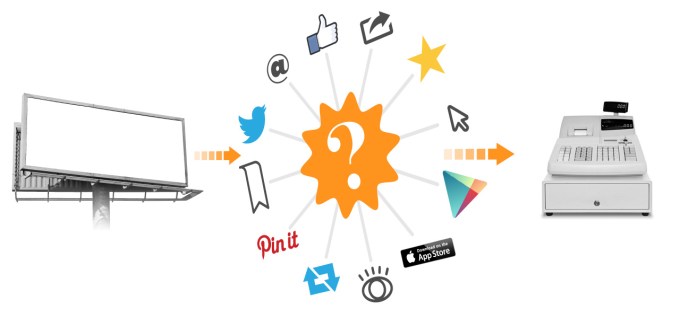
Intermediate metrics help advertisers show internal and external stakeholders that they’re doing a great job. It’s hard for Clorox’s marketing team to be given an instruction of “sell 20 percent more bleach this quarter and you get a big quarterly bonus!” A national “must wear white to participate” tomato fight might increase sales of Bleach without Clorox lifting a finger. So many advertisers will compensate and reward their teams for the achievement of intermediate metrics.
The greatest intermediate metrics allow for the broadest attribution tracking possible (accounting for marginal intent generation), while being somewhat unique to the medium. At scale, Quora might charge for a promoted corporate answer; Gmail might charge for a bolded email; Waze might charge for a “route added.” These would all be intermediate metrics, knowing that none of these actions yield an immediate purchase but hopefully contribute to one. Without an intermediate metric, there would be a publisher-advertiser marketplace failure, since immediate “transaction” tracking would undercount efficacy and cause metrics-driven advertisers to abandon the platform.
The greatest intermediate metrics allow for the broadest attribution tracking possible while being somewhat unique to the medium.
The smartest thing that Google did was charge for the click, not the sale, because it isn’t Google’s fault if your site converts poorly (or if a sale/action is not relevant, as it is for, say, auto research).
The smartest thing that Facebook did was define the like not just as an intermediate metric, but as a quantum of self-worth. Watching Samsung hit 20 million Likes must have made HTC mighty jealous and want to respond accordingly. When I asked a large restaurant chain where they spend most of their money online, the president said “Facebook. We get a lot of likes, and that must be better than not a lot of Likes.” A click — Google’s classic intermediate metric — isn’t too relevant for a restaurant that doesn’t deliver or allow online transactions. Facebook has a potentially broader audience, yet less transactional intent — so ultimately those likes will need to turn into revenue.
As Twitter goes public, it probably needs a stronger intermediate metric that can resonate with the long tail of advertisers. It might not make sense for regular people to “follow” an advertiser like Oreo in the same way they might follow their favorite moviestar, thus making followers a poor metric; in fact, The Bronx Zoo’s Cobra (an actual snake) has more followers than Oreo. The famous Oreo Superbowl tweet was retweeted only 16,000 times. The most retweeted brand advertisement on Twitter (from Nokia) has yet to top 50,000 retweets. Yet perhaps Oreo was seen by millions of people on Twitter, yielding a spike in supermarket sales, and thus followers and retweets — the intermediate metrics with which pundits seem to be measuring Twitter, are the wrong intermediate metrics.
The danger of intermediate metrics is that they feel quantitative — these are numbers, people! — but they might actually be meaningless. Ironically, both parties, advertisers and publishers, often have a vested interest in separating them from sales — for the short term — lest the music stop. Separation allows for “quantifiable metrics” when sales are just too hard to perfectly measure, so advertisers can keep spending and publishers can keep charging.
If a company’s revenue is based on selling questionable intermediate metrics, be cautious — no matter how quickly that revenue is growing. Sometimes metrics are purely about internal vanity and do not last. As an example, “number of app downloads” feels like a key performance indicator, whereas for many companies (Supercuts has an app?!), “apps” make little sense as a paradigm. Depending on how this intermediate metric (app downloads) stands up against actual incremental sales, the whole app download market could suffer. The same goes for many other intermediate metrics. When advertisers start thinking of the intermediate metric as the final action (the R in ROI = achievement of intermediate metric), the market is inflated.
For any company — whether buying traffic or selling it — intermediate metrics are often a crucial strategy in building a broad revenue model and in having a metrics-driven approach to customer acquisition and retention. But it is unwise to divorce the intermediate metric from the final, and crucial, metric of the transaction — to ignore it, or to exaggerate it, is penny wise and pound foolish. Plenty of startups and established industries (television advertising!) will be obliterated when data finally lights the path from impression to transaction and, in some cases, reveals it to be seldom traveled.
We are in the midst of a great revolution in the payments space: anyone with a phone can now accept credit cards; online-to-offline commerce is allowing online payment for offline purchase and significant friction is being removed from the consumer purchase experience thanks to mobile. All of this innovation (read: competition), combined with government intervention, means that payment fees are falling, threatening revenue streams for incumbents and startups alike in the payments space. But a broader opportunity exists: using the data of payments to build a more valuable, more defensible business model, one not dependent on fees. The result will revolutionize offline commerce and online advertising.
Today: It’s All About Fees, and They’re Heading Towards Zero
Payment companies make money by charging fees to “process” a payment from buyer to seller. Square charges 2.75% (or $275/month for volume up to $250K/year). PayPal Here charges 2.7%, as does Intuit GoPayment. Groupon and Amazon are both supposedly working on their own dongles, and prices will continue to fall, especially as these new devices create “one-sided” networks without significant defensibility outside of switching cost and inertia. “Pay with Square” is a potential game changer, as the millions of Square user accounts can ONLY be used with Square. But basic “acceptance of credit cards” is becoming a commodity where prices will keep going down.
Competition between payment companies is only one leg of inevitable downward pricing pressure. Government intervention is the other. Not too long ago, the Australian government decided that payment fees were too high, so now most Australian merchants pay less than .5% for credit card swipes, a fraction of the cost here in the US. The European Union is likely to enact similar legislation. The Durbin Amendment of Dodd-Frank and the $6B+ (pending) Brooklyn Settlement are US-based government and civil attacks on the business of payment fees. Many of these fee-cutting regulations help intermediaries like PayPal and Square short term, by reducing their cost (owed to the Visa/MasterCard infrastructure), but eventually it limits what they can charge, too.
Wherever fees end up, most merchants will still dislike paying them. They are a “cost of doing business” that every merchant has an incentive to bring down. Payment companies generally aren’t delivering new customers; they’re taxing the flow of existing ones. Google effectively charges 20-30% to deliver a customer (if you back out the cost-per-click to percentage of realized sale) to an ecommerce merchant, yet merchants are competing to hand Google more money because each dollar “in” produces more than a dollar “out.” Payment companies charge a fraction of Google, but are often despised (witness the lawsuits and legislation) or treated with promiscuous disrespect.
It comes down to something rather simple: Connecting the bank accounts of buyers and sellers will never be as valuable nor defensible as connecting buyers and sellers. Google delivers customers at the top of the funnel, and payment companies serve the prosaic, but necessary, task of shuffling funds at the end.
Tomorrow: Payment Data Will Revolutionize Commerce & Advertising
As society goes increasingly cashless, payment companies will have a larger business, and a more valuable one, in closing the loop for offline transactions and helping deliver customers. The data they possess is without equal; did somebody buy something? How much did he spend? What did she buy? Paper money cannot be tracked in this manner. In order for Online-to-Offline commerce to take flight, every merchant needs an ability to track online/mobile action to offline purchase, and PayPal Here, Square, GoPayment and others could provide just this for a whole new class of small merchants.
Imagine that Wendy’s, or even a local handyman, wants to advertise on the Internet. What’s the point? What does a click, or an impression, really mean? It’s clear what it means online, since every click can be measured to “action” (e.g., purchase) for an ecommerce company. Who can tell Wendy’s, or the local handyman, if that online advertisement worked?
In an increasingly cashless society, the answer is pretty clear: the payment infrastructure. Tracking that purchase back to the originating source (Google? Yelp? Patch? etc) is known as “closing the loop” and will revolutionize offline commerce and advertising alike.
The million-plus merchants walking around with Square, PayPal Here, and GoPayment dongles want more customers, and these dongles provide a means to “close the loop” and let those merchants acquire more customers, remarket to those customers, understand those customers, and do everything that ecommerce companies have taken for granted for over a decade. Legacy POS systems were poorly integrated and insufficiently verticalized, often requiring a merchant to have separate relationships with every player in the payment chain (hardware vendor, merchant bank, CRM system, etc); moreover, they were priced out of reach of the sole proprietor.
Beyond closing the loop, payment companies can utilize data from existing transactions to generate more transactions. Companies who maintain a direct relationship with the consumer — such as American Express, PayPal, Square, Discover, etc — are in the perfect position to serve as an Amazon recommendation system for “everything.” You bought a tennis racket at Sports Authority? How about tennis lessons with Saul the tennis pro, at a discount thanks to your purchase of a tennis racket, only redeemable with the same payment instrument? You weren’t searching for Saul, and you wouldn’t want an unsolicited email from Saul, but seeing an advertisement for Saul shortly after buying a tennis racket (say, on your purchase receipt) would likely produce a response. It’s a way topreeempt search for a large class of “secondary” purchases (e.g., charcoal after buying a grill; tennis balls after buying a tennis racket, etc), in a “pull” based way.
None of this is to say that the fees charged today are wholly unreasonable and unconscionable; they’re just not long-term defensible as more parties offer the same conduits to existing credit card infrastructure. I have $40 cash and five credit cards in my wallet right now, so any merchant wanting to charge $100 for some widget can either get 97.25% of $100 (if using Square), or $0. That’s an easy decision and shows why things like Square and PayPal Here are hugely beneficial to merchants and consumers alike. But longer term, as those fees continue to compress to the benefit of merchants, the larger business will be in applying the data of payments to the benefit of merchants, consumers, and payment providers alike.
(Originally guest-written for TechCrunch)
The biggest ecommerce opportunity today involves taking offline services and offering them for sale online (O2O commerce). The first generation of O2O commerce was driven by discounting,push-based engagements, and artificial scarcity. The still-unfulfilled opportunity in O2O today is tantamount to tacking barcodes onto un-warehousable services by standardizing and normalizing the units being sold, something I call “Service as a SKU.” Just as Amazon figured out how to build the best warehouses and technology in the world for delivering boxes, somebody will do this for “unboxed” services, with customers driven not by discounts or scarcity, but rather by the Internet’s hallmarks of customer experience and convenience. And unlike how “ship stuff in a box” ecommerce seems to be gravitating towards a few winners, Service as a SKU is still a wide open playing field.
The idea is to turn every service, or unit of commerce, into what retailers typically call a SKU (Stock Keeping Unit). Imagine the following as “items” you can buy, and have “delivered,” with a simple click or tap:
“1 Unit of Plumber-Fixes-Your-Leaking-Toilet”
“1 Unit of Dentist Fixes Your Crown”
“1 Unit of 12-Inch Hole-in-Roof-Is-Fixed”
“1 Unit of Piano Tuner Tunes Your Piano”
“1 Unit of Set Up a Home WiFi Network”
Groupon and LivingSocial, early leaders in O2O commerce, started a wave I wrote about a few years ago, but have historically focused on discounting and creating demand by artificial time or quantity scarcity. There are two main problems here:
-Adverse selection: Groupon et al tend to attract customers looking for deals. This is not what Amazon does, and not how most consumers shop for necessities (e.g., fix my toilet!).
–Push v Pull: Groupon et al tend to rely on “push” (e.g., email) to drive a tremendous amount of sales. Unlike Google, eBay, Yelp, or Amazon, people don’t tend to go to Groupon “unprompted.”
To successfully create a SKU for every service, you need to normalize both the service provider (price/quality) and the service being rendered. It’s more like buying produce than buying something mass-produced in a factory. Or, perhaps more accurately, it’s more like booking a hotel reservation, where the rooms are anything but identical, there exist varying degrees of quality, but there are also quite a few commonalities.
The company that pulls this off will need to have the following:
-A seamless scheduling system, deployed at various service providers, to allow real-time inventory management. OpenTable does this for restaurants, and hence can provide a marketplace for “tables” at opentable.com. You can’t sell boxes without knowing how many items are in your warehouse; you can’t SKU-ify a Service without knowing how many hours are available.
-A trusted ratings system to allow for normalization of services and parsing of consumer feedback. How do I compare a $100 “fix my toilet” plumber to a $175 “fix my toilet” plumber? Ideally this will work like hotels: every service provider has a “star rating” and an associated cost. Hotel rooms are reasonably similar; consumers can choose between a 5 star hotel or a 2 star hotel, and even different star levels have significant variance. Yelp and Angie’s List have tremendous assets in their community-based feedback, although payment companies like PayPal and Square have perhaps an even better potential asset on their hands (chargeback rates are a good proxy for merchant quality, every completed transaction can solicit quality feedback and not just from aggrieved/fanatical customers, etc).
-A no-discounts, no-push site. OpenTable gets people looking for restaurants, and needs neither emails nor discounts to make that happen. Yelp, Google, eBay, Angie’s List, and Amazon are all contenders as they all have consumers “coming back” unprompted. If the product and site are sufficiently convenient, this often happens organically; having a well-designed and convenient search, shopping, payments, and redemption experience avoids the need for push marketing.
-Relationships with offline service providers. Despite the flash nature of Groupon and LivingSocial, their merchant relationships are significant. Yelp has virtually every business profiled but perhaps not every business engaged in an economic relationship.
It’s important to note that Service-as-a-SKU is not lead generation for offline services, nor is it just a glorified scheduling platform. “Leadgen” has been around since the beginning of the internet, but there is no standardization or normalization, not to mention the convenience of “one-click” purchase. There are leadgen services for housing relocation, laser eye surgery, insurance, etc, but none let you actually make a purchase online. The hard part is in “normalizing” to create a single “service item” that can be scheduled, paid for, and “delivered” with a mouse click or smartphone tap. As an example, Uber has done this for black cars, and EXEC is fixing hourly prices and limiting SKUs to low-wage labor services.
At 8:01 AM on June 26, 1974, a shopper named Clyde Dawson bought the first item — a 10-pack of Juicy Fruit gum — to ever be scanned with a UPC (universal product code). Today, barcodes are a part of every mass-market product bought and sold throughout the world. You won’t see plumbers, dentists, limo drivers, or gardeners walking around with UPCs on their backs, but we are poised for another shopping revolution of equal magnitude.
What makes email, Facebook, and Google so valuable? Answer: Visiting them is largely unprompted, notwithstanding the synapses that fire in your brain that make you check your email, your Facebook feed, or decide to research something on Google. In other words, people pull content themselves, rather than having that content be pushed — or foisted — upon them.
The best way of looking at consumer web applications is as a complex stack of “pulls” and “pushes.” Lest these terms be confused with an earlier generation of push: a “pull” is an unsolicited action by a consumer, whereas a “push” is a solicitation by a seller/producer. The consumer ultimately “pulls” from a mobile phone or computer. Everything else is “pushed” to the consumer, through ads, e-mails or other marketing efforts from companies eager to get business and traffic.
The greatest trick that Facebook ever “pulled” was transforming itself from a push platform (dependent on email to woo users back) into a de facto pull platform. Facebook touts that 50%+ of its users log-in every day, and my guess is that the vast majority do so with no prompting. Push is still valuable but simply complements the massive pull that Facebook has developed.
Why is Pull so essential for a web company? The intersecting forces of human psychology and economics.
First, psychology: consider how most people hate being “sold” to. “Being sold to” is a form of push. Consumers get hundreds of unsolicited offers and emails pushed to them every week. They learn to tune these solicitations out, especially if they are not in a buying mindset. Relevance is a function of offer-consumer fit paramaterized by time.
Second, economics: A pull platform doesn’t need to spend any money to reach or acquire customers; a push platform does. Facebook’s marketing spend per user has to be the lowest of any company known to man. Granted, Facebook is intrinsically viral and laden with network effects, but the unprompted pull phenomenon has been crucial to Facebook’s dominance.
The value of pull is not just for consumer companies. Any Business-to-Business company knows the value of “demand generation”: catalyzing a “pull” by customers. The quickest and cheapest sales cycles start with a pull by the prospective customer.
For any web company, fostering Pull is essential to creating value and engagement. There is no shortage of great applications and amazing technologies which stagnate due to a lack of pull. But the greatest economic achievement of being a “pull” platform is in becoming the mechanism by which “push” companies must engage with audiences, paying handsomely to do so. This expectation is why a company like Twitter can be valued in the billions with minimal revenue.
Here are some ways of thinking about fostering pull:
Plan Around Events
Groupon Now is Groupon’s attempt to add Pull to its traditionally Push service. I want to eat, where do I go? Groupon. Every human desire has a natural pull tendency. Being the “first responder” to a human desire is incredibly valuable.
Find Offline Analogies
Most forms of pull fit a predefined social pattern, per the comment on “human desire” above. Before Google, people used phone books (unprompted) to find services. Before email, people would check their postal mailbox, generally at a given time (after the mail was delivered).
Answer Recurring Questions
There are certain types of content that consumers will invariably pull (or want pushed to them). These types of content generally answer recurring questions of a consumer. How much did I spend Receipts, bank websites)? Where am I going (Google Maps)? How do I get there (Kayak)? What’s wrong with me (webMD)?
Build Brand and Familiarity
Once one of the above is satisfied, brand and credential storage foster pull. A frictionless and “known” experience catalyze pull for transactional activities. While Amazon, as the largest spender on Google, does a fair amount of push, they also benefit from a tremendous amount of pull when consumers decide to shop. This is a combination of the brand but also their accumulation of user/payment credentials.
There is no substitute for pull in establishing success for a web company; the key is producing something sufficiently valuable in repeat interactions. Reid Hoffman has notedthat “social networks do best when they tap into one of the seven deadly sins.” It’s no coincidence that people have, unprompted, “pulled” those sins since the dawn of humanity.