All posts by Alex Rampell

Say Goodbye to the Long Tail of Product Resellers (online)

The 1980s and 1990s witnessed the slow death of the “mom and pop” general store, replaced by superstores like Walmart that sold everything from butter to guns.  Regardless of one’s position on this trend, it makes classic economic sense: by buying in bulk, Walmart commands better prices with suppliers, and then passes on lower prices to consumers. (Walmart has even been accused of “predatory” pricing to drive mom and pop stores out of business, raising prices after their disappearance.) By aggregating every product under the sun, Walmart can lure consumers in to buy staples (sometimes sold at/below cost), and cross-sell them other impulse items.

There’s one primary reason why Walmart hasn’t completely taken over the world: geography.  Walmart.com is a drop in the bucket compared to Walmart’s offline retail presence (remember that people spend far more money offline than online). Some communities keep Walmart out, New York City being one such example. And some people just live far away from Walmart.

But nobody can keep UPS or Federal Express trucks away, and the Walmart effect is going to be even more extreme online. This time Amazon is the big gorilla.

Consumers traditionally shop at retailer A versus B based on the intersecting calculus of five variables:

Price (actual price to consumer + “friction” in ordering process)
Geography (proximity to consumer)
Selection (do they have X in my size, or sell rare item Y?)
Service/Brand (do I trust/like them?)
Experience (is it easy/designed to shop for X?)

Internet commerce has witnessed incredible price transparency, where the Walmart effect can play out without any pesky geographical barrier for most items that UPS will ship; this explains why there are 41,000 shoe stores offline in the US but maybe only 5 of scale online.  That leaves Selection, Service, and Experience.  Selection explains why a small site like SquashGear.com is likely thriving, and Service shows how Zappos got to $1B in sales.

The danger is that when a niche becomes big, it will simply be invaded by Amazon, the Internet’s Walmart. I’m pretty certain that if Squash becomes the number one sport in America, Amazon will “go big” and put squashgear.com out of business by squeezing better prices out of suppliers and providing lower prices to consumers, combined with a world-class logistics engine.

If you’re an entrepreneur itching to get into e-commerce, remember that you can’t compete on geography (unless you’re cloning an existing retailer in a region where there is no Amazon), and you can’t compete purely on price.  But here’s what you can do:

Cultivate a better shopping experience: BlueNile is simply a better place to shop for engagement rings. Zappos is a better place to shop for shoes. In some cases, what makes Amazon.com great (every shopping experience is the same) is also its greatest weakness.  Some things are designed to be bought differently.

De-Commoditize: If you’re just another reseller of a generic commodity, you better have a pretty clear advantage outside of price…but these are often tough to come by.  Diapers.com is one of very few companies that has out-Amazoned Amazon. If there’s something unique you can add to the order (e.g., proprietary software that consumers can use with the commodity good) it makes it easier to differentiate and provide value to the consumer in excess of a nominally higher price. For example, a vitamin reseller might be wise to develop a smartphone app to remind consumers of pill times…and bundle it with every order.

Build a marketplace for buyers and sellers, don’t be a reseller. Etsy, eBay, IronPlanet, Copart, Elance and others have built great value by focusing on the defensible art of the network effect.  This area is far from played out, and there are many marketplaces waiting to be created for verticals from babysitting to piano lessons. The best marketplaces tend to be for frequently purchased items with a diverse quantity of sellers and few repeated interactions.  For example, you want to eat at different restaurants, but typically go to the same piano teacher for years, so it’s easy to see why OpenTable might be bigger than a piano lesson marketplace.

Distributed commerce: Who can beat Amazon on price? The companies whose products are sold on Amazon!  Outside of the Kindle, Amazon is merely a reseller — marking up the price of others’ products, so those “others” could theoretically beat Amazon in selling direct to consumer.  But most manufacturing companies do not do a very good job selling products direct to consumer, and hate to risk channel conflict.  And consumers prefer to shop at supermarkets, not “silo” markets.  Imagine a world of decentralized commerce — where you can shop at any number of manufacturers within the context of one meta-shopping cart or wallet.  It might be a pipe-dream, but it’s a huge opportunity that could beat Amazon on price and selection if the experience and service components could be filled in.
Preempting Search

Google: 65.8%
Yahoo: 17.1%
Microsoft: 11%
Ask: 3.8%
AOL: 2.3%
(Search Engine Market Share, source: Comscore, August 2010)

Outside of a tectonic shift in search results/quality – think how offering 100x more email storage encouraged people to switch webmail companies back in 2004 — people are not going to ditch Google as their primary search engine. And Google isn’t taking any chances – by paying Dell $1B for their search toolbar to be pre-installed on new Dell PCs, or pushing Android (who’s the default search engine?), they are doing their part to make current habits continue and lock down their whole “supply chain.”

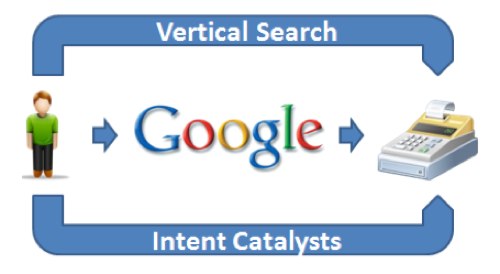
For Google’s enemies, the best way of hurting the search goliath is not to build a better search engine, but rather to give people a reason to stop searching for a wide class of goods and services by preempting search on Google. Given Google’s dependence on harvesting “transactional intent” for its revenue, the key is to move transaction initiation off of Google. The ComScore search marketshare numbers at the top are somewhat meaningless; Google could lose massive revenue while their overall search share, for non-transactional search, stays strong or even grows.

What can preempt Google search — or at least the money-making parts of it? There are two things for Google to worry about: Vertical Search and Intent Generation. Vertical Search will nip away at vulnerable parts of Google in the same way that Etsy, Copart or IronPlanet has nipped eBay – think OpenTable for restaurants, Kayak for travel, Amazon (yes, Amazon) for traditional e-commerce, etc. And Intent Generation catches people further up the funnel, before they search, and delivers them what they want, and gets them to purchase, before they start searching. Intent generation can also spawn impulse purchases and overcome inertia to get people to buy more quickly.

Intent Generation is perhaps the more dangerous, because it is stealing purchases from Google’s clutches – bypassing any kind of search.

Vertical Search

Amazon: if everyone in the world signs up for Amazon Prime (unlimited, free 2-day shipping) and becomes a loyal Amazon customer, who would search for anything shopping-related on Google? We’re a long way from this happening, but imagine Amazon as the “e-commerce search engine” and Google as the “random stuff I’m looking for when not buying” search engine. I believe the long-tail of ecommerce resellers will deteriorate due to economies of scale and lack of geographical differentiation (e.g., 40,000 offline shoe stores, but only 5 of scale online), thereby making Google less relevant for a whole category of searches, and benefiting Amazon as the largest, broadest ecommerce company.

ZocDoc, OpenTable, and Yelp: Since becoming an OpenTable convert and Yelp user, I have not searched once for a restaurant on Google, and I bet these two companies are quickly taking away searches from Google for the dining category. I’m a big believer in ZocDoc, and if that can become the Expedia of medicine (long way to go for that to happen), Google could lose another category.

Kayak and Expedia: Expedia is a great example of what Google needs to avoid. If you’re looking for a hotel in Phoenix, you probably head straight to Expedia, Kayak, or another online travel agency (OTA). Google doesn’t have much to lose here because it’s never had a foothold in travel search, but its purchase of ITA is very strategic as a way of reversing that.

Intent Generation and Catalysis

Groupon: for “impulse” purchases, things like Groupon are pushing offers to consumers rather than relying on consumers to pull (search). The half-million or so Gap Groupons sold on 8/19/2010 represent half a million customers who won’t be searching for Gap, much less any other clothing retailer, on 8/20/2010. Groupon snatched these customers (and their discretionary clothing spend) before they got a chance to search. Some of this is accretive and not preemptive, but consumers only have finite income and a million Groupons every day will have a substantial impact on Google.

Facebook: With more traffic than Google, Facebook only has an estimated 5% of the revenue of its rival. Social recommendations, a catalyst for Groupon’s success, can help preempt search, but these tend to further curate intent rather than harvest it, as Google does. The holy grail is the ability to show the perfect advertisement at the perfect time (precognition, like in Minority Report), something Facebook has a better chance of doing than anyone. The popularity of gaming on Facebook is another angle we have seen be effective – encouraging people to buy something (e.g., a new sweater at Gap) in order to get credits in a game. This is both an example of intent generation and intent catalysis; perhaps you knew you were going to buy a sweater eventually, but you decide to buy it today, and buy it from Gap and not Macy’s, in order to deck out your virtual restaurant on Restaurant City.

Payment Companies: By knowing how much you spend and where, payment companies have tremendous opportunity to change future behavior, generating and catalyzing intent. American Express recently sent me a very nice coupon/gift certificate for Barneys. A month later, when I thought about going shopping, I went straight to Barneys, and didn’t search elsewhere. It preempted my search and changed my behavior. Unlike Groupon, which offers great deals to everyone, payment companies have nonpareil data to use in targeting offers to consumers, and furthermore allowing merchants to target specific consumers. PayPal, American Express, or a resurgent Google Checkout could fundamentally change the nature of ecommerce through intent generation in the same way that Catalina Marketing has altered the CPG and supermarket industries.

With Bing, Microsoft has made a laudable attempt to out-Google Google, but Google has thousands of engineers who can quickly out-Bing Bing. The battle for search is over for now — Google won — but the battle for the underlying revenue is just heating up.

Why Online to Offline Commerce is a Trillion Dollar Opportunity

(Originally a guest post for TechCrunch)

What do Groupon, Restaurant.com, OpenTable, and SpaFinder all have in common?

They are all enablers of online to offline commerce.

Groupon’s growth has been nothing short of extraordinary, but it’s merely a small subset of a growing category which I’d like to call Online to Offline (O2O) Commerce, in the vein of other commerce terms like B2C, B2B, C2C, etc. O2O is more of an adverb that modifies those business classifications: it’s a combination of payment model and traffic generator for merchants (and a “discovery” mechanism for consumers) that changes and creates offline purchases and is inherently measurable, since every transaction (or reservation, for things like OpenTable) happens online. This is distinctively different from the directory model (think: Yelp, CitySearch, etc) in that the addition of payment helps quantify performance and close the loop – more on that later.

In retrospect, the fact that this is “big,” or that Groupon has been able to grow high-margin revenues faster than almost any other company in the history of the internet, seems pretty obvious. Your average ecommerce shopper spends about $1000 per year. Let’s say your average American earns ~$40,000 per year. What happens to the other $39,000? (The delta is higher when you consider that ecommerce shoppers are higher-income Americans than most, but the point is the same).

Answer: most of it (disposable income after taxes) is spent locally. You spend money at coffee shops, bars, gyms, restaurants, gas stations, plumbers, dry-cleaners, hair salons, etc. Excluding travel, online B2C commerce is largely stuff that you order online and gets shipped to you in a box. It’s boring, although the ecommerce industry has figured out an increasing number of items to sell online (witness Zappos’s success with shoes: $0->$1B in 10 years, or BlueNile’s with jewelry). FedEx can’t deliver social experiences like restaurants, bars, Yoga, sailing, tennis lessons, or pole dancing, but Groupon does. Moreover, your locally owned and operated Yoga studio has little marginal cost to add customers to a partially filled class, meaning that the business model of reselling “local” (especially local services) is often more lucrative than the traditional ecommerce model of buying commodity inventory low, selling it higher, and keeping the difference while managing perishable or depreciating inventory.

The important thing about companies like Restaurant.com or Groupon is that performance is readily quantifiable, which is one of the tenets of O2O Commerce. Traditional ecommerce tracks conversion using things like cookies and pixels. Zappos can determine their ROI for online spend because every completed order has “tracking code” on the confirmation page. Offline commerce doesn’t have this luxury; the bouncer at the bar isn’t examining your iPhone’s browsing history. But O2O makes this easy; because the transaction happens online, the same tools are now available to the offline world, and the whole thing is brokered via intermediaries like Restaurant.com. This has proven to be a far more profitable and scalable model than selling advertising to local establishments; it’s entirely due to the collection of payment by the online intermediary.

Does Groupon deserve a 10 figure valuation? It’s easy to see a world where O2O Commerce dwarfs traditional (stuff in a box) e-commerce – simply because offline commerce itself dwarfs online commerce, and O2O is simply shifting the discovery and payment online. If Groupon can grow its leadership position, I predict an 11 figure valuation based on discounted cash flow alone. Groupon is not a gimmick or a game, but a successful example of offline commerce being driven by an online storefront and transaction engine.

Venture Capitalists and Entrepreneurs would be wise to think beyond cloning the “deal of the day” concept – and instead think about how the discovery, payment, and performance measurement of offline commerce can move online. This will have ripple effects across the whole Internet industry — advertising, payments, and commerce — as trillions of dollars in local consumer spending have an increasingly online genesis.

The Rise of Transactional Advertising

The marriage of brand advertising and free content is facing peremptory annulment. There is no shortage of punditry around “the death of the media company” and whether it is a just dessert or a societal travesty. But that’s looking at it from the media company and consumer viewpoint – what do advertisers think about all of this? Where is online advertising headed and what does that mean for free content?

Making content free was not a well thought out business model. Rather, before the days of Sirius XM and DirecTV, there was no more of a way to charge for freely accessible radio waves than there was to charge for air or sunshine. Making content free, and charging for advertising interspersed in that free content, was pretty much the ONLY business model back then.

And it worked pretty well, because supply (advertising “units”) was limited by the amount of content produced and, more importantly, by the narrow “channels” where such content was made available. With such low supply, high demand, and massive reach, it was easy to reach large swaths of the populace. The advertisers couldn’t really quantify their results, but they came up with a wide variety of methods to attempt to do so. Market research firms such as ACNielsen flourished to fill the need for “metrics.”

But, as I argued in my last piece, brand advertising doesn’t really work – or, perhaps better put, is superseded by “transactional advertising.”

The old logic went like this — people were more likely to buy Coca-Cola versus Carbonated Dark-Colored Sugar Water X because Coca-Cola had a brand (which Coca-Cola has spent billions on). What’s the value of Coca-Cola’s brand? Pure math – it’s the Net Present Value (NPV) of the difference that consumers will pay for Coca-Cola versus, say, RC Cola, for the lifetime of the consumer and duration of the brand. When you pay $1 for a Coke versus $.50 for an RC Cola, the $.50 difference is chalked up to the “brand.” (Yes, perhaps there are differences in taste, too – but even with an identical formula and taste, I would argue RC Cola wouldn’t sell as well as Coke). Multiply $.50 times billions upon billions of cans of Coke, and you see the power of brand.

I don’t disagree with this notion, but I would argue that it is becoming largely irrelevant for a large class of goods and service providers (think soda or television set, not Rolex or BMW), and that the “brand” advertising money can be better spent, thereby imperiling expensively produced, freely distributed content. To wit: what if Walmart refused to stock Coca-Cola, instead stocking just RC Cola? Granted, Walmart stocks Coca-Cola because consumers demand it, and consumers demand it because of the brand that Coca-Cola has created, but that can easily be reversed. If Walmart decided to stock only RC Cola and expel Coca-Cola from its shelves, this would change RC Cola’s fortunes, and harm Coca-Cola, quite a bit.

Preferential placement of a good or service at/near the point of a transaction is something I call “transactional advertising,” which I predict will expand as a category in the coming years. Transactional advertising describes a clear food chain of brand and positioning; the titans at the top are Google, Amazon, Walmart, and other “aggregators” who themselves hold considerable brand equity and/or organic traffic. Smaller players exist in niche fields: BankRate, Shopping.com, Edmunds.com, Lending Tree, even Diapers.com have become destinations that steer consumer decisions. These have potential to be the new “media” companies in a transactional advertising universe, odd as that might sound.

This form of transactional advertising exists today, although you might not know it. Proctor & Gamble spends great effort and expense (though it pales in comparison to their brand advertising spend) to ensure eye-level placement wherever its products are sold. Many retailers “charge” for shelf-space, with the clear understanding that better merchandised goods have a better chance of ending up in consumers’ shopping carts.

Today you see very little in the way of transactional advertising online; rarely does one brand pop up in another brand’s checkout experience. There’s a good chance that will change in a major way in the near future. If old media companies can figure out how to attach themselves to more transactions, they have a fighting chance of sticking it out online.