How to Invest in People

 Seed bets are largely people bets, and the way I think about them is a set of simple (but hard to know!) assessments of the entrepreneurs — can they materialize labor and capital, are they going to get to traction on the seed (vs what I call a “slow boil” company), and how prolific/encyclopedic are they in terms of understanding the history and present of the product they are building:

-Materialize Labor: “Who are your first 5 hires?” I always try to ask this question. The best answers are where the person literally has five people ready to jump off their existing ship(s) and join and those people are great…it shows that they are a magnetic attractor of talent. But even without that, do they know whom to hire? Fastest ramp is where the 5+ are already ready to jump and those 5 are themselves great.

-Materialize Capital: another description for “heat” but with more of a future lens — how good of a presenter are they? How do I handicap their future fundraising? (“best sign of future financing = current financing” rule still applies). The no-brainer for investment n is investment n+1 from top firm is in the bag 🙂 It’s one advantage to backing “seniors” in the SV sense.

-Is this a “fast boil” company or a “slow boil” company? In other words, is there a good chance — based both on the entrepreneur, TBH team, and idea/product, that they can get to discernible traction early? This is more of a “next fundraising round” output per unit of time measure, because the hard seeds are the ones where they’ve achieved zero discernible (outside) progress on the capital…which some ideas (and fundraise amounts) are more prone to, but of course this is outdone by “ability to materialize capital” 🙂

-How “deep” are they in the domain? If their exposure is nascent, did they REALLY take the time to learn the history, present, and have a theory for the future of the space? I know we call this the idea maze, but I consider it more a sign of intellectual rigor plus ability and willingness to challenge their beliefs and take input from all sorts of people. Robinhood founders met with and studied every past brokerage. Collisons found the rarest of rare books on how the Visa network was built from the 50s to the present and I believe even sought out and met with Dee Hock, the (at the time) 80-something founder of Visa who had moved to a farm. Brex founders took the time to meet and learn from every payments wunderkind. I see this pattern again and again — and EARLY — in people I consider exceptional. They are able to network to anyone from nothing (e.g. Brex guys from Brazil, Collisons from Ireland) — although this is arguably a more important trait for something where major platform/BD deals are crucial.

-Do they want to learn/win, or do they want to think they’re right?

Similar to the above, I really look for people who want to spar/duel around the best way to accomplish a solution — they are headstrong, which is great, but also want to learn of alternatives — somewhat the manifestation of “strong ideas, weakly held”

-Marathon, not a sprint — they will not give up

what in their past convinces me that, when they’re going through hell, that they’ll keep going? Have they faced adversity? What kind and how? Even if silver-spoon-fed, what motivates them and what have they done that requires incredible tenacity?

-Hire fast, fire fast, decision fast — can they make FAST decisions? Are they decisive or indecisive? Are they careful or careless? What is the most caring/selfless thing they’ve done, and the most sociopathic thing they’ve done?

-Image or impact. How much do they seem to care about how others perceive them? Do they want to be liked? Doing the popular thing requires no leadership, doing the unpopular thing requires massive courage AND leadership to get others to follow. Do they want to have everyone like them and assemble a team for adoration, or to win at all costs?

-Motivation in starting the company. Revenge / Count of Monte Cristo? A very rich person has the dual risks of starting a rich-person-problem company (e.g., wine, second homes, workouts, etc) — and, more problematically, tiring and giving up…it’s easy to quit and retreat back into a life of comfort. The most powerful motivator I have ever seen is not money, it’s revenge. Proving the motherf@&$ers who fired you, humiliated you, doubted you, took your baby away etc wrong AND capitalizing on an opportunity you know best. Renaud with LendingClub->Upgrade, Bloomberg with Salomon Brothers->Bloomberg, Duffield with PeopleSoft/Oracle->Workday, etc.

-do they have some path to get their first five customers? Who wants to run their business on enterprise software written by a company with 9 months of cash? 

anyway, probably a lot to learn here from everyone, so just sharing! Despite the fact that traction is scientific and “entrepreneur assessment” is not, I actually would like to believe that the opposite is true, given that we’re always buying options of future performance which always comes down to the people 🙂

As a reminder, one lens for evaluating entrepreneurs is the Freshman-Sophomore-Junior-Senior one, which translates to (taking the investable case for each!):

-Freshman — almost no “work” experience, potentially completely uncredentialed (autodidact), but brilliant, naive, and where the naïveté is a weapon that allows them to try something that nobody else would attempt (or that others have attempted and failed at, thus dissuading more status-seeking humans)

-Sophomore — highly credentialed, early in career, has followed a more typical “credentialed” path (Harvard/Stanford/Yale/Princeton -> McKinsey/Goldman/Google -> Business School), been at the top of their class/work group.

-Junior — sophomore but now later in career with significant responsibility and management experience, think a VP of Google or Facebook.

-Senior — a successful startup founder (>$100M exit) who is doing it again.

Most venture capital returns have been in the Freshman and Senior buckets. Seniors have the highest “hit” rate provided (per above) they’re doing something in their domain and for the right set of reasons. Freshmen have the most variance — some of the biggest companies (Facebook, Google, Airbnb, Shopify, etc) but arguably the highest failure rate. The issue with sophomore-juniors has historically been inability to violently swerve off a safe path but there are exceptions (e.g., Instagram).

Digital Payments are Going to REALLY Grow

The payments market is going to massively expand over the next decade because:

1. ANYONE can now build anything digital — AI code creation means exponentially more digital SKUs that can be created and, of course, paid for. We are in the very early innings here. The gating item is just human creativity. It’s not just software. Can you whistle or come up with a tune? Then you can compose music (no need to learn to read music or know music theory). Can you think of an idea for a movie? You can just…create one. Etc.

Combined with:

2. Almost anything that was “payroll” (paying PEOPLE) can now be “payments” (paying for THINGS). For example: “Hiring an assistant” or “hiring a paralegal” (both payroll) -> paying for a SKU.

We don’t think of ADP or Paychex as payments companies because they aren’t; they are payroll companies. Paying people != paying things.

But more tasks/outputs that were once only available through “paying for people” now become available for purchase on a credit or debit card. This is already starting to happen and accelerate.

And of course, this is not zero sum! Much of this is “everything to the right” of the supply-demand equilibrium point, where there’s conceptually high quantity demanded at a very low price where there’s heretofore no (human) labor supplied. Lots of people will want to purchase a SKU who were unable to hire a person historically.

Redoing Education: Lysenkoism and Preference Falsification

Somebody needs to build a parallel education stack, from top to bottom. The current one is just too broken.

There’s an incredible new input to education (learn anything for free with AI!) and a very different world in terms of needed skills (and economic realities) upon graduation. Against a legacy cost curve that seemingly is inflating to infinity and is immune to productivity gains.

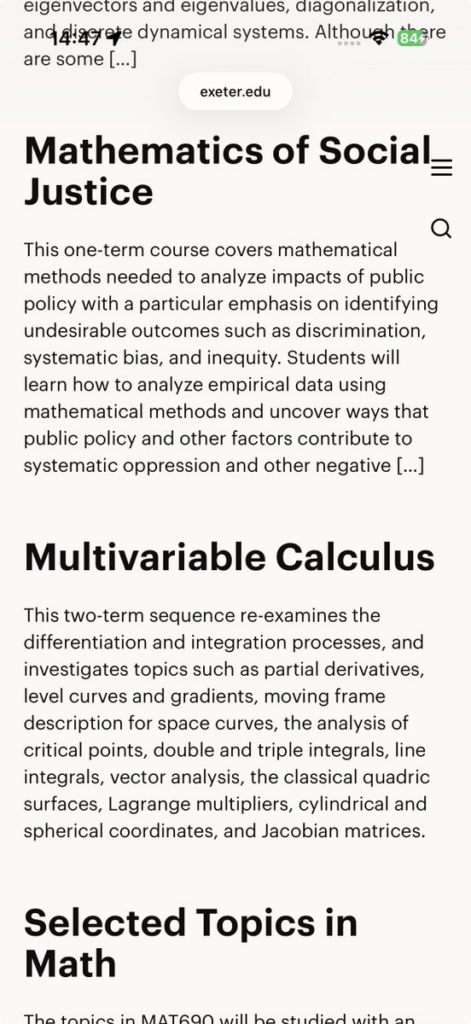
Here’s a math course at Exeter and the introductory, mandatory Biology class at Andover. Andover and Exeter are two of the “best” high schools in America, something that other schools try their best to emulate. The kids that go there want to go to a “good” college so must pretend to enjoy / agree with these courses in order to get the grades and recommendations to get into the “good” colleges. Got a C in Biology? Take a stand against the English teacher who generates grades based on vibes? No good school for you!

The “good” colleges thus are increasingly filled either with people who have excelled at preference falsification and politics, or who genuinely believe in Lysenkoism.

It’s also why college grade inflation is not surprising. Force everyone to take hardcore quantum mechanics and grades will deflate. But the students who have perfected themselves through superficial perfectionism have a real skill (superficial perfectionism!) and will continue that throughout college and life. It just stops accruing benefits outside of academia.

The “Comma MBA” Problem and Local Maxima

The best entrepreneurs constantly “read the room” (or the market) and adjust their presentation style, their mannerisms, their product description, their team, their focus, their advisors — everything. They have the smallest number of axioms (things they accept without questioning). Everything else is subject to questioning, upgrading, and re-synthesis. Particularly since almost invariably they started off at a “local maximum” in terms of talent and advice.

I call this the “comma MBA” problem. One time we had a nice fellow from Canada come pitch us, and on his business card he had his name, followed by “MBA” in the same way a doctor would put “MD.” His slide deck referenced his MBA, his pitch mentioned how everyone is “good at business” because they have business degrees, etc.

There’s nothing wrong with an MBA (well, maybe 😂). But what he thought was a positive was not resonating, and he just…didn’t get that hint. And to show I’m not trying to cast shade at MBAs, one time we had a CEO talk about how amazing his tech team was because of their “.NET” prowess — the technical version of the “comma MBA” problem above.

But let’s take a step back. Imagine that in our MBA friend’s small town, he went to the local business celebrity who seemed very wise, saying “make sure to emphasize the fact that you have an MBA! Otherwise the VCs will not take you seriously!”

Both the good entrepreneur and the bad entrepreneur would seek advice from the same village elder. But the good entrepreneur would quickly learn and adjust from experience — “wow, that guy is wrong — I didn’t get the reaction/feedback I thought I would.”

The bad entrepreneur sticks to the village elder’s advice. The good entrepreneur upgrades his/her advisor when it’s clear that it’s a constraint. We consequently give people the benefit of the doubt when they show up with a metaphorical “comma MBA” mistake; the important thing is ensuring they are always trying to learn and upgrade from their metaphorical village elder and resulting priors. And sometimes the village elder is exceptional, too — but it’s statistically rare.

It’s part of why the founding team is so important. I like to say that there are only two jobs at a startup: selling the thing, and making the thing. That’s it. A very good technical person who knows nothing about sales can be bamboozled by a bad sales guy, and a very good sales guy can be bamboozled by a bad tech person.

Your co-founder ideally serves an “axiomatic” role. If you can’t implicitly trust your co-founder, you’re in trouble. That’s not to say that the co-founder must be the most talented person in the domain! Rather, because the co-founder isn’t angling for a promotion and has no political aspirations, she just wants what’s best for the company and understands how to make the right decisions. (One useful cultural value at a scaling company: “You should always be willing to hire your own boss.”)

You will constantly get bad advice. Your job is to know when to discard the advice, but also when the discard the *people* who are clearly meting out bad advice and not doing what’s best for the company. And ideally you surround yourself with talent where you don’t have to second-guess everything and can instead rely on your team — it’s the best way to scale yourself.

Software Clone Wars of 2004, meet AI Cloning of 2026

History doesn’t repeat, but it rhymes.

Before SaaS, and before freemium, there was “shareware” — try before you buy software. This was a concept dating back to the 1980s, where software would be freely distributed on floppy discs attached to PC magazines…dozens of products on one floppy! Written by hobbyists and even upstart companies.

id Software of Doom fame started out like this, as did McAfee. As did I!

As things like BBSs, AOL, Compuserve, and eventually the Internet grew in the 1990s, one of the main use cases was downloading shareware.

And it eventually started becoming a big business. The biggest download site was the appropriately named Download.com, owned by CNET.

Around the same time, more people in more countries got access to the internet. And this little site called Elance (now Upwork!) survived the dotcom bust and ended up being a leading outsourcing site for everything from translation to, you guessed it, software engineering.

So now there was a huge opportunity. You pick the number one or even number twenty product on Download.com that’s printing money. You go to Elance. You get dozens of predominantly Indian and Eastern European outsourcing shops to compete / bid on “cloning” it.

I had a pop-up blocker (how I met @jonoringer), a couple of security products, and a bunch of utilities like a cool macro tool, an email tracker, etc.

But now I could hire somebody for $500 and have them replicate anything on the top download site on the Internet! It was incredible.

But it wasn’t. There is such much complexity under the hood that you never see merely by using the product. You see it when designing the product, when receiving hundreds of customer complaints, when realizing how much you could improve your conversion funnel, etc.

You can replicate something “skin deep” but miss most vital organs. Who knew you needed a Pancreas or two kidneys?

Elance fundamentally changed the shareware business. Anyone with agency could now hire somebody to clone a product or build a product.

But here’s what I noticed:

-cloning almost never worked, because there was too much “dark matter” in these products to be understood or seen when the goal is just rote replication

-coming up with a NEW idea — much better path, since you have to conceive of all of the myriad corner cases. No free ride to rest on. -technical people still reigned supreme, since they could edit the resulting code from the outsourced shops

-distribution > product. Now that it was so easy to build (or hire to build!), the advantage went to those with a real knack for acquiring customers. And it couldn’t just be “I uploaded it to the file library” like it used to be in the good old days of the 90s

Now replace Elance with Claude or Cursor, and repeat this exercise Distribution will rule supreme. Original thought and insight will rule supreme. “Cloning” things at a shallow depth is a fool’s errand.

Good luck.