Category Archives: Economics

The Principal-Agent vs. Agents Problem

Every human in the workforce has two crude goals:

  1. Be richer.
  2. Be lazier.

Get paid 2x more, or keep salary flat? Get paid more!

Go home at 11:01 PM, or stay up until 5 AM? Go home at 11:01 PM!

This isn’t a moral judgment. It’s just…economics.

Which brings us to one of the stranger problems with enterprise AI: AI can make every employee dramatically more productive without making the enterprise any more productive.

Imagine a Goldman Sachs analyst. At 11 PM, the boss sends over a presentation with the traditional two-word demand: “please fix.”

In the old world, the analyst spends six hours changing fonts, updating charts, reconciling numbers, and moving logos three pixels to the left. The deck is finished at 5 AM.

In the new world, the analyst secretly gives it to AI. The deck is finished at 11:01 PM. The analyst goes home and goes to sleep.

This is obviously a massive productivity improvement for the analyst.

What changed for Goldman Sachs?

Nothing!

The same presentation was delivered. The same analyst is employed. The same salary is paid. The same client is billed. Goldman doesn’t get a bigger fee because its analyst slept six extra hours.

AI created an enormous economic surplus. The analyst captured 100% of it in the form of leisure.

This is the classic principal-agent problem—with a new set of agents.

The enterprise is an ethereal “principal.” It wants more revenue, lower costs, faster turnaround, happier customers, etc. But an enterprise can’t actually do anything. It needs human agents—employees—to act on its behalf.

Now those human agents have AI agents acting on their behalf.

So the chain looks something like:

Enterprise principal -> human agent -> AI agent

The enterprise wants more output per dollar. The human wants more dollars per unit of effort. The AI agent generally follows the instructions of the human sitting at the keyboard.

Guess whose objective function gets optimized first?

This is why AI “adoption” inside an enterprise can be wildly misleading. Maybe 90% of employees use AI every day. Maybe every analyst, associate, paralegal, recruiter, consultant, and salesperson has become 5x more productive.

But if headcount is the same, output is the same, and revenue is the same, the enterprise has adopted AI technologically—not economically.

The employees are richer in time. The principal is not richer in money.

This also relates to a point I made recently: sometimes the user is not the customer.

User = person who actually uses the product.

Customer = person who actually pays for the product.

Normally, user != customer is a strong negative for product quality. If the user and customer are the same person, the product, sign-up flow, onboarding, etc. all have to be great. If they’re different, the customer can force the user to tolerate an awful product.

But AI introduces a different—and more interesting—version of user != customer.

The human agent is the user. The enterprise principal is the customer. And their goals are not necessarily aligned.

The Goldman analyst might LOVE a product that turns six hours of work into sixty seconds. But the analyst might love it precisely because Goldman doesn’t know how much time it saves.

What happens if Goldman finds out that every analyst is secretly producing presentations in sixty seconds?

Two logical options:

  1. The analyst class can be smaller.
  2. The existing analysts can produce 5x more work.

    Both benefit Goldman.

    Neither necessarily benefits the analyst.

    So the analyst has a perfectly rational incentive to use AI—and an equally rational incentive to hide the productivity gain. The best product for the user might be one that the customer can’t see!

    This is also why banning AI inside enterprises will often just create “shadow AI.” If a tool gives somebody back six hours of sleep, a corporate policy memo is unlikely to stop its use. The tool is effectively part of the employee’s compensation.

    The real enterprise opportunity, then, isn’t merely to get employees to use AI. They’re going to do that anyway.

    The opportunity is to get the principal to capture some of the benefit.

    That might mean selling completed outcomes instead of employee tools. Don’t give the analyst a faster way to make the presentation; make the presentation.

    It might mean redesigning workflows around the new level of output. If something that took six hours now takes one minute, the deadline shouldn’t remain six hours away forever.

    It might mean measuring throughput, turnaround time, revenue, resolutions, or other outcomes—rather than counting licenses and declaring victory because “80% of employees used AI this month.”

    And it probably means sharing some of the gains.

    If every productivity improvement results in more work, layoffs, or lower compensation, employees will rationally conceal productivity improvements. If employees participate in the upside—more pay, promotion, flexibility, or even permission to go home at 11:01 PM—they have a reason to reveal what AI can actually do.

    Otherwise, the enterprise will spend billions of dollars buying AI tools that its employees use to work less.

    AI can make the agent lazier.

    AI can make the principal richer.

    The trillion-dollar question is whether it can do both.
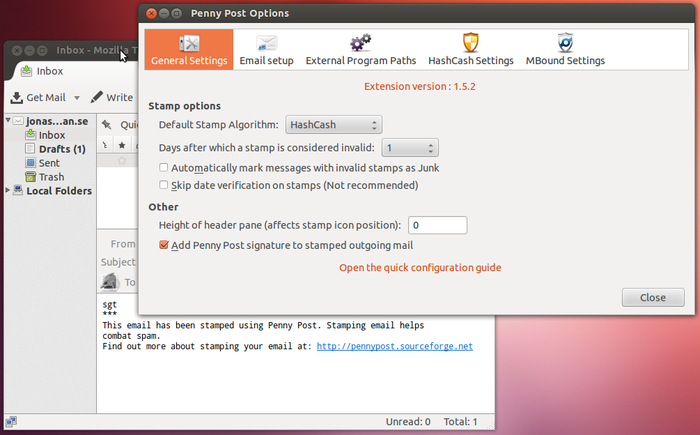
    AI’s Proliferation Requires a new “Proof of Work”

    The proliferation of AI demands a new “proof of work.” Personalized, intelligent spam is still spam. Personalized, intelligent unwanted sales calls are still…unwanted. Humans “just checking in” can now be superpowered and never drop a ball again…which means all communication is going to be so crowded as to be unusable.

    Bitcoin’s origins date back to a system called Hashcash, proposed by Adam Back in 1997 (“Hashcash was originally proposed as a mechanism to throttle systematic abuse of un-metered internet resources such as email, and anonymous remailers in May 1997”).

    Postal mail requires a postage stamp, and that small cost prevented abuse. Want to send out a billion letters? That’s going to cost you a few hundred million dollars. That explains why you don’t get 1000 pieces of physical junk mail every day.

    But email? Virtually free. Hence subject to abuse.

    Hashcash would force the *sender* to do a certain amount of [then!] CPU work, which the recipient could instantly verify. An intentional asymmetry. 20 seconds to send, .001 seconds to verify.

    It never took off because Bayesian etc spam filtering got better, things like CAN-SPAM were passed, etc. But I implemented Hashcash back in the day, and thought it was the right solution since it used the laws of economics to control the problem. Increase cost, decrease supply. Ensure it’s not worth the cost unless enough economic value is created.

    Fast forward to 2026. AI-powered email, phone calls, text messages, and all other forms of communication are about to explode. And given AI’s “computer use” wizardry, everyone can just have AI use existing systems to pump out more, more, more…and look indistinguishable from humans.

    The Turing test has been rendered essentially obsolete, so we don’t need a better Captcha. We need an economic solution.

    Bitcoin took proof of work and turned it into a currency / a store of value. One option is to simply “charge” per receipt/connection, to create an economic constraint. Another is to force/throttle based on proof of work in a way that hopefully is brute-force GPU resistant — which is the exact same thing as “charging,” but without a currency.

    But we are quickly headed towards a communications catastrophe, and rather than forcing agents to get “smarter” and sneak past more filters (a never-ending virus v anti-virus battle), there’s a real opportunity to create a proof of work standard and use an economic solution.

    Digital Payments are Going to REALLY Grow

    The payments market is going to massively expand over the next decade because:

    1. ANYONE can now build anything digital — AI code creation means exponentially more digital SKUs that can be created and, of course, paid for. We are in the very early innings here. The gating item is just human creativity. It’s not just software. Can you whistle or come up with a tune? Then you can compose music (no need to learn to read music or know music theory). Can you think of an idea for a movie? You can just…create one. Etc.

    Combined with:

    2. Almost anything that was “payroll” (paying PEOPLE) can now be “payments” (paying for THINGS). For example: “Hiring an assistant” or “hiring a paralegal” (both payroll) -> paying for a SKU.

    We don’t think of ADP or Paychex as payments companies because they aren’t; they are payroll companies. Paying people != paying things.

    But more tasks/outputs that were once only available through “paying for people” now become available for purchase on a credit or debit card. This is already starting to happen and accelerate.

    And of course, this is not zero sum! Much of this is “everything to the right” of the supply-demand equilibrium point, where there’s conceptually high quantity demanded at a very low price where there’s heretofore no (human) labor supplied. Lots of people will want to purchase a SKU who were unable to hire a person historically.

    Cheat Code: Try to Pay More

    When I was running my little “shareware” business in college, I hired my first PR firm. Press really moved the needle for us (credibility and reach), and I wanted more. This PR firm had some very big name clients and lots of connectivity to the journalists and publications we cared about.

    There was a monthly retainer, something like $10,000, and I fought hard to negotiate it down to something like $5,000. Almost immediately I was disappointed. I was getting almost nothing from them.

    But of course I wasn’t. The firm only had so many favors they could call in. Should they use them on their biggest customer, or their smallest one? I was their smallest one.

    I had an epiphany: Don’t negotiate down. Negotiate up. Try to be the highest paying customer.

    I fired them, met with this Boston firm named fama PR, told them I wanted to be their highest paying client, and asked them point blank what that would take. I was a college kid and they probably thought this was funny, but we worked out a plan by which I’d pay them $40-$60K+/month (in 2003!) for certain performance.

    If I remember correctly, we had different tiers: get us on The Today Show and that’s $10K, front page of USA Today/NYT/WSJ also $10K, lesser tier $5K, etc.

    We launched this product called DidTheyReadIt in May 2004, and it was on the front page of USA Today, and then Carl Quintanilla came out to interview me for The Today Show. And many more. I still have the PR book they built of all of the appearances. It was insane.

    Mission accomplished: biggest client.

    The moral of the story is you get what you pay for. There are related learnings, too. The principal-agent problem is real. Shared services with no currency are hard. Let’s dive into those.

    This played out many years later when hiring tech recruiters who typically take a percentage of first year salary (of the placed employee). They might take 15-30% depending on the market.

    Remember what a tech recruiter does. They often find a really good candidate and peddle him/her to every company to maximize the chance of earning their fee. (In many cases, they’ll send cold emails about this — “I have 4 amazing candidates!”).

    At TrialPay we once lost a REALLY good candidate and learned that our recruiter (who sent us the candidate!) was ACTIVELY selling him to reject our HIGHER offer and instead take an offer from another company! What the hell? My team was so pissed.

    But of course this happened. We had smartly (and stupidly) negotiated the fee down. Let’s say we offered the engineer $150K, the other company offered the engineer $140K, and you’re the recruiter — would you rather get 30% of $140K, or 15% of $150K?

    Was this unethical of the recruiter? Yes. Is this how the world works? Also yes.

    You get what you pay for. The world is a competition and you are better off maximizing outputs versus minimizing inputs.

    First Principles on Lending…

    Original Posted: https://x.com/arampell/status/1893883095646093315?s=20

    From first principles: If you ask me to loan you $100, and I think there’s a 50% chance you don’t pay me back, I should only make the loan if I get $200 back. Otherwise, I shouldn’t make the loan! And you won’t get the loan.

    The A in APR is Annual, so even if I think there’s only a 10% chance you don’t pay me back, and the loan is a week long, the APR will be enormous on a percentage basis, but only $11.11 on a dollar basis (.9 [probability] X Repayment = $100, so Repayment = $111.11)

    That’s a nominal APR of 577% (or a compounded rate of 23,900%).Should that be “illegal”? If you want to restrict access to credit, then yes. I think most people would say that being able to loan their friend $100 to get back $111.11 the next week when their friend is only 90% reliable…should be perfectly fine…particularly when both parties opt in.

    These headlines always miss the fact that most Americans don’t have good access to credit and more competition is the best way of lowering costs, not forcing banks to make money-losing loans (that doesn’t work!) or making it hard to start new companies to compete (the CFPB enjoyed doing that)

    New Essay: The Transmutation of Capital into Labor

    Originally posted as a Twitter thread on August 22, 2024


    New Essay: The Transmutation of Capital into Labor

    https://a16z.com/ai-turns-capital-to-labor/

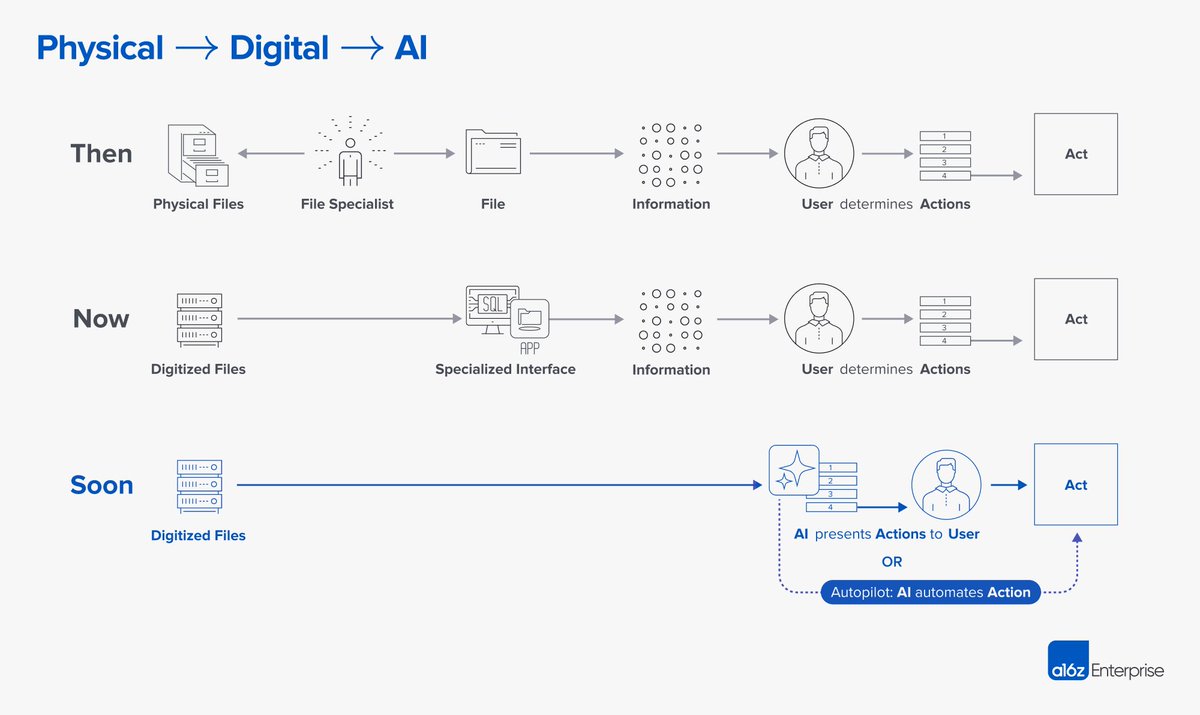
    The first era of software took analog files, digitized them, and made them accessible with a specialized interface. Think PeopleSoft for HR files, Quickbooks for ledgers, Epic/Cerner for health…

    This has played out for 50+ years as more industries have moved to running on software, not files. Cloud lowered the adoption barrier. Adding financial services to cloud made more markets “big enough” for specialized companies (e.g., Toast, ServiceTitan) to exist.

    But the same humans that acted on the analog files now act on the digital files! And sometimes it’s impossible to align hiring and training (of those humans) with business needs.

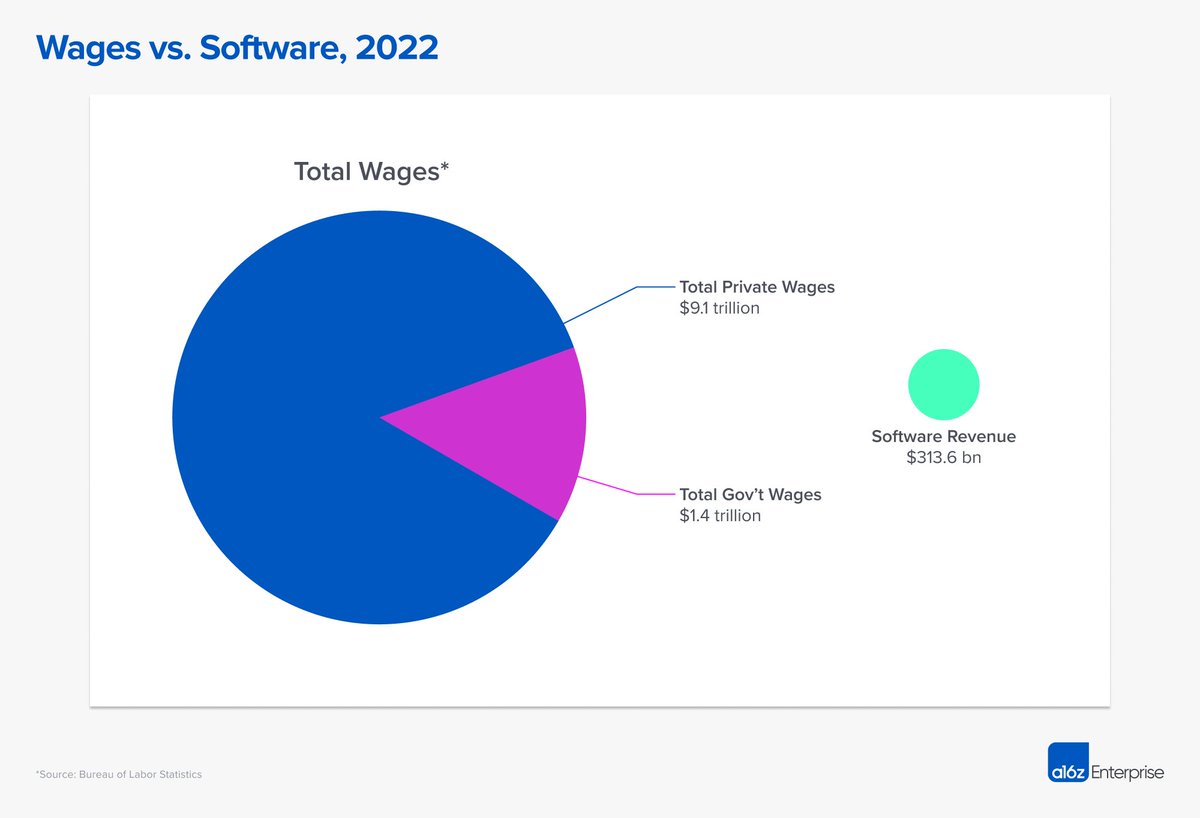
    This is what’s exciting about AI. It’s not filling software budget. It’s filling “labor” budget.

    Wages in the US alone are $10T+ per year. The worldwide software market is a few hundred billion dollars.

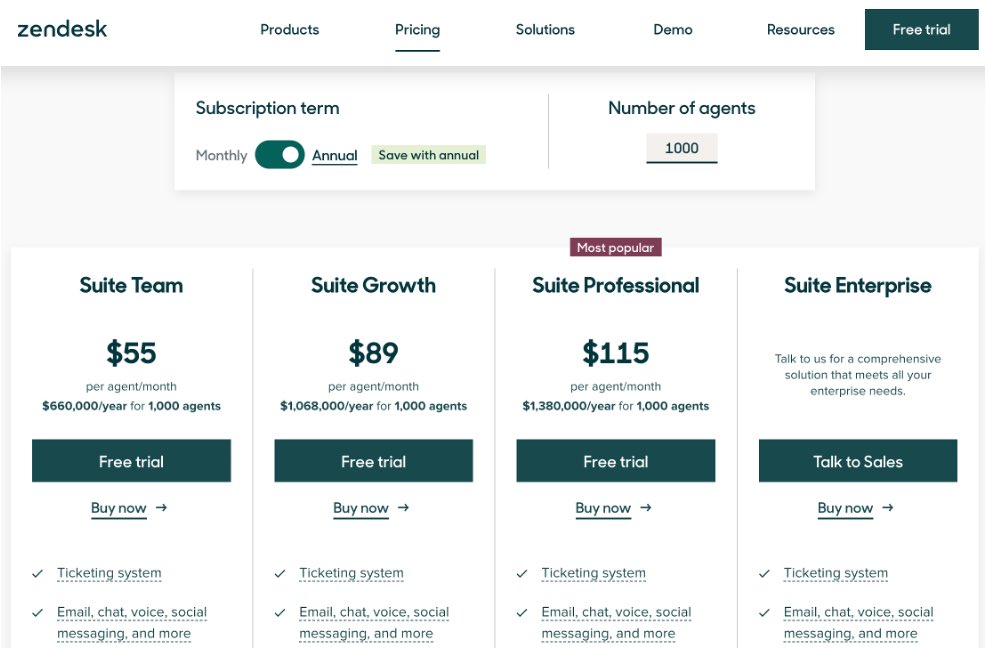
    The original “digital filing cabinet” winners have a tremendous amount of potential to add AI, but also have a daunting task of shifting from “per seat” pricing to “per outcome” pricing. Zendesk monetizes per seat. What if a business needs 95% fewer seats because of AI?

    Some of the biggest startup outcomes will likely be “net new” industries where a business runs on nothing but Excel…because the software budget was small, the human budget large, and the ability to hire humans was so hard…think compliance officers at a bank.

    There’s a saying in economics: “the cure for high prices, is high prices.” As the price goes up, more widgets get manufactured, which increases supply, which lowers the price.
    But when it comes to humans and wages, there’s too much latency because of training, licensing, etc.

    AI will largely augment employment, and fix many of the “market failures” present with highly skilled yet episodic labor. Imagine: I need your skill for 3 days a year (peak demand), but you need to go to school for 3 years to earn it.

    Outcome Based Pricing

    Originally posted as a Twitter thread on June 21, 2024


    Can’t wait to see the first “incumbent” (in a large software field…like support, CRM, HR, etc) switch from “per-seat” pricing to **per-outcome** pricing.

    I’m writing an essay on this now, but consider Zendesk at $115/seat per month…or ~$1.4M/year for 1000 agents:

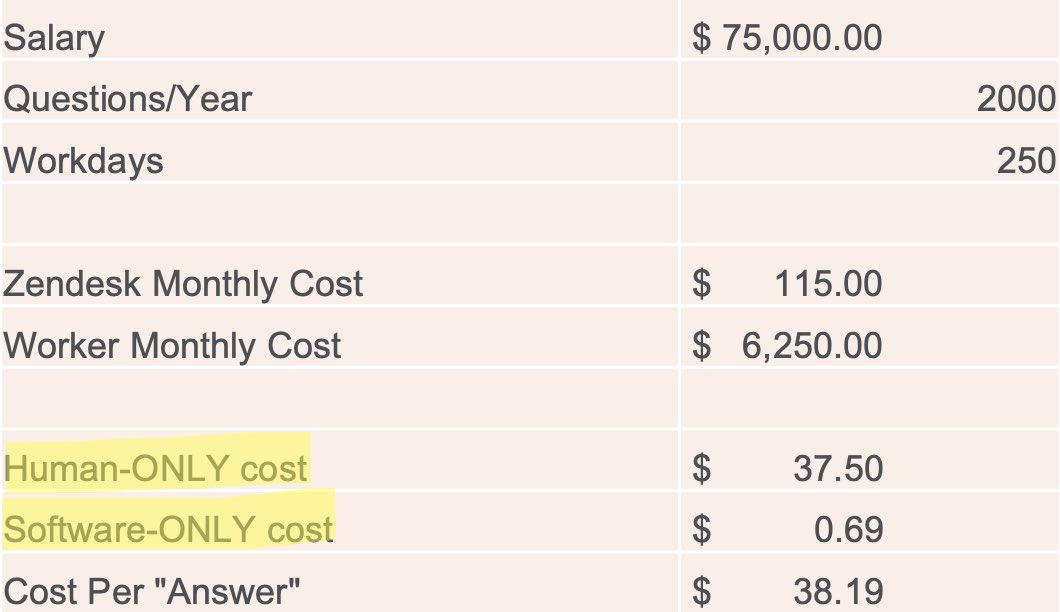
    Let’s say an agent is paid all-in $75,000/year and answers 2000 tickets per year.

    This makes the human cost of a ticket $37.50, and the software cost $.69.

    The human cost obviously massively outstrips the software cost…and unlike software licenses, it can take months to “install” (find, hire, train) a human to occupy that seat. And in many areas there is simply a dearth of qualified humans given licensing latency

    In other words, you can’t simply lift wages and produce more workers…if it’s a role that requires licensing or sufficient training (think mortgage brokers, nurses, etc)

    Not to mention the fact that it’s hard (and cruel!) to “flex” humans. Southwest Airlines can’t hire tons of humans when bad weather threatens to cancel flights and then fire tons of humans when weather is clear. But software is perfect for this

    So: given the rate of improvement in AI for asynchronous support — what will it take for Zendesk to switch from (in the prior example) $115 per seat per month to, say, $10 per successful ticket answered BY Zendesk? Still much cheaper, more flexible, instant provisioning

    It’s obviously going to happen, but how should they price this — it’s the ultimate example of value-based pricing? How to have this interact with existing “seats”? How to have teams not feel threatened by their new AI colleagues filling “seats”?

    Whole industries will change, and new ones will be created now that software can produce the outcome vs simply be the tool.

    Salesforce charges per-seat pricing for salespeople…why not charge per sale?
    Maybe Workday can charge for HR “resolutions”
    Etc

    Banks and Fear

    Originally posted as a Twitter thread on March 11, 2023


    We no longer live in the “It’s a Wonderful Life” bank era. Fear can spread at the speed of WhatsApp and iMessage and Twitter, and electronic transfers can instantaneously render a bank insolvent.

    Branches and branch-centric thinking are anachronisms.

    At the same time, banks in 2023 do MUCH MORE than just lend and deposit money. They provide pipes and technology for *everything.* Payments are mostly electronic, not cash. Payroll goes to a payroll company which…has its own bank.

    The Great Depression rendered a whole generation skeptical of banks. Money under mattresses was a thing. But that’s before commerce was entirely electronic. Most people can’t live life “cash under a mattress” even if they try. Lots of places won’t even accept cash!

    Image

    Image

    And if you just say, ok, I’ll diversify banks at $250K max cap…what do you do if your business has a $1M payroll run to make and you use ADP/Paychex/etc. Which bank do THEY use? Or: How do you buy something like a >$250K house where the money “sits” somewhere in escrow?

    Do we really want to concentrate all US deposits in 4 big banks? They can’t withstand a 50% instant withdrawal event, either. Or concentrate OUT of banks and into short-term t-bills?

    2023 is not 1933

    The “Finance” Opportunity of AI

    Originally posted as a Twitter thread on January 27, 2023


    What is the “Finance” and “Financial Opportunity” of AI?

    If “Bit Manipulation” is a key part of your COGS or SG&A, there’s a huge opportunity or huge disruption coming your way (or a PE firm that might just buy you).

    Two sections follow: “Known Knowns” and “Known Unknowns”

    Known Knowns: There are companies already doing X, and thus there are two opportunities:
    -sell a tool to turn “bit-manipulation-by-people” costs -> GPU usage (AI base marginal cost)
    -create a vertically integrated company that competes with a legacy player…by doing the above

    Financial services (unlike, say, Campbell Soup or Boeing or Fedex) are primarily “bit manipulation” — little atom moving needed!

    How do you apply for a mortgage? Insurance? Reinsurance?

    A lot of the cost is…movement of bits. Move info from here to there, validate X, etc.

    Companies, and people within companies, tend to be extraordinarily slow routers of information. Person X emails Y, who’s on vacation…who upon return asks for more info, and then passes it to Z, etc. Do it more quickly, save money and win share.

    There’s a tremendous private equity opportunity here, which is the “finance” opp. Any company might see a *dramatic* difference in bottom line once more of these bit-manipulation functions are automated. It’s like going from seamstress -> loom -> textile factory…for bits.

    Next: Known Unknowns. What I’m fascinated with are companies that cannot/do not exist today due to a market failure between what companies/consumers will pay and what people will work for…in the realm of bit manipulation.

    For example: “Find all counterfeit listings of my product on Reddit/FB/Twitter/forums, for $100K/year” or “Reach out to unhappy customers and get more information, for $100K year”
    There’s probably lots of demand at a given price but impossible to provide service at that price

    So there are no “market comparables” or set of companies to look to. It’s just an old fashioned supply/demand curve where there’s no quantity demanded at the price where labor is willing to supply…

    Working on an essay on this with some data from existing companies — more to come soon.

    Maturity Matters

    Originally posted as a Twitter thread on October 25, 2022


    If you had bought the May 2020 30 Year T-Bill (1.25% Coupon) at auction, you’d currently be holding something worth LESS THAN $.50 on the dollar. The Aug ‘22 issue is trading at $.77!

    If you are investing your cash, no matter how safe the instrument, MATURITY MATTERS.

    I know Fintwit knows this. But if you are, say, an unprofitable startup investing your cash, *do not invest in long-maturity products* — it doesn’t matter how safe they are. Holding to maturity is not the benefit it seems. And the problems are magnified with illiquidity.