Category Archives: Education

Redoing Education: Lysenkoism and Preference Falsification

Somebody needs to build a parallel education stack, from top to bottom. The current one is just too broken.

There’s an incredible new input to education (learn anything for free with AI!) and a very different world in terms of needed skills (and economic realities) upon graduation. Against a legacy cost curve that seemingly is inflating to infinity and is immune to productivity gains.

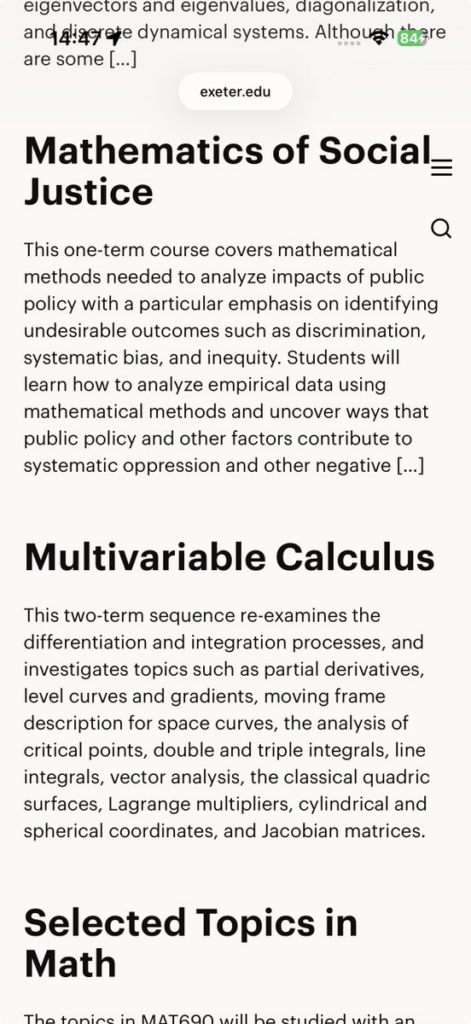
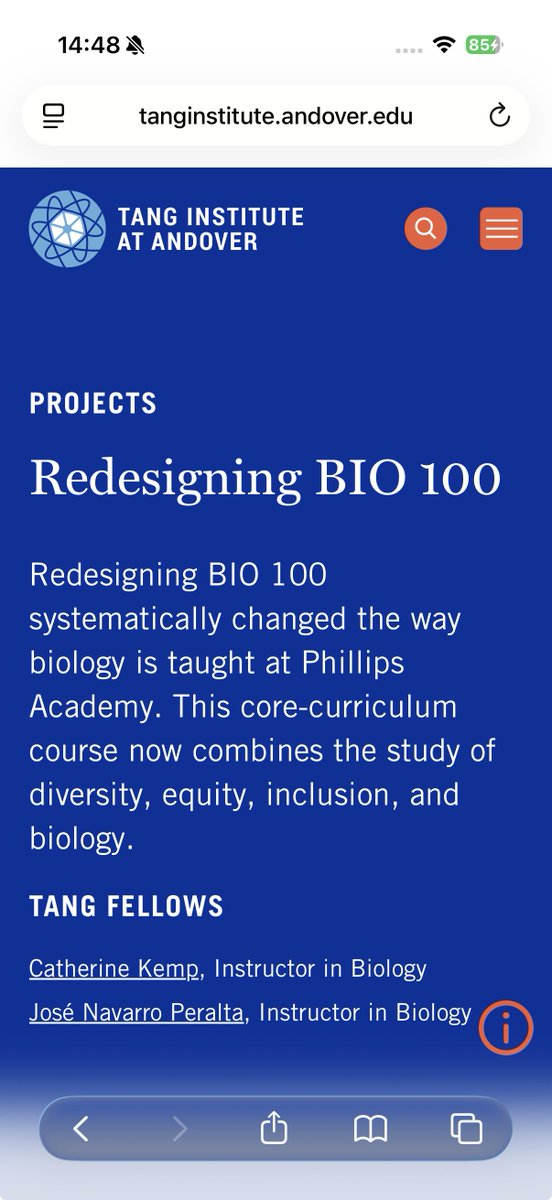
Here’s a math course at Exeter and the introductory, mandatory Biology class at Andover. Andover and Exeter are two of the “best” high schools in America, something that other schools try their best to emulate. The kids that go there want to go to a “good” college so must pretend to enjoy / agree with these courses in order to get the grades and recommendations to get into the “good” colleges. Got a C in Biology? Take a stand against the English teacher who generates grades based on vibes? No good school for you!

The “good” colleges thus are increasingly filled either with people who have excelled at preference falsification and politics, or who genuinely believe in Lysenkoism.

It’s also why college grade inflation is not surprising. Force everyone to take hardcore quantum mechanics and grades will deflate. But the students who have perfected themselves through superficial perfectionism have a real skill (superficial perfectionism!) and will continue that throughout college and life. It just stops accruing benefits outside of academia.

Education and Home-Schooling

Originally posted as a Twitter thread on January 02, 2022


Normalizing/destigmatizing home schooling — as well as appending social, athletic and other “non-academic” parts of the school experience — feels both (a) necessary (school closed!) and (b) a solution to the country’s increase in woke nonsense (eg: https://sfist.com/2021/02/10/sf-school-board-votes-to-permanently-end-merit-based-admissions-at-lowell-high/ )

I realize this sadly isn’t practical for many households (single-parent, or both parents at work, etc) where school doubles as child-care. But “remote school” has no child-care and has adopted no advances in INDIVIDUALIZED instruction — something the internet can uniquely do

That’s the worst part of this whole “Zoom school” experience. It could have been a great step forward for 1-1 “mastery learning,” which DRAMATICALLY changes educational outcomes — this has been tested, proven, and known for decades:

https://en.m.wikipedia.org/wiki/Bloom%27s_2_sigma_problem

Instead, Zoom-school got rid of the good — the social experience (learn how to get along with peers in the real world!) — and did nothing to use the unique nature of what 1-1 learning/technology can accomplish. It just moved the mediocre part online, making it even worse…

Add in the hyper-inflation of education costs, and we are getting much less result for much more $$$…now with free degraded mental health outcomes given social separation! There’s a free and arguably better version of Zoom school called Khan Academy
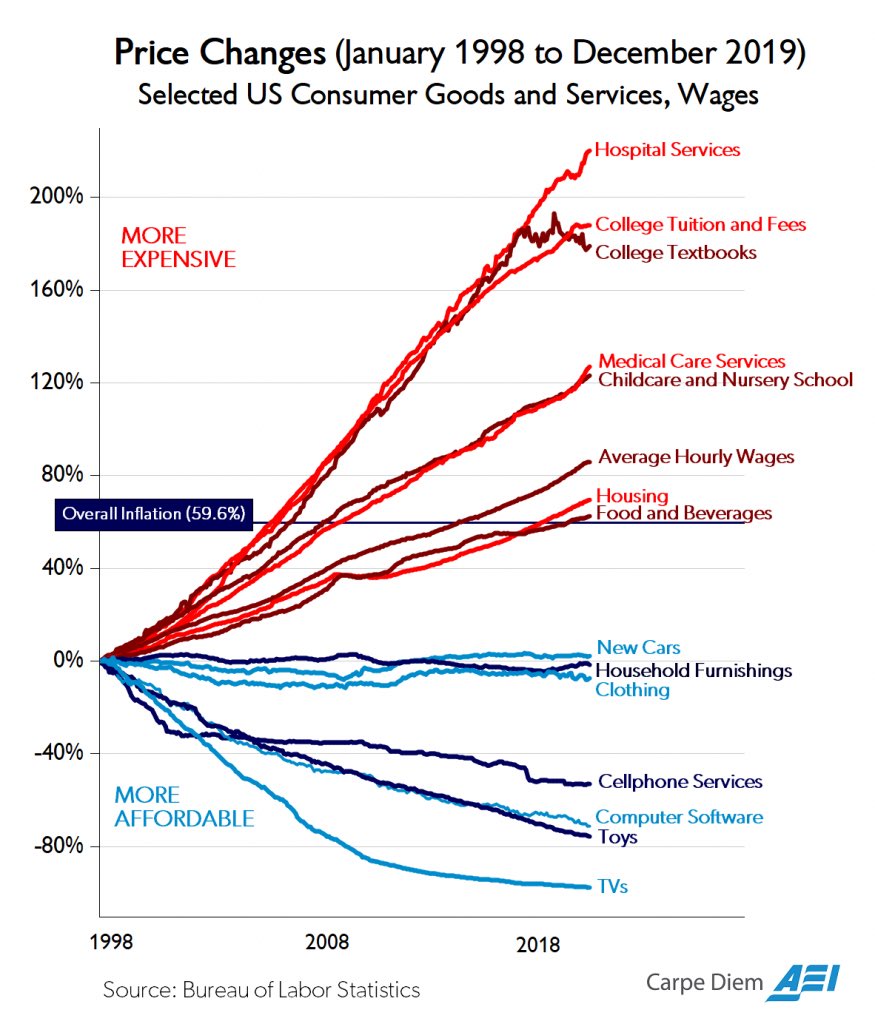
Hopefully as credentials get unbundled from education the higher education monopoly will falter… https://x.com/arampell/status/1105667061986914305

But K-12 is far more foundational and less credential oriented. Pedagogy and social interaction matter. The internet has limitless free content, and experts from all over who can offer individualized instruction catered to the EXACT level of each pupil…

I’ve been astonished how much my kids have learned (far in excess of the one-size-fits-most school curriculum) from free online content (eg 3Blue1Brown on YouTube)… and sites like Wyzant that aggregate experts from around the world in ANY topic for 1-1 on-demand instruction

I used to think school choice / vouchers was the solution, and it certainly WOULD be helpful during Covid as public schools shut but private schools stayed open — a huge blow for lower income families. Imagine if this had happened 36 years ago:

https://www.nytimes.com/1985/11/14/us/reagan-proposes-vouchers-to-give-poor-a-choice-of-schools.html

But now I’m much more convinced that a vibrant, technology-first homeschooling option is the counterweight we (parents) really need given the panoply of problems with the established education system/culture (cost, outcome, lower-the-ceiling v raise-the-floor mentality, etc)

Historically, home-schooling had (has?) a stigma attached to it — it’s just not “normal” and how will kids fare without normal social experiences attached?

But this is going to change — both because the offline keeps getting worse (or shut!) and the online — the “strong” form being the online native — keeps getting better. My partner @cdixon applies strong v weak to tech writ large here:

https://cdixon.org/2019/01/08/strong-and-weak-technologies

Online-native education — provided the offline accoutrements are solved! — will also hopefully bring true equality of opportunity to students anywhere and everywhere. That’s a future we should all want to strive for.
Fin.
Why I don’t believe in conspiracy theories

Originally posted as a Twitter thread on January 19, 2021


Why I don’t believe in conspiracy theories, summarized in a Ben Franklin quote:
“Three can keep a secret, if two of them are dead.”

When talking about large scale hiding of ANYTHING + the auditability of electronic records + human stupidity, natural path is exposure

It’s why there are not aliens stored in Area 51, it’s why the election wasn’t stolen, and it’s why the idea that Florida is wholesale fabricating numbers is nuts. Occam’s Razor and Ben Franklin.

But a counterpoint to this is: can you trust “consensus but unfalsifiable” conclusions? I’m increasing a No. No experiments, not replicable, but social stigma and no funding to oppose:

https://www.nature.com/articles/s41562-018-0399-z

Incentives matter, too.

Remote Education

Originally posted as a Twitter thread on July 30, 2020


There’s an opportunity to turn remote education from a weakness to a strength — from a badly rendered “sage on a stage” (constant in education for 100s of years, but *worse* online!) to individualized instruction. To see why, let’s take a trip to 1984 — not Orwell, but Bloom

Prof Benjamin Bloom wrote a seminal work in 1984 showing that individualized instruction lifted outcomes by 2 standard deviations — outperforming 98% of regular students:
http://web.mit.edu/5.95/www/readings/bloom-two-sigma.pdf
But he remarked, it was “too costly for most societies to bear on a large scale”

But the Internet has solved this problem, conceptually! What we need(ed) was a forcing function to abandon the status quo, which Bloom showed is demonstrably worse than individualized tutoring. We potentially have that in Covid, which has incredibly made the status quo *worse*

Homeschooling was “weird” and “dangerous” (https://news.harvard.edu/gazette/story/2020/05/law-school-professor-says-there-may-be-a-dark-side-of-homeschooling/) but now parents get to see (Zoom-spying!) how ineffective the “status quo” is — and speaking as a parent who knows the Bloom data and the traditional/dumb homeschooling stigma, I now care only about the data

Schools have (had?!?) one big thing going for them — kids learn how to socialize, to get along with other people, to deal with adversity, unfairness — side note, but this (school!) graduation speech by Justice Roberts is the best ever: https://time.com/4845150/chief-justice-john-roberts-commencement-speech-transcript/

But Zoom school has none of this. It’s worse in every way than what was already a proven-to-be-suboptimal model for education!

I hope some forward thinking schools will try to go on remote education offense, whereas most are just going on “how do I turn this thing on?” defense.

I encourage everyone to read the Bloom paper. We now have the means (so many great tutoring platforms for a fraction of the cost of private school). We have the motive. And with Covid, we have the opportunity. Fin.

The Anachronism of Education

Originally posted as a Twitter thread on March 13, 2019


Educational institutions bundle an education (knowledge) and a credential. The means of getting an education keep getting cheaper — at the limit, it’s just consumption of (free) knowledge — and it’s therefore the credential that’s getting more expensive.

Why did all these rich and famous people cheat and bribe their kids into school? To help them get an education, or to help them get a credential?

Ancient Credentials are not only backwards looking, and a poor substitute for accomplishment, but they are increasingly irrelevant in a world of real time feedback and measurement.

“But would you see a doctor without an MD credential from a top school?” We should care about what you know, how well you practice it, and other relevant metrics

But when those things aren’t easily available or normalized, we instead care about a document, often appropriately enough written in a dead language (Latin) about some past achievement.

6/ Which, coming full circle with today’s indictments, often means nothing.

“Silicon Valley Does X”

Originally posted as a Twitter thread on January 08, 2019


“Silicon Valley Does X” — what does it mean? It *DOES NOT* (or should not) mean “same thing HQ’d in high cost of living SF.” It means a true first principles approach to re-inventing a stagnant industry, process, and way of thinking.

The philosophical burden of proof is often described as “he/she who brings the claim supplies the proof” (or this, by Carl Sagan: “extraordinary claims require extraordinary evidence.”) This is *very* relevant for “Silicon Valley Does X.”

There is often little evidence for *current* positions (outside of precedent) and consequently “Silicon Valley Does X” is pilloried for bothering to re-examine and re-think orthodoxy.

Any industry trusting random humans to make uniformly optimal decisions with little or no feedback loop — now THAT is an extraordinary claim, requiring extraordinary evidence! So industries like real estate, medicine, investing, lending, etc

Real estate: “this agent knows the best stager and it will make your house sell for more” …proof?

Medicine: “don’t screen for X, too many false positives” (best way to solve that is to…collect more data! look at longitudinal changes!)

Education: “you can’t learn from a computer screen / credentials are everything”…really?

“Silicon Valley Does X” is about challenging assumptions, and often exposing that those assumptions are themselves not evidence based. And guess what? Sometimes the orthodoxy is right…

…but we should be grateful that there are entrepreneurs willing to risk failure and challenge it.