Category Archives: Finance

Digital Payments are Going to REALLY Grow

The payments market is going to massively expand over the next decade because:

1. ANYONE can now build anything digital — AI code creation means exponentially more digital SKUs that can be created and, of course, paid for. We are in the very early innings here. The gating item is just human creativity. It’s not just software. Can you whistle or come up with a tune? Then you can compose music (no need to learn to read music or know music theory). Can you think of an idea for a movie? You can just…create one. Etc.

Combined with:

2. Almost anything that was “payroll” (paying PEOPLE) can now be “payments” (paying for THINGS). For example: “Hiring an assistant” or “hiring a paralegal” (both payroll) -> paying for a SKU.

We don’t think of ADP or Paychex as payments companies because they aren’t; they are payroll companies. Paying people != paying things.

But more tasks/outputs that were once only available through “paying for people” now become available for purchase on a credit or debit card. This is already starting to happen and accelerate.

And of course, this is not zero sum! Much of this is “everything to the right” of the supply-demand equilibrium point, where there’s conceptually high quantity demanded at a very low price where there’s heretofore no (human) labor supplied. Lots of people will want to purchase a SKU who were unable to hire a person historically.

Not All SaaS is the Same

There are effectively three kinds of SaaS and it seems the (public) markets can’t tell the difference between the three with the coming AI wave.

Group 1: Software utility is not tied to heads, or if tied to heads not based on those heads delivering an outcome WITH the software. Companies can’t cut back on Workday seats because of AI! Quickbooks is used in small businesses. These systems of record will add AI features which will be accretive to revenue — think background checks for Workday, collections for QuickBooks, etc.

Group 2: AI potentially lowers # of users of the product but potentially introduces more usage? If you need fewer graphics designers you might need less Adobe licenses, but it’s possible you need more? Or the expanded output and productivity gains of AI increases usage?

Group 3: Software utility and pricing are DIRECTLY based on heads using software, where AI directly erases heads for the vertical. Zendesk falls squarely in this category. Theoretically CRM could, too. Without a pivot to outcome based pricing, these guys are in trouble.

But there’s a huge difference between the three. The best companies often have hostages, not customers — and they will maintain pricing irrespective of AI usage.

There’s another thread of “companies will vibe code their own software” but unlikely for critical systems of record where renting is cheaper than owning (hence the shift to SaaS from On Prem starting 20 years ago!)

More here on the value of filing cabinets:

https://a16z.com/ai-turns-capital-to-labor

First Principles on Lending…

Original Posted: https://x.com/arampell/status/1893883095646093315?s=20

From first principles: If you ask me to loan you $100, and I think there’s a 50% chance you don’t pay me back, I should only make the loan if I get $200 back. Otherwise, I shouldn’t make the loan! And you won’t get the loan.

The A in APR is Annual, so even if I think there’s only a 10% chance you don’t pay me back, and the loan is a week long, the APR will be enormous on a percentage basis, but only $11.11 on a dollar basis (.9 [probability] X Repayment = $100, so Repayment = $111.11)

That’s a nominal APR of 577% (or a compounded rate of 23,900%).Should that be “illegal”? If you want to restrict access to credit, then yes. I think most people would say that being able to loan their friend $100 to get back $111.11 the next week when their friend is only 90% reliable…should be perfectly fine…particularly when both parties opt in.

These headlines always miss the fact that most Americans don’t have good access to credit and more competition is the best way of lowering costs, not forcing banks to make money-losing loans (that doesn’t work!) or making it hard to start new companies to compete (the CFPB enjoyed doing that)

New Essay: The Transmutation of Capital into Labor

Originally posted as a Twitter thread on August 22, 2024


New Essay: The Transmutation of Capital into Labor

https://a16z.com/ai-turns-capital-to-labor/

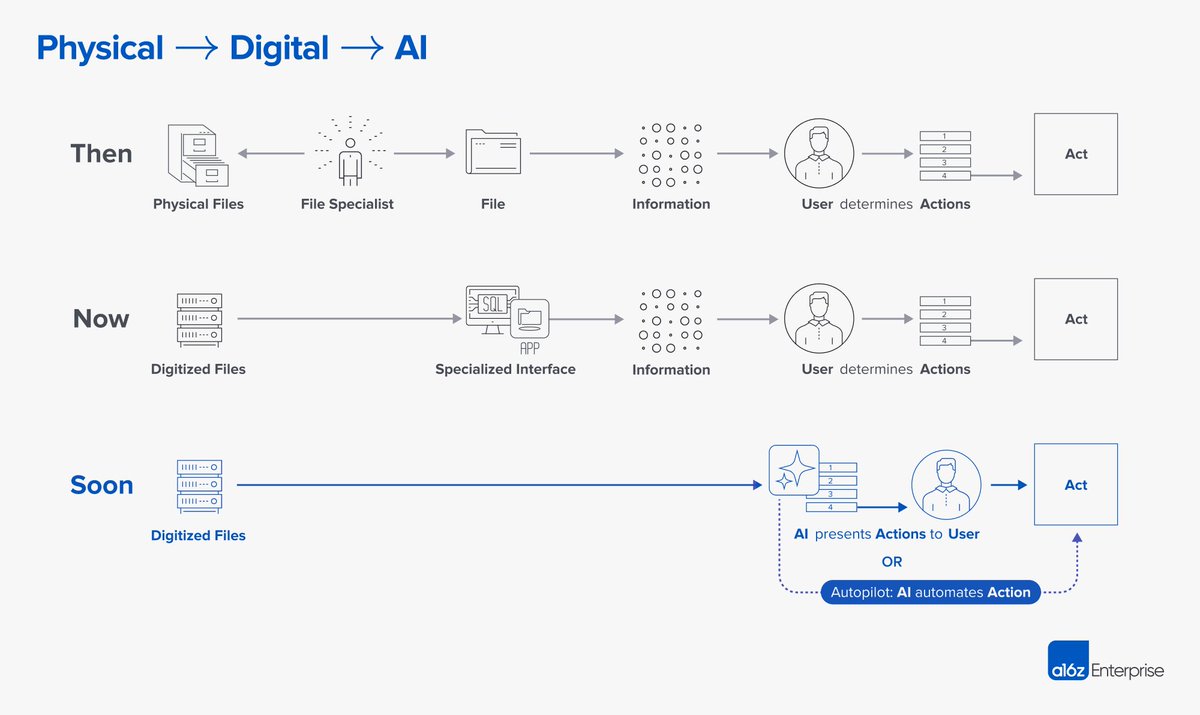
The first era of software took analog files, digitized them, and made them accessible with a specialized interface. Think PeopleSoft for HR files, Quickbooks for ledgers, Epic/Cerner for health…

This has played out for 50+ years as more industries have moved to running on software, not files. Cloud lowered the adoption barrier. Adding financial services to cloud made more markets “big enough” for specialized companies (e.g., Toast, ServiceTitan) to exist.

But the same humans that acted on the analog files now act on the digital files! And sometimes it’s impossible to align hiring and training (of those humans) with business needs.

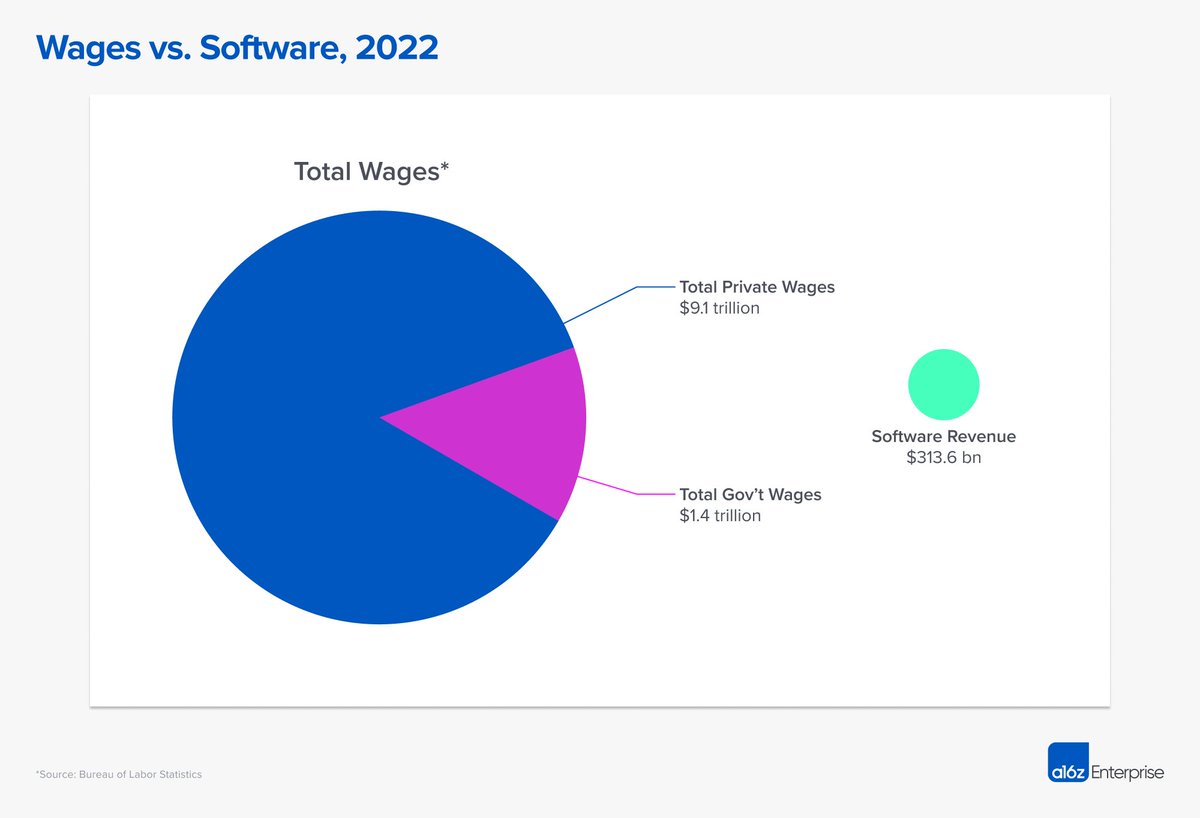
This is what’s exciting about AI. It’s not filling software budget. It’s filling “labor” budget.

Wages in the US alone are $10T+ per year. The worldwide software market is a few hundred billion dollars.

The original “digital filing cabinet” winners have a tremendous amount of potential to add AI, but also have a daunting task of shifting from “per seat” pricing to “per outcome” pricing. Zendesk monetizes per seat. What if a business needs 95% fewer seats because of AI?

Some of the biggest startup outcomes will likely be “net new” industries where a business runs on nothing but Excel…because the software budget was small, the human budget large, and the ability to hire humans was so hard…think compliance officers at a bank.

There’s a saying in economics: “the cure for high prices, is high prices.” As the price goes up, more widgets get manufactured, which increases supply, which lowers the price.
But when it comes to humans and wages, there’s too much latency because of training, licensing, etc.

AI will largely augment employment, and fix many of the “market failures” present with highly skilled yet episodic labor. Imagine: I need your skill for 3 days a year (peak demand), but you need to go to school for 3 years to earn it.

Banks and Fear

Originally posted as a Twitter thread on March 11, 2023


We no longer live in the “It’s a Wonderful Life” bank era. Fear can spread at the speed of WhatsApp and iMessage and Twitter, and electronic transfers can instantaneously render a bank insolvent.

Branches and branch-centric thinking are anachronisms.

At the same time, banks in 2023 do MUCH MORE than just lend and deposit money. They provide pipes and technology for *everything.* Payments are mostly electronic, not cash. Payroll goes to a payroll company which…has its own bank.

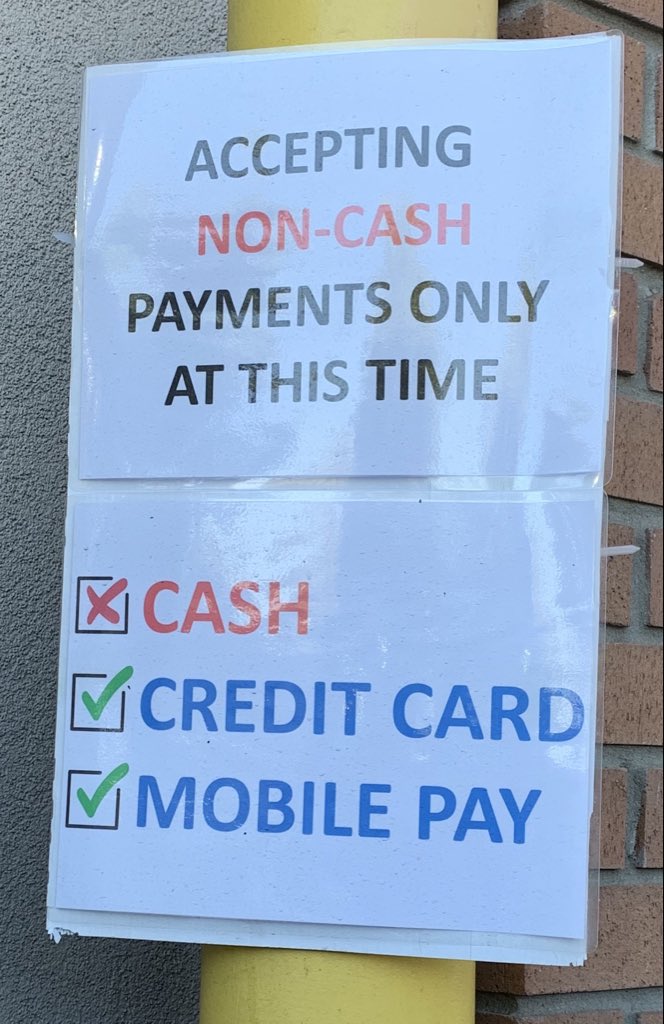
The Great Depression rendered a whole generation skeptical of banks. Money under mattresses was a thing. But that’s before commerce was entirely electronic. Most people can’t live life “cash under a mattress” even if they try. Lots of places won’t even accept cash!

Image

Image

And if you just say, ok, I’ll diversify banks at $250K max cap…what do you do if your business has a $1M payroll run to make and you use ADP/Paychex/etc. Which bank do THEY use? Or: How do you buy something like a >$250K house where the money “sits” somewhere in escrow?

Do we really want to concentrate all US deposits in 4 big banks? They can’t withstand a 50% instant withdrawal event, either. Or concentrate OUT of banks and into short-term t-bills?

2023 is not 1933

The “Finance” Opportunity of AI

Originally posted as a Twitter thread on January 27, 2023


What is the “Finance” and “Financial Opportunity” of AI?

If “Bit Manipulation” is a key part of your COGS or SG&A, there’s a huge opportunity or huge disruption coming your way (or a PE firm that might just buy you).

Two sections follow: “Known Knowns” and “Known Unknowns”

Known Knowns: There are companies already doing X, and thus there are two opportunities:
-sell a tool to turn “bit-manipulation-by-people” costs -> GPU usage (AI base marginal cost)
-create a vertically integrated company that competes with a legacy player…by doing the above

Financial services (unlike, say, Campbell Soup or Boeing or Fedex) are primarily “bit manipulation” — little atom moving needed!

How do you apply for a mortgage? Insurance? Reinsurance?

A lot of the cost is…movement of bits. Move info from here to there, validate X, etc.

Companies, and people within companies, tend to be extraordinarily slow routers of information. Person X emails Y, who’s on vacation…who upon return asks for more info, and then passes it to Z, etc. Do it more quickly, save money and win share.

There’s a tremendous private equity opportunity here, which is the “finance” opp. Any company might see a *dramatic* difference in bottom line once more of these bit-manipulation functions are automated. It’s like going from seamstress -> loom -> textile factory…for bits.

Next: Known Unknowns. What I’m fascinated with are companies that cannot/do not exist today due to a market failure between what companies/consumers will pay and what people will work for…in the realm of bit manipulation.

For example: “Find all counterfeit listings of my product on Reddit/FB/Twitter/forums, for $100K/year” or “Reach out to unhappy customers and get more information, for $100K year”
There’s probably lots of demand at a given price but impossible to provide service at that price

So there are no “market comparables” or set of companies to look to. It’s just an old fashioned supply/demand curve where there’s no quantity demanded at the price where labor is willing to supply…

Working on an essay on this with some data from existing companies — more to come soon.

The Future of Payments…is Red?

Originally posted as a Twitter thread on January 12, 2023


The Future of Payments…is Red?

What could disrupt Visa/MasterCard/Amex? How might a new payments Goliath start?

Let’s talk about the Target Red Card. Target did >$100B in revenue last year, 20% of which happened on its own cards:
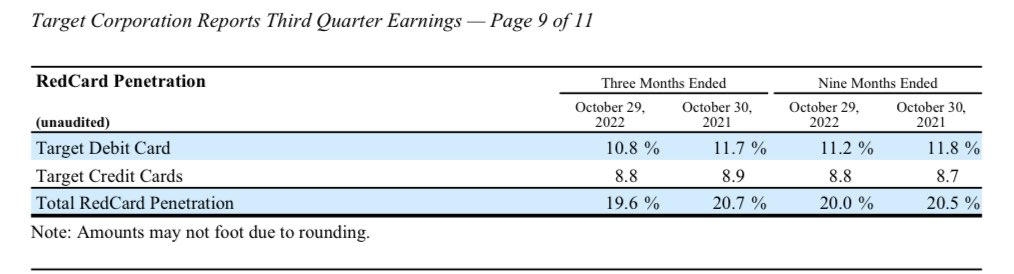
You’ll see “Target Debit Card” and “Target Credit Cards” (source: Target 10Q)

Many retailers have what are known as co-branded credit cards. Target’s is issued by TD Bank; Amazon => Chase; American Airlines => Citi. Some retailers make more on cards than on their core biz!

But what is extremely interesting, and has compelled me to scan every Target 10Q for years, is the Target Debit Card, which makes up over 11% of Target’s entire revenue. The Debit Card just pulls money directly from your bank account — allowing Target to not pay interchange.

It should be self-evident why this is important. Look at Target’s Q1-Q3 revenue last year — $76.6B sales, $2.4B pretax income. Imagine every Target transaction was credit card (not the case) @ a blended 2% fee => $1.5B in incremental income if shifted to ACH, 63% more profit!
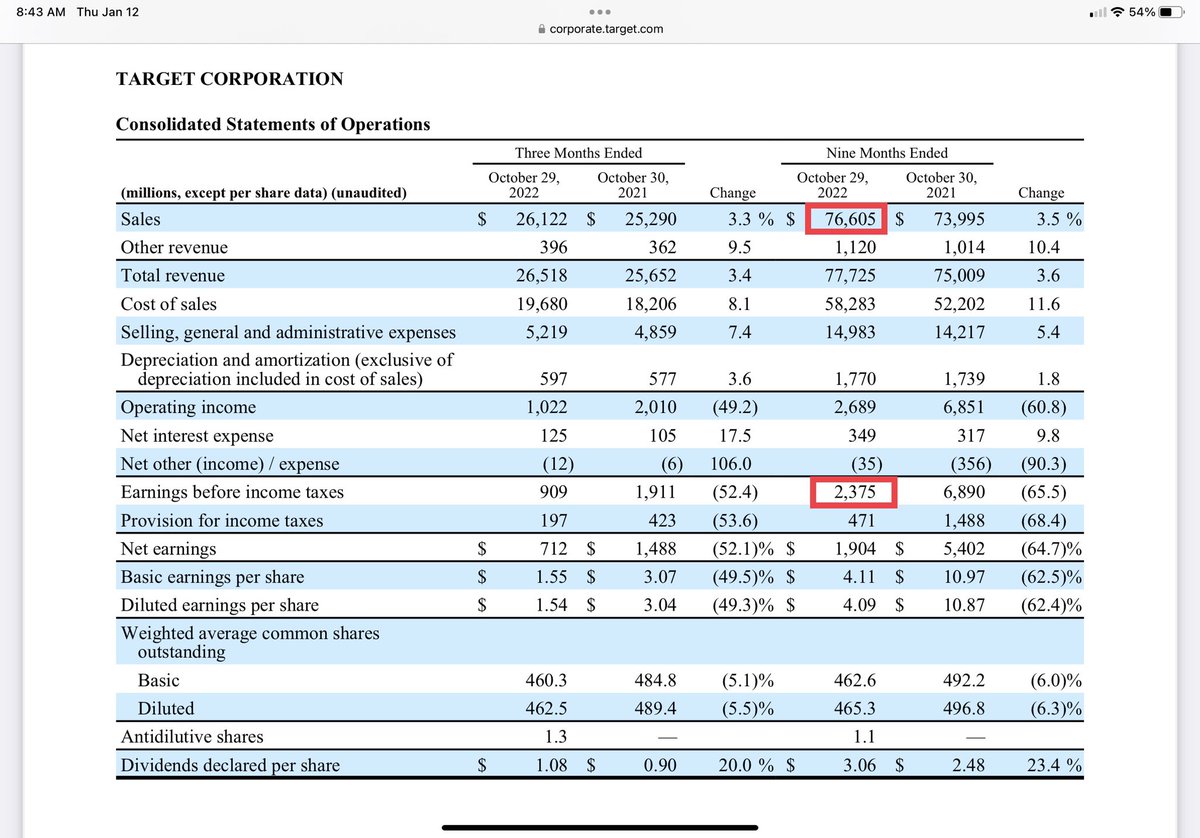
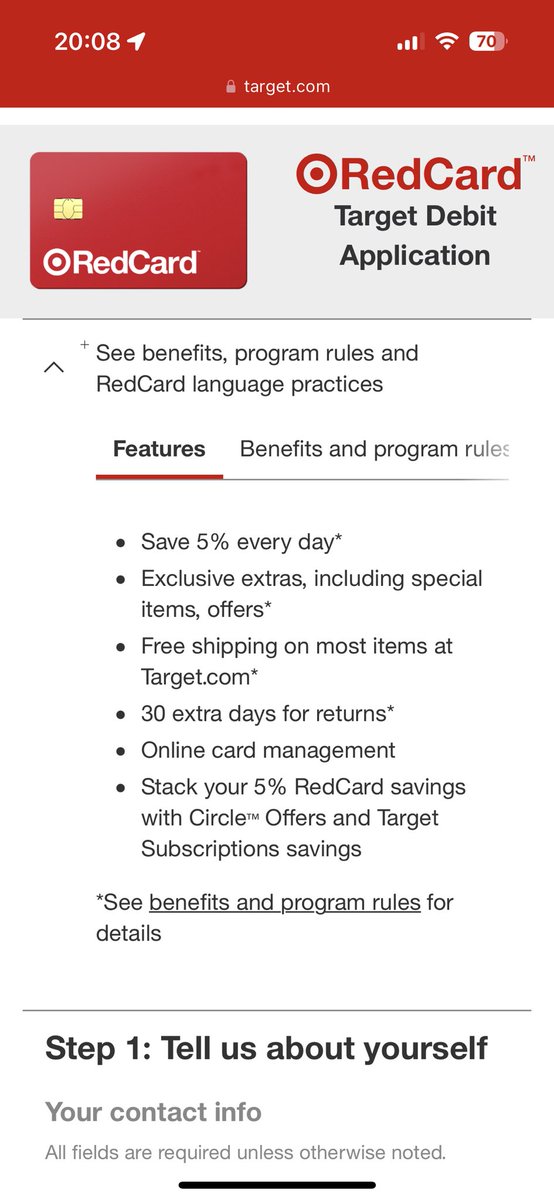
Target has impressively shifted 20% of their *entire* sales to their own cards. The only “illogical” part of this is that to save 2%, they are…giving up 5%, albeit to the user directly in savings at Target, which is the primary benefit of Red Card.
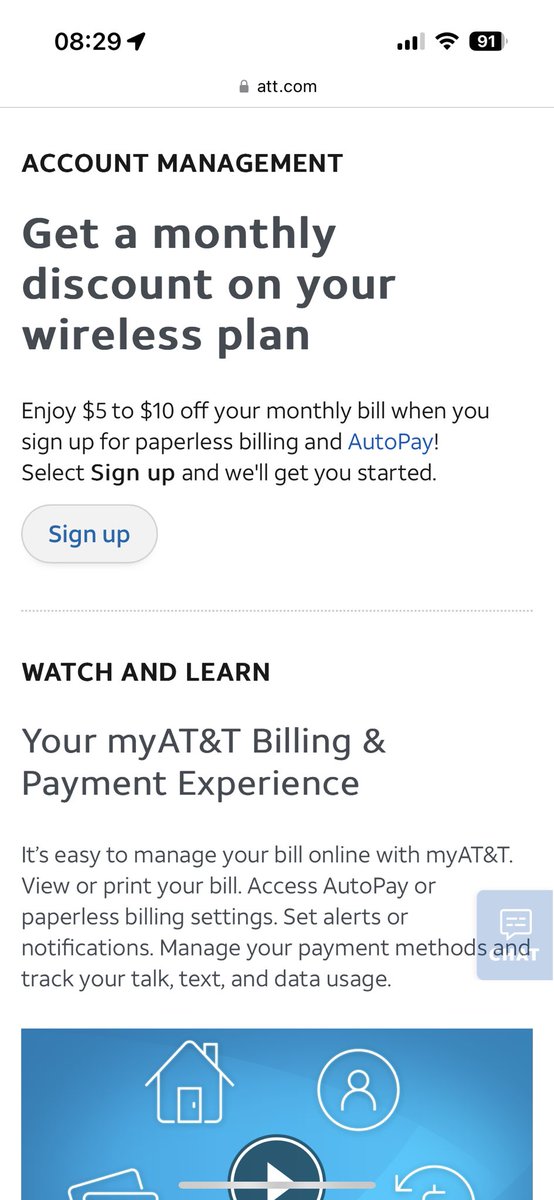
Target isn’t an outlier here. Most “frequent interaction” or high frequency billing companies do the same. Here’s Verizon and AT&T, which give you substantial savings monthly for moving your bill pay off credit cards and to ACH (or sometimes debit cards, given lower avg fee)
Image

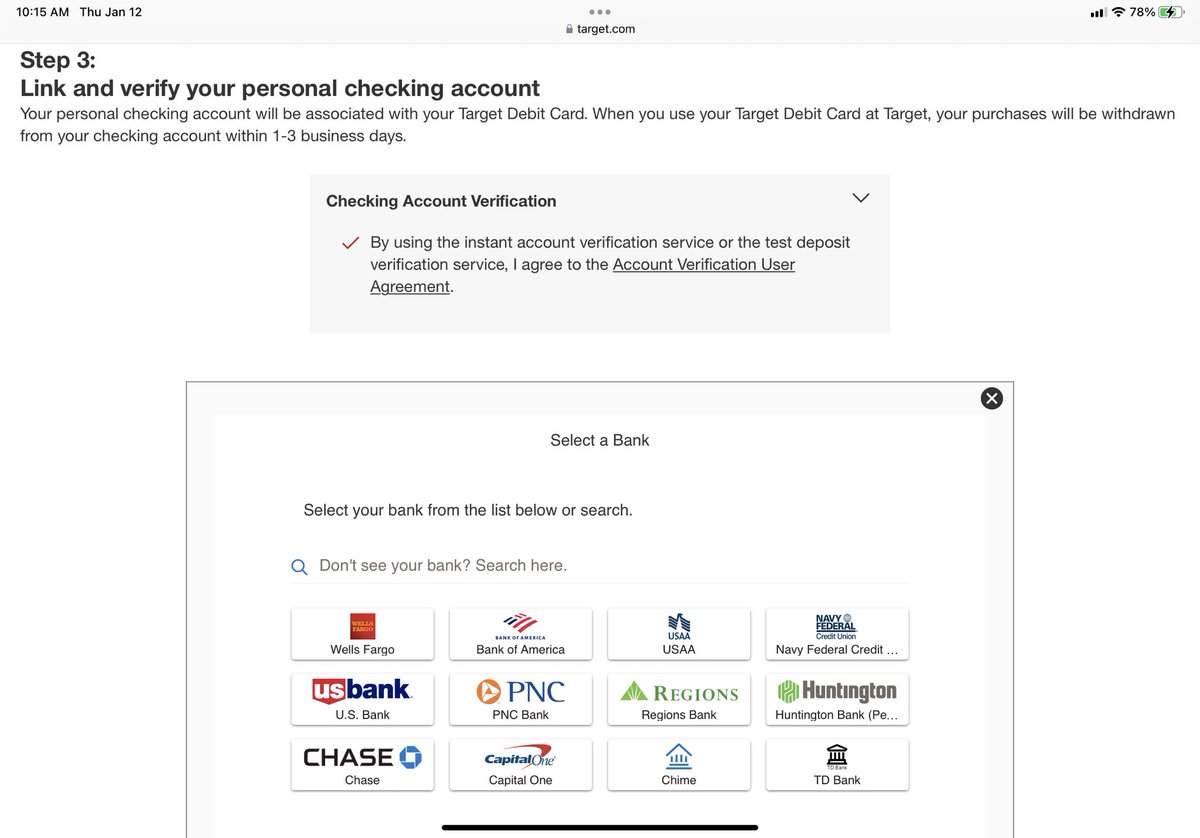
When you sign up for a Red Card debit card, you link your existing bank account and let Target pull funds from it. It’s just a “router” to your existing bank account.

Image

Image

So effectively the Debit Red Card is an abstraction layer around payments, mapping a POS transaction at a Target store to a subsequent low-cost ACH debit from an existing checking account.

This is harder than it seems. For anyone in Credit/Debit payments, you might recognize the “verbs” of payments: Authorize, Capture, Settle, Void, Credit. Not to mention things like chargebacks. ACH has fundamentally different “verbs” and Red Card is a Rosetta Stone of sorts.

Why is this potentially the future of payments? For one, tools like @Plaid have made the connection extraordinarily easy. You don’t have to remember your bank account number or “routing code.” Just log-in to your bank account ONCE and you’re done. Consumers are used to this.

Every “high frequency biller” should be doing this, and experimenting with pricing and benefits. Albertson’s, Netflix, Walmart, Costco, Safeway, Microsoft, Disney, etc. It’s likely trillions of $ of “frequent merchant-consumer interaction” payments that *could* shift.

While I think Target has been smart to roll this out, it seems paying 5% to save 2% (and justifying it by showing increased engagement, which likely reverses cause and effect / shows sampling bias!) is not smart. Better to provide one-time benefit to switch, I would think.

To wit: Log-in to Netflix. See a message: “Switch to direct debit, get $2 off this month. Just click here!” -> long term savings of $100M+/year to Netflix in North America alone based on projected interchange costs.

The “hard” part of this, not surprisingly, is software. What’s needed is “Red Card as a Service” for retailers — and in particular, “frequent interaction” retailers. This would likely sit alongside the existing payments stack, or maybe above it…

Because ideally the one team (at the merchant) that handles dispute resolution/chargebacks, or refunds, or store credits…doesn’t care about the tender type. All of that is just abstracted away into whatever tools they already use.

The other thing that’s needed is a much better onboarding experience. Frankly it’s shocking that Target is at 20% given how complex they make the onboarding and how much information they gather…better software/CX/UX would make it much more compelling.
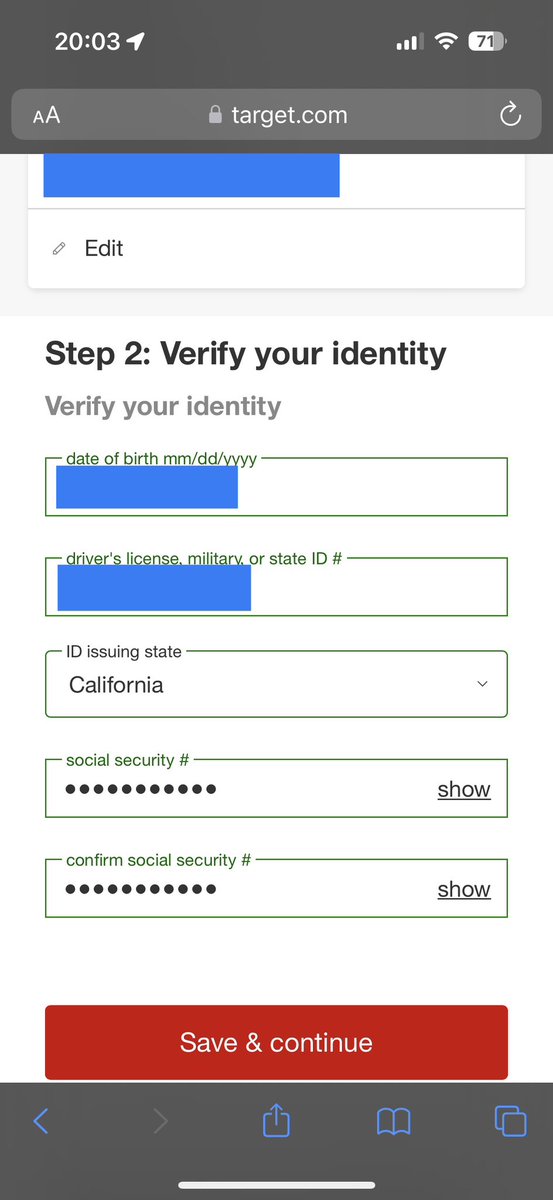
The truly magical experience would be what I would call the “Customer IQ Test.” An automatic mapping of their credit/debit card to their *existing* checking account could be done in the background…credit bureaus and other players already have this.

The IQ Test would thus be: “Do you want to save $5 right now by switching your Visa Card ending in 2655 to your Bank of America account ending in 7688? Click Yes to confirm and your’e done.”

Because fundamentally, the reason “Red Card as a Service” hasn’t taken off in the past is because of the twin moats protecting so much of banking. Inertia (hard to switch) and Rewards (merchant fees fund customer benefits, with banks in the middle). Inertia is now decreasing.

There are other huge benefits to a “frequent interaction biller” introducing this. E.g., “Pre-pay $1000 of spend at Safeway for $950” —> ensures that that person buys all of their groceries at Safeway. Or maybe a quasi subscription.

Not to mention all of the other “fintech” cross-sells available if you have a link to the customer’s checking account and a dominant/frequent relationship with them.

There’s a good question of how many frequent billers does the average customer have, what merchants might this make sense for, etc. But in general, the tools are coming/exist to make this easy, fast, and low-friction…and the economic incentive for merchants is MASSIVE.
Private-to-Private M&A

Originally posted as a Twitter thread on October 17, 2022


How we almost merged our company TrialPay, many times, while navigating the “can’t raise cash without growth, can’t grow without raising cash” problem. The embedded thread shows the surviving path, but let me walk you through several that *didn’t* work https://x.com/arampell/status/1562557849128931328

It’s not uncommon during bull markets to have too many competitors on the field for a given space. A “roll-up” can theoretically create more pricing power while eliminating redundant teams, tech platforms, etc…increasing revenue while lowering OpEx! “Synergies” galore 🏦💵

And even without an “over-competed” space, you might have one company with LOTS of cash, and another with lots of product-market fit but unable to raise…so one way to “raise money” is effectively to just merge with a cash-rich competitor. If cash is king, merge with cash!

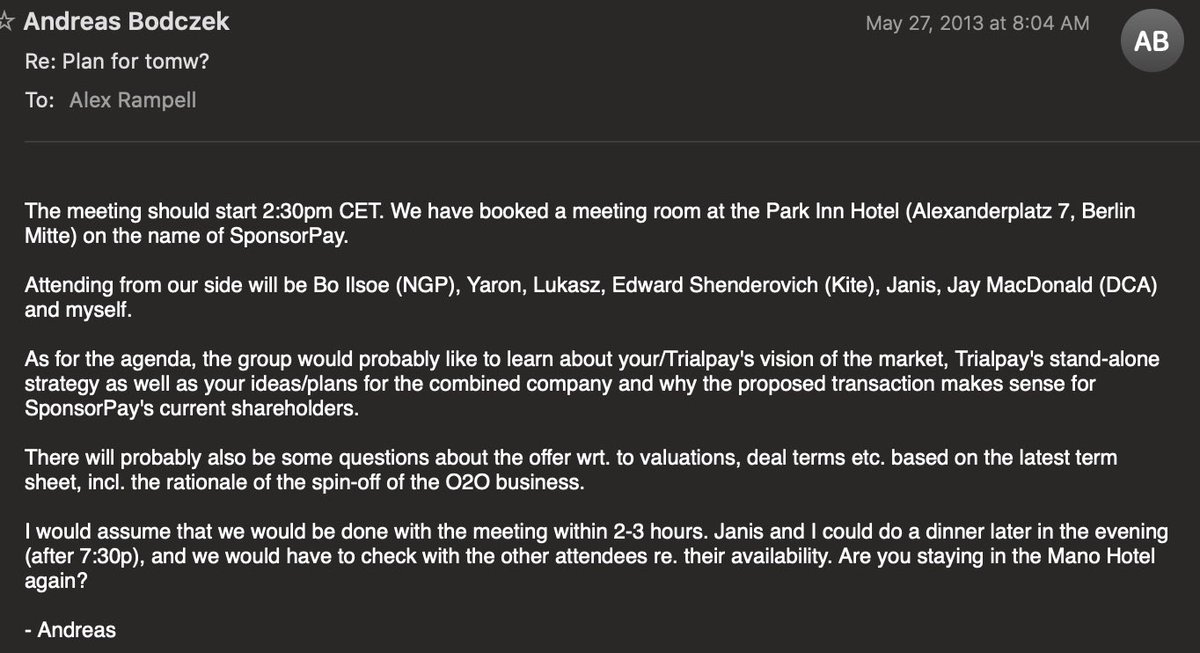
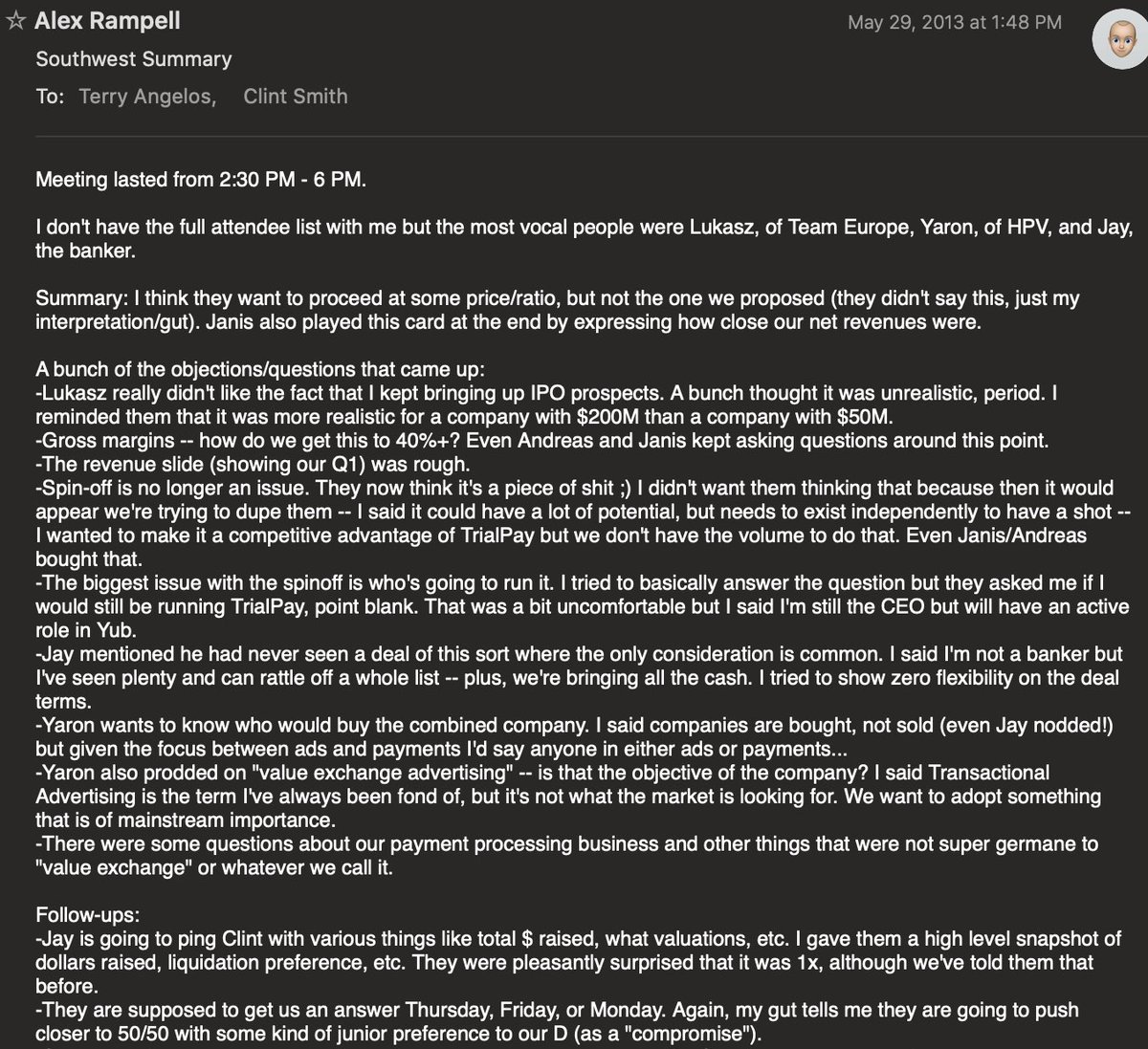
Let’s go back to May 28, 2013. Here I am in the *last* row of the now defunct AirBerlin, flying from LAX to Berlin to meet with SponsorPay regarding a merger. I needed to make a presentation and proposal, which I attempted to do from my seat…despite the reclining guy in front

Image

The problem with private-private mergers is obvious. How do you ascribe relative value to each company? For public companies, there’s a constant voting machine. For private companies, you have an old valuation, cash in bank, burn/revenue, and rosy projections around the future

We had just come off another merger that was almost magical. We bought a company called Lift Media with an identical product, moved all their customers to our platform, only needed one person from their team (not to sound heartless)…so we got all their revenue w/ $0 cost

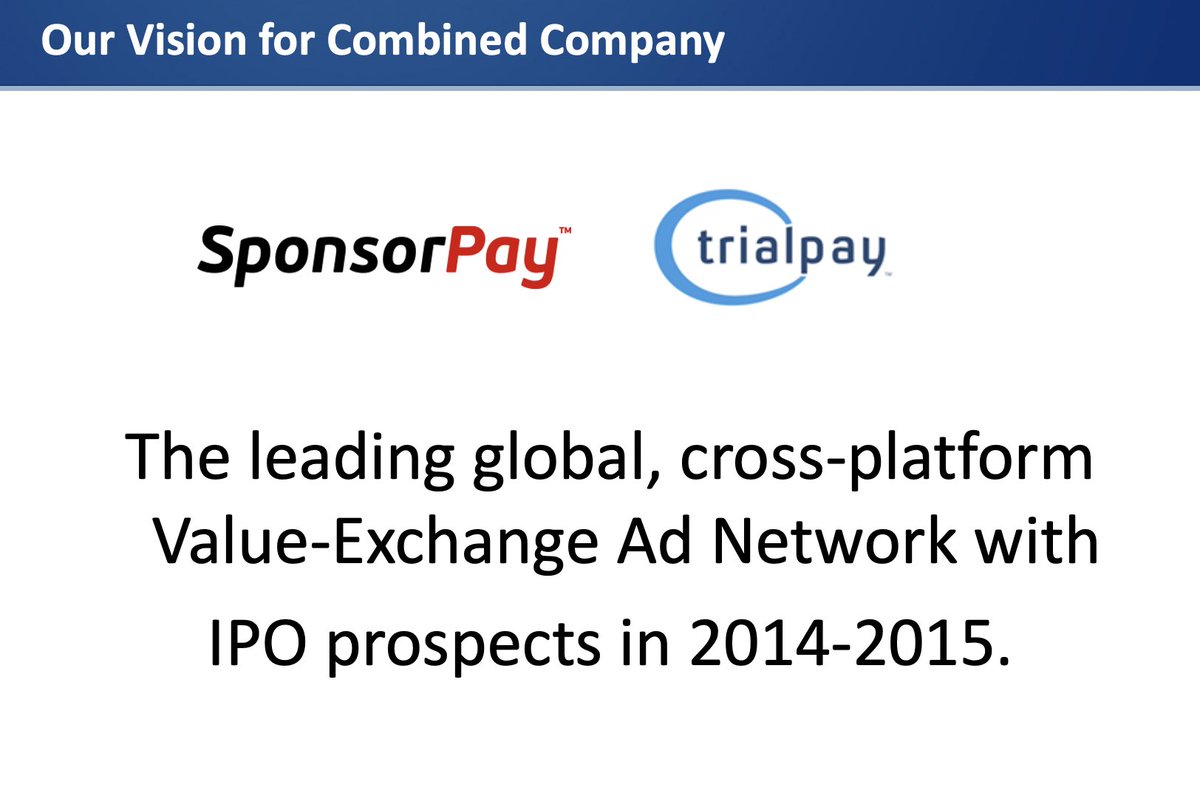
With SponsorPay, we had more cash and more revenue. We were (internally) bearish on our future growth, since we were late to mobile. They were more bullish on their future growth. We both were probably showing a bit more bravado during the negotiations – my opening slide here

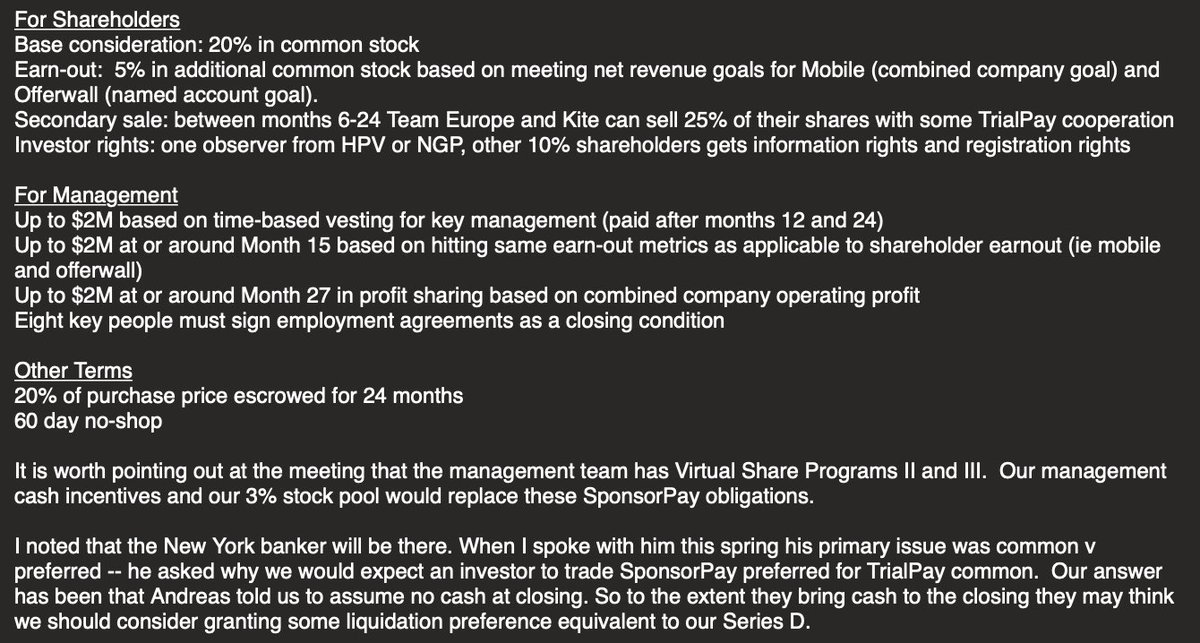
After looking at their financials and our relative cash positions, here’s what we offered (I figure the statute of limitations is up on sharing this stuff since neither company exists anymore! SponsorPay became Fyber became Digital Turbine, so you know how the story ends)

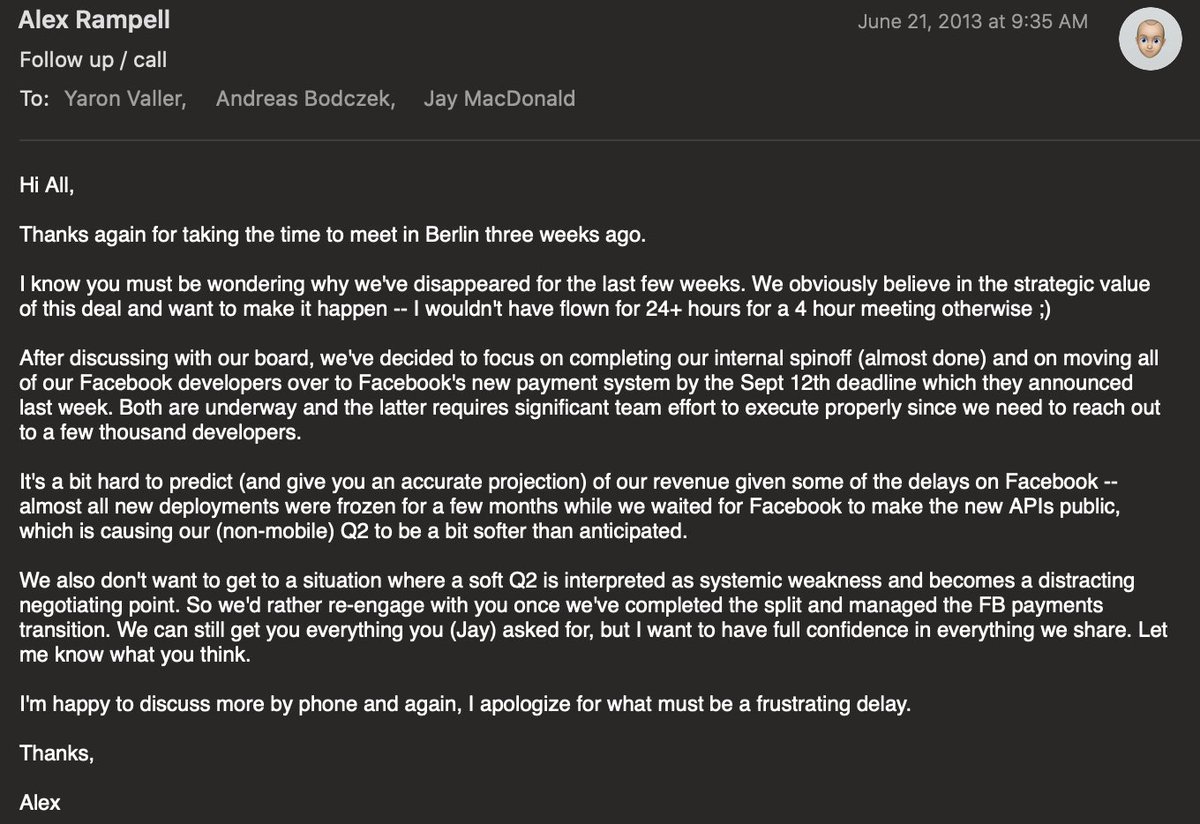
But it was a hard sell. Their investors wanted cash, or at the very least not common stock in our company. We were busy with our spinoff of Yub (see thread in 1). They had hired a banker to try to “shop” our deal. We basically got nowhere, but we didn’t have a sense of urgency

We were also very torn on further diluting our ownership to “double down” on our core strategy by doing a competitive merger. Did it really make sense to give up 20%+ to get more revenue scale but still have 10 other competitors? Like whack-a-mole…with the smallest mole.

I was honest with them that we were busy on our spinoff and likely to see some short term financial pain, and didn’t want to enter the negotiation on “defense” as a result of this. But honestly, my biggest concern was the adage that two turkeys don’t make an eagle

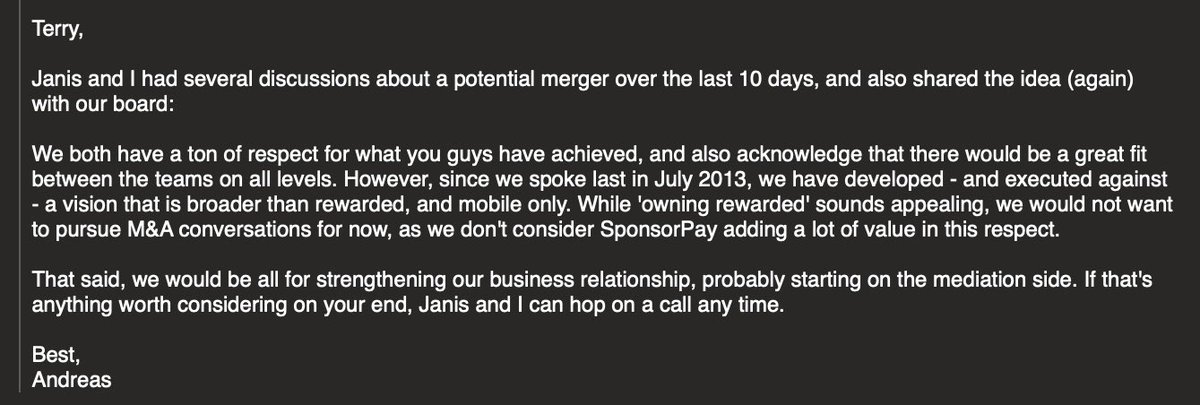
As the year went on, we missed our numbers. They were doing better. We still had more cash. But while we kept opportunistically trying to make this happen, we became further and further apart on price and *strategy*…and after about a year they pulled out, rightfully so.

Image

We were pursuing other deals as well. Accel had a challenged company called GetJar which we looked at buying, but we couldn’t get there. I spent a ton of time with PE firms looking at doing a take-private + merger with a public company, Digital River, that needed new tech

This one (DRIV) was arguably the most insane. Merge our unprofitable company plus tech-forward and differentiated team into a profitable but slow-growing public company, steered by a slash-and-burn PE firm. But valuation was even more challenging in this model.

We prostrated ourself in front of every company adjacent to us but our cash position, once our strong point, was weakening. We even had conversations with “that stock might be valuable!” tech companies (future eagles, with us almost acting as VCs) but we had too much rev/opex

In the end, the path we took was the one I wrote about here: https://x.com/arampell/status/1562557849128931328

But several learnings from this experience of private-to-private M&A, including when I’ve seen it work well.
A. 🦃+🦃 ≠ 🦅. Make sure there’s a *real strategy* you can get behind
B. Don’t waste time. If you are cash rich in a bad market, that’s your value. Move fast.
C. “Optics” converge on irrelevance quickly. “Optics” are a reason not to cut burn, not to eliminate products, etc. You’re merging with a private company, not a BigCo
D. Roll-ups are good if they get you to market leadership, but not if they leave you with high fragmentation
E. To quote The Godfather II (and Sun-Tzu): “Keep your friends close, but your enemies closer.” Being on good, text-message-banter terms with the CEOs of all your competitors is *always* a good idea…particular in an environment like this.

Hope this was helpful. I think we’ll see a lot more private-to-private deals, particularly amongst late stage companies, in this market cycle. Fin.

iBuying and Marketplaces

Originally posted as a Twitter thread on November 02, 2021


few thoughts on iBuying in light of ZG news:
Amazon started off stocking every book it sold, but the vast majority of revenue is now 3P marketplace/FBA (Fulfilled by Amazon). Once AMZN aggregated consumer demand, it started aggregating other sellers and charging commissions

So iBuying is not simply “let’s take lots of principal risk by playing market maker.” Opendoor is aggregating a lot of inventory, which in turn aggregates consumer demand (direct to OD), which then would allow OD to aggregate 3P supply since supply follows consumer demand

the only way to do this is to buy the homes since, as a principal, Opendoor can choose to withhold from MLS and simply list direct. An agent representing a homeowner could try this but…there’s no strategic value to owner in risking lower price for “strategic value to company”

next: cohort math. The real embarrassment to ZG is that their misfire on this business impugns the accuracy of their apparently not very accurate “Zestimate.” But the reason for the misfire, IMHO, is about how cohorts work and age.

let’s say I buy 1000 homes this month for $300M. Avg price $300K. Between commissions, fixes, cost of capital, etc I might be shooting for 50bps profit at the end. But the last 10 homes to sell will make or break me. Why?

by virtue of the fact that they are my LAST 10 to sell, something must be wrong with them. Termites, ghosts, etc. I might need to discount them by 50% to sell them. But that 50% principal impairment wipes out my WHOLE cohort profit/is not realized until the END of cohort!

so basically:
-there is a lot of strategic value to aggregating supply -> aggregating demand to build a marketplace in the biggest asset class in the world. It’s not dumb to try.
-it is very, very hard to get it working, particularly since it will look good until the very end