Originally posted as a Twitter thread on August 15, 2021
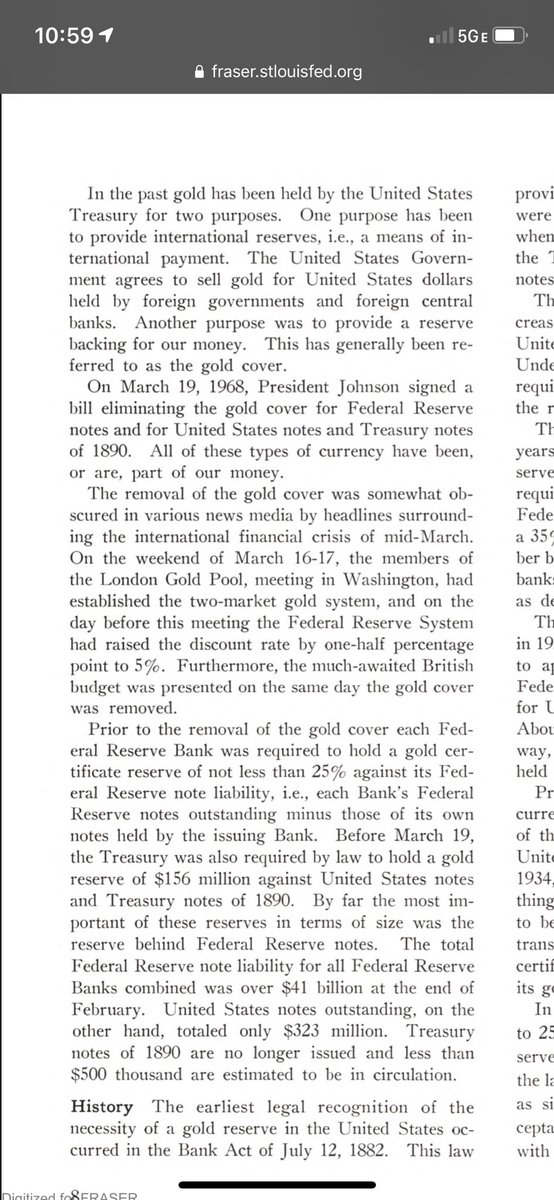
While Bretton Woods and USD gold convertibility formally ended on August 15, 1971, the writing was on the wall for years, particularly once LBJ suspended the 25% Gold Cover for Federal Reserve Notes (and 1890 Treasury Notes) in March 1968:
Originally posted as a Twitter thread on February 14, 2021
Why are there so many SPACs?
Answer 1: Great economics for sponsor (average of 20% of money raised upon deSPAC / merging with a target, Eg $400M SPAC = $80M). It’s like a separate carried interest pool for each company and liquid since already public!
Answer 2: Great economics for investors assuming 0% interest rates (get 100% of your money back if you don’t like the deal! Get warrants just in case you do!). There is no reason NOT to invest in every SPAC at IPO if your alternative is a Bank of America checking account.
Answer 3: TINA (There Is No Alternative), especially given investor inability to access private companies.
However, it’s clear there are way more SPACs than targets (b/c answer #1 in particular). In which case the beneficiary will be…investment bankers who raise the SPACs 🙂
Originally posted as a Twitter thread on August 28, 2020
There’s been a lot of misinformation about IPOs — particularly around the narrative of “intentional underpricing” and subsequent IPO pops / “money left on the table.” IPOs aren’t perfect, but the problem isn’t the pop — a sideshow caused by quirky supply/demand imbalances.
The things to fix are aggregating the most demand, blurring the lines between private and public for a seamless transition to being public, and more thoughtful lockup releases, while also ensuring that a company is sufficiently well capitalized.
Many are celebrating SPACs and Direct Listings, which both have their place as valuable tools, as the “death” of the IPO *because* of a misunderstanding of what causes a pop. A price without a quantity is not a price: block sales happen at a discount, M&A at a premium.
But today, an IPO remains the best way to raise a large block of primary capital. It *should* improve, but the way to measure improvement is not pop against low float, but on aggregation of the most demand (*all* investors) in a way that sufficiently capitalizes the company.
There’s a lot more data and examples to back this up in this piece which @skupor and I put together. It’s long but hopefully shows exactly the dynamics and game theory in play around how a company goes public and what’s in a price: https://a16z.com/2020/08/28/in-defense-of-the-ipo/
Originally posted as a Twitter thread on August 16, 2020
Today is August 15, the 49th anniversary of the de facto end of Bretton Woods, creating the fiat currency world we know today. Bitcoin’s birthday is October 31, 2008, but it has a spiritual secondary birthday of today — the widespread beginning of fiat money.
Until August 15, 1971, dollars were backed by gold at a fixed rate of $35/ounce. The dollar was the world’s reserve currency, and underpinning this reserve was this gold backing. Any foreign government could convert their dollars to gold.
At least, they could *conceptually* convert dollars to gold. In reality, by 1971, the US was “writing checks” (printing dollars) that the gold vaults couldn’t “cash” (or metal!) — a run on the gold, so to speak, would metallurgically bankrupt the vaults.
Before 1971, there really wasn’t a notion of purely fiat money with floating exchange rates — or at least not one that was taken seriously. The US was the manufacturing center of the world and dollars were the needed, default currency, backed by gold.
Nixon delivered the following speech on August 15th, announcing this change and codifying it with Executive Order 11615, closing the gold window. It never opened again.
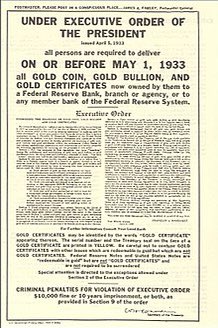
What’s really fascinating is that because gold backed the entire monetary system, owning (non-jewelry) gold was *illegal* from 1933 until 1974. Gold was the settlement ledger for currencies, the true reserve, although the more easily portable/official reserve was the US dollar.
There are many things about a gold standard that make little sense (eg, the supply can increase with a newly discovered mine in South Africa or Russia!) and its inflexibility provides fewer tools for dealing with economic shocks like the Covid one we are dealing with now.
But more so than anything else, gold represented a de facto store of value — and this was *codified* into the financial system until 1971. Seeing as gold now trades at >$2000/ounce, vs $35/ounce in 1971, there’s clearly a divergence between fiat and gold.
And yet gold is: heavy, next to impossible to send around the world (think checks are bad?), hard to divide, and hard to verify. This was NOT a problem before 1971 because the US dollar was none of these things and yet had the backing of/convert ability to gold!
This is why I consider today to be the second birthday of Bitcoin. From 1971-2008, there really wasn’t a financial instrument that had “fixed” dimensions, a reputable store of value but with an easy form of settlement/transmission, which the US dollar until Aug 15 provided.
Given how long it’s been since gold was a reserve currency, and how antiquated gold vaults seem, Bitcoin — for all its flaws — is a logical and superior successor. Particularly given how much money is now being printed by every government, kept in check by…nothing.
Originally posted as a Twitter thread on August 07, 2019
Controlling currency used to mean controlling payments. You print the money as the sovereign; all payments are transacted with that paper. But non-paper payments have changed that and yielded geopolitical risk…
David Ricardo coined the term “comparative advantage” — why trade makes sense. But there’s this issue of geopolitical risk. Growing *zero* food within Country X might be a bad idea if there is a war of anything that interrupts logistics…
So it’s been well-understood, as a matter of national security, that it makes sense to have self-sufficiency in several areas in case trade breaks down
Which brings us back to how currency now has little to do with payments. Governments have very little control over how commerce and payment networks work, or rather, the ability to *keep* them working
The two largest payment networks are in San Francisco (Visa) and Purchase, New York (MasterCard). They are the routers for a huge and growing amount of commerce in *all* countries but they are domiciled in the US, subject to its laws
It’s going to be interesting to see, as paper money goes away and commerce is transacted entirely via payment networks such as these, how governments react. It’s not clear to me that they really understand what’s happening
Now if I’m the UK or France, I might think — hmm, what if that happens to me? In 10 years, things affecting the *commerce* supply, for lack of a better word, will be more influential than anything governments have done in “currency”
China is the only major (non-US) country to have thought this through, as they have their own payment network, China UnionPay, which can interoperate outside of China. But I suspect and expect this to be a bigger deal going forward…
And generally speaking, any network that has an outsize impact on the economy of another country will start being scrutinized more under national security guidelines OR be required to have separate instances that can operate independent of the parent…
For example, imagine that everyone in China took an Uber to work (pre Didi merger). Geopolitical risk having “key economic factor” based in San Francisco — chaos if Uber or the US government cut that off
Food supplies, petroleum, and products of war were the original “national security” risks that couldn’t be subject to plain old free trade. In the 21st century and beyond: NETWORKS.
Fin.
So why don’t consumers do this? It’s WAAAY too complicated for, in this case, an average of $271 per month. Add in the paradox of choice (refinance with whom?), getting stuff notarized, getting both spouses to sign, and hidden fees…and it’s easier to do nothing
Roboadvisors have been around for a while focused on investing assets and optimizing portfolios, but I believe the bigger opportunity is on roboadvising debt — and this has potentially the gravest impact to banks who *make money on friction* (which is all banks!)
There are lots of refinance companies out there, but the biggest opportunity is to do it all automagically for consumers whenever savings can be had (including shifting unsecured debt into secured debt). Refinance as a service, not leadgen to open yet another account
Banks are effectively the biggest “managed marketplaces” out there, between depositors and borrowers. Both sides are getting screwed over by a giant take rate protected by friction (too hard to switch) — with banks earning healthy spreads and record profits
Originally posted as a Twitter thread on September 19, 2018
Visa today has a $328B market cap, bigger than virtually every bank on earth (JPM at $384B is the only one bigger). And yet it started out as a non-profit owned BY banks. How did it become more valuable than its “parents”? https://x.com/VisaNews/status/1042078029114048518
Since Visa intermediates rates between banks (“interchange” between card issuers and merchant acquirers) and clears transactions between issuing banks and acquiring banks, it is the ultimate “central ledger” or platform for finance.
It was originally part of Bank of America, called BankAmericard. But to syndicate this platform beyond BoA, it became a consortium — Visa. Independence (to ensure the central platform didn’t take too much economic rent!) was ensured via non-profit ownership structure
…that is, until 2008 when it went public in the largest US IPO of all time. It reorganized from a non-profit to a for-profit, partially to avoid anti-trust issues (all of the banks get together and decide what to charge merchants…imagine the airlines doing this!)
To me, this is a great example of where/how decentralized networks can preserve true independence (value accrues to network participants vs central player) — and why protocol design, if you will, trumps legal design
Visa is a great and incredibly valuable company. The “protocol” is one of transactional authorization/settlement/clearance. But it was enshrined in a once not-for-profit central actor who today has more value than all but one network participant
Despite a lot of “private blockchain” nonsense out there, this is a great example of how Visa could have or should have been constructed by banks way back when to ensure perpetual independence and inability to capture value as central ledger.
Protocol design matters. And a well thought through protocol is more valuable and protective than lawyers, contracts, and even governments — it will survive all of them.