Category Archives: Startups

How to Invest in People

 Seed bets are largely people bets, and the way I think about them is a set of simple (but hard to know!) assessments of the entrepreneurs — can they materialize labor and capital, are they going to get to traction on the seed (vs what I call a “slow boil” company), and how prolific/encyclopedic are they in terms of understanding the history and present of the product they are building:

-Materialize Labor: “Who are your first 5 hires?” I always try to ask this question. The best answers are where the person literally has five people ready to jump off their existing ship(s) and join and those people are great…it shows that they are a magnetic attractor of talent. But even without that, do they know whom to hire? Fastest ramp is where the 5+ are already ready to jump and those 5 are themselves great.

-Materialize Capital: another description for “heat” but with more of a future lens — how good of a presenter are they? How do I handicap their future fundraising? (“best sign of future financing = current financing” rule still applies). The no-brainer for investment n is investment n+1 from top firm is in the bag 🙂 It’s one advantage to backing “seniors” in the SV sense.

-Is this a “fast boil” company or a “slow boil” company? In other words, is there a good chance — based both on the entrepreneur, TBH team, and idea/product, that they can get to discernible traction early? This is more of a “next fundraising round” output per unit of time measure, because the hard seeds are the ones where they’ve achieved zero discernible (outside) progress on the capital…which some ideas (and fundraise amounts) are more prone to, but of course this is outdone by “ability to materialize capital” 🙂

-How “deep” are they in the domain? If their exposure is nascent, did they REALLY take the time to learn the history, present, and have a theory for the future of the space? I know we call this the idea maze, but I consider it more a sign of intellectual rigor plus ability and willingness to challenge their beliefs and take input from all sorts of people. Robinhood founders met with and studied every past brokerage. Collisons found the rarest of rare books on how the Visa network was built from the 50s to the present and I believe even sought out and met with Dee Hock, the (at the time) 80-something founder of Visa who had moved to a farm. Brex founders took the time to meet and learn from every payments wunderkind. I see this pattern again and again — and EARLY — in people I consider exceptional. They are able to network to anyone from nothing (e.g. Brex guys from Brazil, Collisons from Ireland) — although this is arguably a more important trait for something where major platform/BD deals are crucial.

-Do they want to learn/win, or do they want to think they’re right?

Similar to the above, I really look for people who want to spar/duel around the best way to accomplish a solution — they are headstrong, which is great, but also want to learn of alternatives — somewhat the manifestation of “strong ideas, weakly held”

-Marathon, not a sprint — they will not give up

what in their past convinces me that, when they’re going through hell, that they’ll keep going? Have they faced adversity? What kind and how? Even if silver-spoon-fed, what motivates them and what have they done that requires incredible tenacity?

-Hire fast, fire fast, decision fast — can they make FAST decisions? Are they decisive or indecisive? Are they careful or careless? What is the most caring/selfless thing they’ve done, and the most sociopathic thing they’ve done?

-Image or impact. How much do they seem to care about how others perceive them? Do they want to be liked? Doing the popular thing requires no leadership, doing the unpopular thing requires massive courage AND leadership to get others to follow. Do they want to have everyone like them and assemble a team for adoration, or to win at all costs?

-Motivation in starting the company. Revenge / Count of Monte Cristo? A very rich person has the dual risks of starting a rich-person-problem company (e.g., wine, second homes, workouts, etc) — and, more problematically, tiring and giving up…it’s easy to quit and retreat back into a life of comfort. The most powerful motivator I have ever seen is not money, it’s revenge. Proving the motherf@&$ers who fired you, humiliated you, doubted you, took your baby away etc wrong AND capitalizing on an opportunity you know best. Renaud with LendingClub->Upgrade, Bloomberg with Salomon Brothers->Bloomberg, Duffield with PeopleSoft/Oracle->Workday, etc.

-do they have some path to get their first five customers? Who wants to run their business on enterprise software written by a company with 9 months of cash? 

anyway, probably a lot to learn here from everyone, so just sharing! Despite the fact that traction is scientific and “entrepreneur assessment” is not, I actually would like to believe that the opposite is true, given that we’re always buying options of future performance which always comes down to the people 🙂

As a reminder, one lens for evaluating entrepreneurs is the Freshman-Sophomore-Junior-Senior one, which translates to (taking the investable case for each!):

-Freshman — almost no “work” experience, potentially completely uncredentialed (autodidact), but brilliant, naive, and where the naïveté is a weapon that allows them to try something that nobody else would attempt (or that others have attempted and failed at, thus dissuading more status-seeking humans)

-Sophomore — highly credentialed, early in career, has followed a more typical “credentialed” path (Harvard/Stanford/Yale/Princeton -> McKinsey/Goldman/Google -> Business School), been at the top of their class/work group.

-Junior — sophomore but now later in career with significant responsibility and management experience, think a VP of Google or Facebook.

-Senior — a successful startup founder (>$100M exit) who is doing it again.

Most venture capital returns have been in the Freshman and Senior buckets. Seniors have the highest “hit” rate provided (per above) they’re doing something in their domain and for the right set of reasons. Freshmen have the most variance — some of the biggest companies (Facebook, Google, Airbnb, Shopify, etc) but arguably the highest failure rate. The issue with sophomore-juniors has historically been inability to violently swerve off a safe path but there are exceptions (e.g., Instagram).
The “Comma MBA” Problem and Local Maxima

The best entrepreneurs constantly “read the room” (or the market) and adjust their presentation style, their mannerisms, their product description, their team, their focus, their advisors — everything. They have the smallest number of axioms (things they accept without questioning). Everything else is subject to questioning, upgrading, and re-synthesis. Particularly since almost invariably they started off at a “local maximum” in terms of talent and advice.

I call this the “comma MBA” problem. One time we had a nice fellow from Canada come pitch us, and on his business card he had his name, followed by “MBA” in the same way a doctor would put “MD.” His slide deck referenced his MBA, his pitch mentioned how everyone is “good at business” because they have business degrees, etc.

There’s nothing wrong with an MBA (well, maybe 😂). But what he thought was a positive was not resonating, and he just…didn’t get that hint. And to show I’m not trying to cast shade at MBAs, one time we had a CEO talk about how amazing his tech team was because of their “.NET” prowess — the technical version of the “comma MBA” problem above.

But let’s take a step back. Imagine that in our MBA friend’s small town, he went to the local business celebrity who seemed very wise, saying “make sure to emphasize the fact that you have an MBA! Otherwise the VCs will not take you seriously!”

Both the good entrepreneur and the bad entrepreneur would seek advice from the same village elder. But the good entrepreneur would quickly learn and adjust from experience — “wow, that guy is wrong — I didn’t get the reaction/feedback I thought I would.”

The bad entrepreneur sticks to the village elder’s advice. The good entrepreneur upgrades his/her advisor when it’s clear that it’s a constraint. We consequently give people the benefit of the doubt when they show up with a metaphorical “comma MBA” mistake; the important thing is ensuring they are always trying to learn and upgrade from their metaphorical village elder and resulting priors. And sometimes the village elder is exceptional, too — but it’s statistically rare.

It’s part of why the founding team is so important. I like to say that there are only two jobs at a startup: selling the thing, and making the thing. That’s it. A very good technical person who knows nothing about sales can be bamboozled by a bad sales guy, and a very good sales guy can be bamboozled by a bad tech person.

Your co-founder ideally serves an “axiomatic” role. If you can’t implicitly trust your co-founder, you’re in trouble. That’s not to say that the co-founder must be the most talented person in the domain! Rather, because the co-founder isn’t angling for a promotion and has no political aspirations, she just wants what’s best for the company and understands how to make the right decisions. (One useful cultural value at a scaling company: “You should always be willing to hire your own boss.”)

You will constantly get bad advice. Your job is to know when to discard the advice, but also when the discard the *people* who are clearly meting out bad advice and not doing what’s best for the company. And ideally you surround yourself with talent where you don’t have to second-guess everything and can instead rely on your team — it’s the best way to scale yourself.

Software Clone Wars of 2004, meet AI Cloning of 2026

History doesn’t repeat, but it rhymes.

Before SaaS, and before freemium, there was “shareware” — try before you buy software. This was a concept dating back to the 1980s, where software would be freely distributed on floppy discs attached to PC magazines…dozens of products on one floppy! Written by hobbyists and even upstart companies.

id Software of Doom fame started out like this, as did McAfee. As did I!

As things like BBSs, AOL, Compuserve, and eventually the Internet grew in the 1990s, one of the main use cases was downloading shareware.

And it eventually started becoming a big business. The biggest download site was the appropriately named Download.com, owned by CNET.

Around the same time, more people in more countries got access to the internet. And this little site called Elance (now Upwork!) survived the dotcom bust and ended up being a leading outsourcing site for everything from translation to, you guessed it, software engineering.

So now there was a huge opportunity. You pick the number one or even number twenty product on Download.com that’s printing money. You go to Elance. You get dozens of predominantly Indian and Eastern European outsourcing shops to compete / bid on “cloning” it.

I had a pop-up blocker (how I met @jonoringer), a couple of security products, and a bunch of utilities like a cool macro tool, an email tracker, etc.

But now I could hire somebody for $500 and have them replicate anything on the top download site on the Internet! It was incredible.

But it wasn’t. There is such much complexity under the hood that you never see merely by using the product. You see it when designing the product, when receiving hundreds of customer complaints, when realizing how much you could improve your conversion funnel, etc.

You can replicate something “skin deep” but miss most vital organs. Who knew you needed a Pancreas or two kidneys?

Elance fundamentally changed the shareware business. Anyone with agency could now hire somebody to clone a product or build a product.

But here’s what I noticed:

-cloning almost never worked, because there was too much “dark matter” in these products to be understood or seen when the goal is just rote replication

-coming up with a NEW idea — much better path, since you have to conceive of all of the myriad corner cases. No free ride to rest on. -technical people still reigned supreme, since they could edit the resulting code from the outsourced shops

-distribution > product. Now that it was so easy to build (or hire to build!), the advantage went to those with a real knack for acquiring customers. And it couldn’t just be “I uploaded it to the file library” like it used to be in the good old days of the 90s

Now replace Elance with Claude or Cursor, and repeat this exercise Distribution will rule supreme. Original thought and insight will rule supreme. “Cloning” things at a shallow depth is a fool’s errand.

Good luck.

Cheat Code: Try to Pay More

When I was running my little “shareware” business in college, I hired my first PR firm. Press really moved the needle for us (credibility and reach), and I wanted more. This PR firm had some very big name clients and lots of connectivity to the journalists and publications we cared about.

There was a monthly retainer, something like $10,000, and I fought hard to negotiate it down to something like $5,000. Almost immediately I was disappointed. I was getting almost nothing from them.

But of course I wasn’t. The firm only had so many favors they could call in. Should they use them on their biggest customer, or their smallest one? I was their smallest one.

I had an epiphany: Don’t negotiate down. Negotiate up. Try to be the highest paying customer.

I fired them, met with this Boston firm named fama PR, told them I wanted to be their highest paying client, and asked them point blank what that would take. I was a college kid and they probably thought this was funny, but we worked out a plan by which I’d pay them $40-$60K+/month (in 2003!) for certain performance.

If I remember correctly, we had different tiers: get us on The Today Show and that’s $10K, front page of USA Today/NYT/WSJ also $10K, lesser tier $5K, etc.

We launched this product called DidTheyReadIt in May 2004, and it was on the front page of USA Today, and then Carl Quintanilla came out to interview me for The Today Show. And many more. I still have the PR book they built of all of the appearances. It was insane.

Mission accomplished: biggest client.

The moral of the story is you get what you pay for. There are related learnings, too. The principal-agent problem is real. Shared services with no currency are hard. Let’s dive into those.

This played out many years later when hiring tech recruiters who typically take a percentage of first year salary (of the placed employee). They might take 15-30% depending on the market.

Remember what a tech recruiter does. They often find a really good candidate and peddle him/her to every company to maximize the chance of earning their fee. (In many cases, they’ll send cold emails about this — “I have 4 amazing candidates!”).

At TrialPay we once lost a REALLY good candidate and learned that our recruiter (who sent us the candidate!) was ACTIVELY selling him to reject our HIGHER offer and instead take an offer from another company! What the hell? My team was so pissed.

But of course this happened. We had smartly (and stupidly) negotiated the fee down. Let’s say we offered the engineer $150K, the other company offered the engineer $140K, and you’re the recruiter — would you rather get 30% of $140K, or 15% of $150K?

Was this unethical of the recruiter? Yes. Is this how the world works? Also yes.

You get what you pay for. The world is a competition and you are better off maximizing outputs versus minimizing inputs.

How To Sell and Raise Awareness

There are only two jobs at an early stage startup: Making the product, and selling the product. That’s it.

Here’s how to sell the product.

Contrary to popular belief and movies that lionize sales: You can’t sell until somebody is ready to buy. And you don’t know when they’re ready to buy.

Every other human brain is (to you) a random number generator. Once a year it might fire “1” (yes). Your job is to make sure you show up around this time, or are remembered such that they call YOU when it fires a “1”. Most of the time it’s a “0.” Sometimes people only change their mind when enough time has passed, irrespective of data (https://www.arampell.org/2023/09/01/when-to-escalate-vs-wait/).

Bother the person every day and they’ll get a restraining order. Hire an Ivy League kid afraid of rejection who nudges them once every 5 years, and they’ll forget who you are when their brain (or circumstances) finally says “yes.”

We consequently had a rule: everyone should hear from us once a month. You need to mix up the way people hear from you. We had light, medium, and heavy. Light might be a personalized email or forwarded news article. Medium would be an in person visit (often “I happen to be in the area…”). Heavy would be an event or gift.

This rule applied to current customers (account management), prospects (sales), and strategic partners (see my thread on selling your company: https://www.arampell.org/2023/01/04/how-to-sell-your-company/). Everyone must hear from you every month or on some regular cadence.

One year at TrialPay we were sending out very nice, customized gift boxes. It seems kind of cruel to throw away a plant (versus, say, a cheap mug or t-shirt), and nobody can kill a cactus since they can survive in a desert. So we sent everyone a cactus in a blue, dinosaur TrialPay pot. When visiting customers for years to come, I always saw that pot. When their brain said “maybe I should use that alternative payments thing” there was a cactus staring at them with our logo, and likely an email within a few weeks.

If you’re selling to somebody important, you need to remember they are overloaded and you are their last priority, but there’s a secret way in: the Executive Assistant. My dad taught me this trick. Send a nice gift to every EA every year and you’ll be stunned at the results.

The former President of PayPal once took a 6 week sabbatical and when he came back he was stunned that I was the first meeting on his calendar. We had breakfast and his first words: “How the f*** did you become the first meeting on my first day back?” I smiled.

The way to model most big company behavior: anyone can say NO, but nobody can say YES. How do you get to yes?

You need to sell horizontally; everything above applies to probably 5-10 people in the organization you are selling into. You need to prevent the NO from crashing the party.

Next: building awareness. As I’ve mentioned, normally you can’t sell to the CEO since your product is likely not one of their top priorities:

https://www.arampell.org/2018/01/13/dont-just-sell-to-the-ceo/

https://www.arampell.org/2022/12/08/the-goldilocks-zone-of-cost-irrelevance/

We had tons of competition, companies that did the exact same thing as we did, making all sorts of grandiose claims.

So my job, as CEO, was to position us and myself as an expert in the space. How? By ensuring that we became the source of truth for the press, and an “expert” to the CEO’s actual bosses: Wall Street and analysts.

Since I was trying to both make the term “transactional advertising” a thing and get through to PayPal, I reached out to every single analyst who covered eBay. Cold (and once a month until they responded!), but with lots of thoughts around where payments were going.

It was pretty cool when one of them eventually asked the CEO of eBay what his plans with transactional advertising were. “You mean…like…Alex Rampell’s company?” Boom. Inception.

The same applied for the press. I once was told that the Press never wants to be too fawning over any particular subject, such that they’d have to write something bad about Mother Teresa just to be balanced. We got great one-off standalone articles in the NYT and WSJ about us, but what now?

The answer: come up with a metric that YOU OWN. Who could uniquely talk about conversion rate for Facebook games? TrialPay! Or abandoned shopping cart rates. Etc. Thus rather than having a standalone piece, my goal was to have an “According to TrialPay…” in every single article.

And then these press pieces were fed into the “once a month” engine. You need to assume that NOBODY reads these (statistically true!), so your job is to use them as external credibility and sheepishly send them out, include them in marketing collateral, etc.

Because when you have a 5 horse race and you need to win, you need to SHOW that you’re the market leader with external validation, and you can’t get caught up in the lies of marketing collateral where everyone CLAIMS to have features X, Y, and Z or even customers A, B and C.

Lastly, for most products, there’s plenty of selling that needs to happen AFTER you’ve sold. Your existing customers should still hear from you (at least) once a month, and you should set clearly defined goals for your account management team. More on that later.

Not All SaaS is the Same

There are effectively three kinds of SaaS and it seems the (public) markets can’t tell the difference between the three with the coming AI wave.

Group 1: Software utility is not tied to heads, or if tied to heads not based on those heads delivering an outcome WITH the software. Companies can’t cut back on Workday seats because of AI! Quickbooks is used in small businesses. These systems of record will add AI features which will be accretive to revenue — think background checks for Workday, collections for QuickBooks, etc.

Group 2: AI potentially lowers # of users of the product but potentially introduces more usage? If you need fewer graphics designers you might need less Adobe licenses, but it’s possible you need more? Or the expanded output and productivity gains of AI increases usage?

Group 3: Software utility and pricing are DIRECTLY based on heads using software, where AI directly erases heads for the vertical. Zendesk falls squarely in this category. Theoretically CRM could, too. Without a pivot to outcome based pricing, these guys are in trouble.

But there’s a huge difference between the three. The best companies often have hostages, not customers — and they will maintain pricing irrespective of AI usage.

There’s another thread of “companies will vibe code their own software” but unlikely for critical systems of record where renting is cheaper than owning (hence the shift to SaaS from On Prem starting 20 years ago!)

More here on the value of filing cabinets:

https://a16z.com/ai-turns-capital-to-labor

AI Commerce

Originally posted as a Twitter thread on August 29, 2025


How will AI commerce start?

Sometimes the best way to predict the future is to observe the present.

Millions of people who value their money more than their time already hunt or wait for deals.

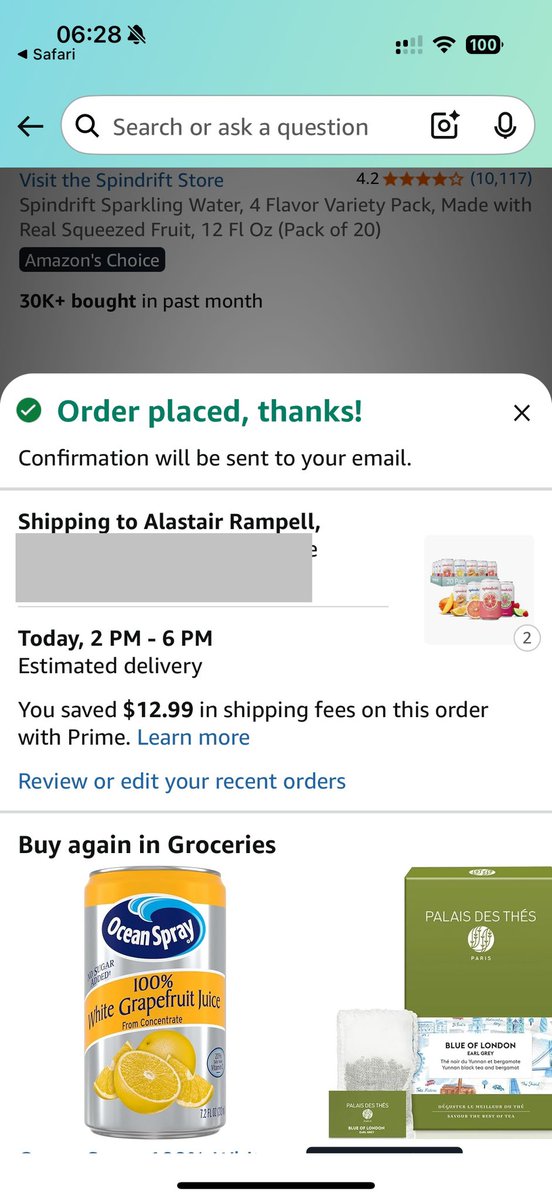
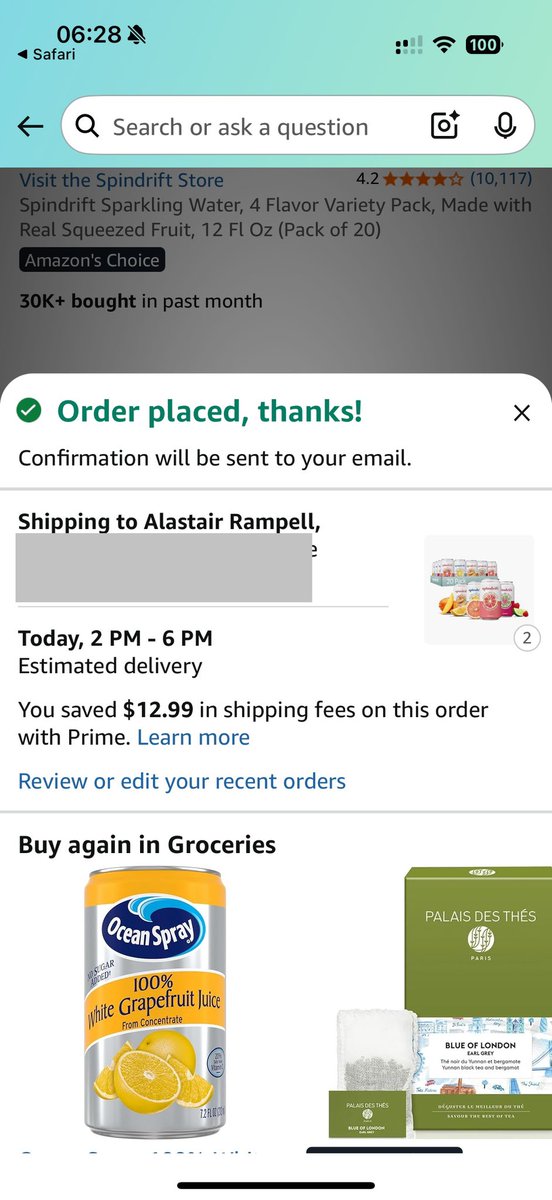
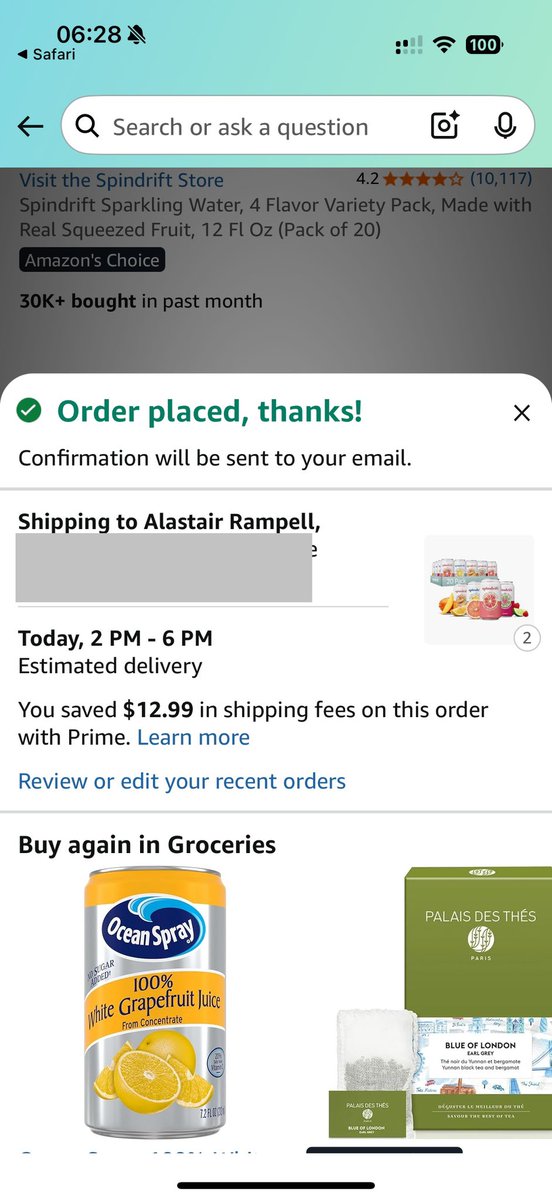
Including me:) I had an alert for Spindrift, it cleared my price, and I bought.

All that is missing from this example is the “do it for me” — as in “BUY it for me when this item clears a specific price”

There’s no question that “buy this SKU for me at the lowest price” (already an observed behavior for those who value money > time) will migrate to AI

More in this piece from @venturetwins and me:

https://a16z.com/ai-x-commerce/

Help Wanted? Hire my software!

Originally posted as a Twitter thread on October 08, 2024


Help Wanted? Hire my software!

Airbnb famously grew by “[growth] hacking” Craigslist — automatically responding to listings to encourage a cross-listing to Airbnb:

https://hackernoon.com/how-airbnb-hacked-craigslist-for-viral-growth-24l35eg

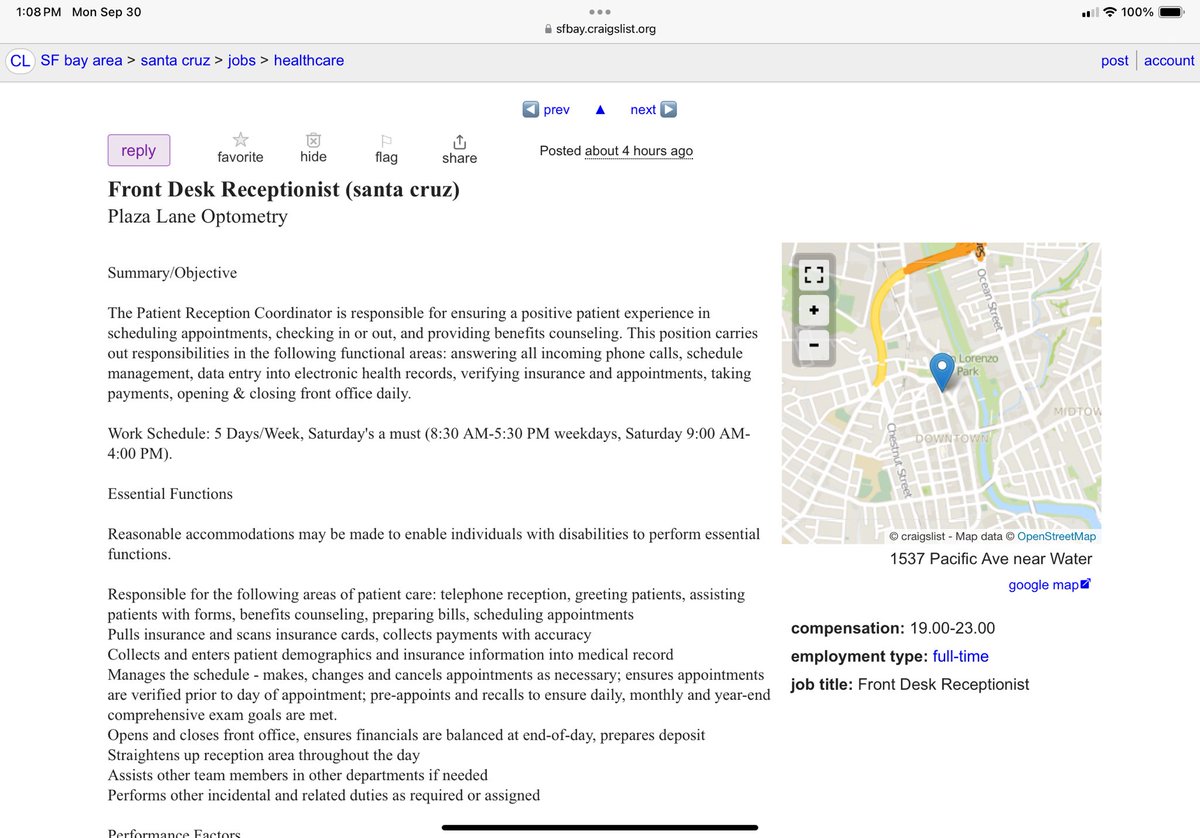
As software “becomes” labor (https://a16z.com/ai-turns-capital-to-labor/), we will see similar hacks to sell software — responding to job postings with software products that do a meaningful percentage of the job’s responsibilities. “I know you’re looking for a ‘Bachelor’s Degree preferred with 5 years of experience X’, but our AI-powered software product can do everything you need, is fully trained, and only costs $20,000/year…and can start tomorrow.”

Try going through Craigslist or Monster for job listings — and notice for each job how many of the responsibilities could be done with AI *in its current form* or where AI will be very soon, particularly with more integrations…here’s a local optometrist:

One of my favorite restaurants where I live uses *zero* system for reservations. You have to call, they’re closed in the morning, and the number is always busy during peak dining times. I asked the owner — why not use an online reservation system? They’re so inexpensive now!

His answer: “We are *always* at capacity. We have never had a day where our tables are not full. This would just be an additional expense, and the employee who answers the phone is needed to greet/seat diners anyway — so the reservation taking has no extra cost.”

I asked him: “What if she retires or quits?”
“Well, then I’d hire somebody else”
“What if a software products could do everything she did, for half the cost, spoke 100 languages, never called in sick, and was never late. Would you hire that ‘product’?”
“That sounds crazy, but I guess?”

We’ve already started to see some of this. AI-powered products focused on specialized “complex workflows” are taking on tasks like the ones seen in the prior Optometrist advertisement. And some technology-laggards are adopting these tools first because (like with my restaurant example) they’ve just avoided tech because it’s felt like an extraneous expense…

New Essay: The Transmutation of Capital into Labor

Originally posted as a Twitter thread on August 22, 2024


New Essay: The Transmutation of Capital into Labor

https://a16z.com/ai-turns-capital-to-labor/

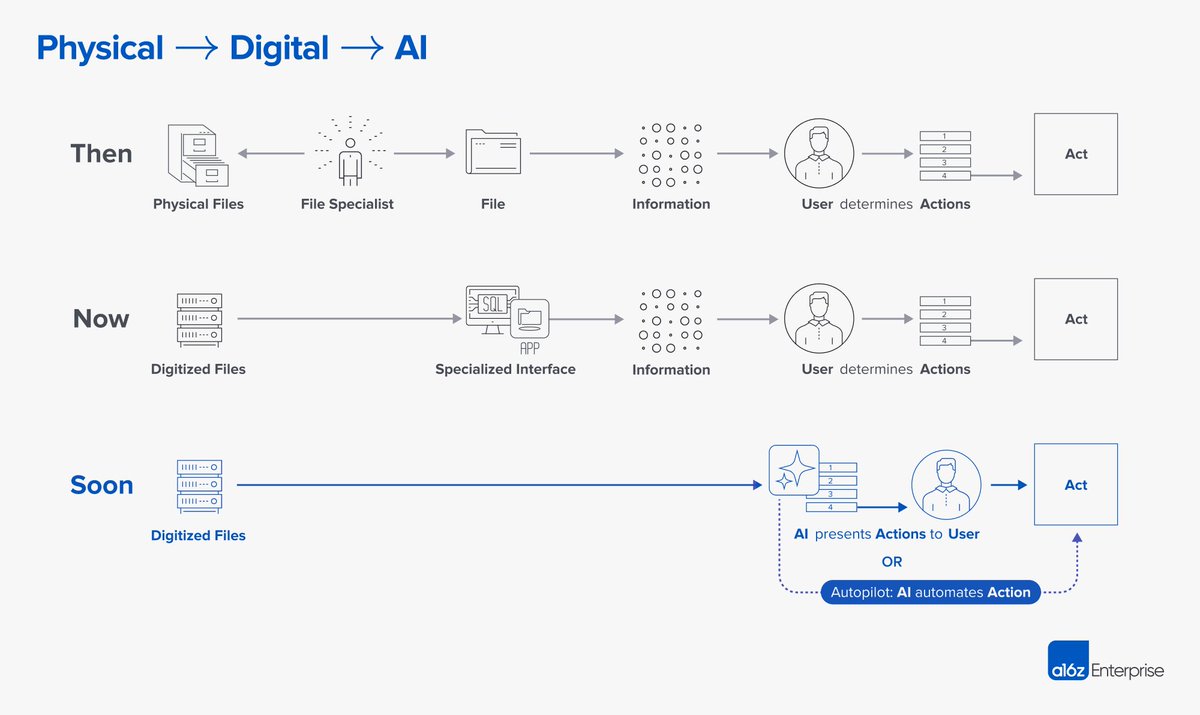
The first era of software took analog files, digitized them, and made them accessible with a specialized interface. Think PeopleSoft for HR files, Quickbooks for ledgers, Epic/Cerner for health…

This has played out for 50+ years as more industries have moved to running on software, not files. Cloud lowered the adoption barrier. Adding financial services to cloud made more markets “big enough” for specialized companies (e.g., Toast, ServiceTitan) to exist.

But the same humans that acted on the analog files now act on the digital files! And sometimes it’s impossible to align hiring and training (of those humans) with business needs.

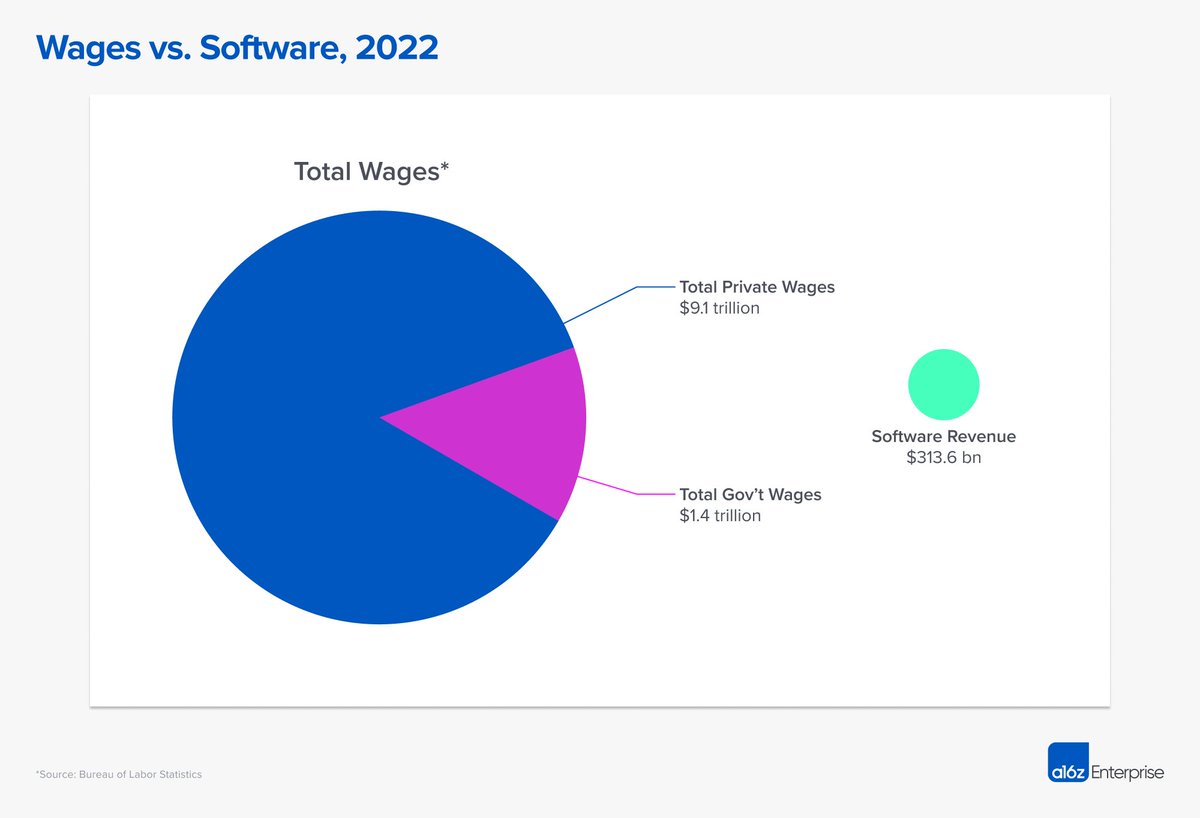
This is what’s exciting about AI. It’s not filling software budget. It’s filling “labor” budget.

Wages in the US alone are $10T+ per year. The worldwide software market is a few hundred billion dollars.

The original “digital filing cabinet” winners have a tremendous amount of potential to add AI, but also have a daunting task of shifting from “per seat” pricing to “per outcome” pricing. Zendesk monetizes per seat. What if a business needs 95% fewer seats because of AI?

Some of the biggest startup outcomes will likely be “net new” industries where a business runs on nothing but Excel…because the software budget was small, the human budget large, and the ability to hire humans was so hard…think compliance officers at a bank.

There’s a saying in economics: “the cure for high prices, is high prices.” As the price goes up, more widgets get manufactured, which increases supply, which lowers the price.
But when it comes to humans and wages, there’s too much latency because of training, licensing, etc.

AI will largely augment employment, and fix many of the “market failures” present with highly skilled yet episodic labor. Imagine: I need your skill for 3 days a year (peak demand), but you need to go to school for 3 years to earn it.