Category Archives: Startups

Stochastic Gross Margins of Financial Services

Originally posted as a Twitter thread on November 03, 2021


Many areas of financial services have “stochastic margins” per widget, but hopefully (obviously!) positive margins for the whole batch of widgets sold – unlike most manufacturers, with fixed/declining COGS at scale. This means many things when you build a “financial” business

You might make or lose money on the marginal loan, marginal insurance policy, marginal payment processed, marginal market-making trade. Apple makes the same margin on every iPhone 13 Pro it sells.

In no particular order, here are some things to think about:

Understanding adverse selection v positive selection is crucial. And the “default” (when you are providing pure MONEY) is being *overwhelmed* with adverse selection before the positive selection customers even show up. Bad loans, risky insurance, tainted properties, etc.

ONE FORM of adverse v positive selection is pull v push. In most businesses organic consumer adoption is a godsend. In risk, it is not! Compare people searching for “I need a loan” to people who get “pushed” a loan offer based on their highly desirable, prescreened credit

This is one of many reasons why postal mail works so well (surprisingly!) for lenders. It’s not just the saturation of the channel – it’s push v pull, picking your customers vs trying to pick through the sea of (possibly) adverse selection applicants

So tracking the **channel** against the cohort performance is *crucial* to understand which channels tend to have more of this adverse dynamic, even holding things like credit score or underwriting risk constant. Cohort customers by time AND channel (and other behaviors)

Be highly, highly tuned to “anomalously high” conversion rates. It might mean that you found a great channel, or it might mean you found a motherlode of desperate/bad/fake customers

A life insurance executive once told me that they found that post-midnight advertising on the History Channel was their most cost effective channel, but turned out to be netting very bad, depressed customers — which didn’t show up in medical underwriting but tracked to channel

Another form of adverse selection happens when you are buying/underwriting a subset of financial products without seeing the full set. Think lenders who sell SOME of their loans. The offered products are ipso facto riskier or worse than the retained ones.

The tail REALLY matters – cohorts need to season. If you are selling life insurance, you don’t know if you’re good or bad at underwriting until (sadly) people die. If you’re buying homes…until the VERY last homes sell.

A mistake I see many companies make is they record their early realized gains, and either assume that will continue or (equally bad) hold everything else in the tail at cost. The last trades are almost always the worst — that’s why it took so long to unload them

Promotions are their own form of adverse selection in “deal seekers.” PayPal once ran a giant promo (trying to launch their offline biz) with HomeDepot, and saw massive customer adoption – but all from SlickDeals deal seekers who saw opportunity for profit

so:
-let cohorts season before assuming anything
-understand channels
-always watch for adverse selection
-be vigilant watching for anomalously HIGH conversion rates
-push can outperform pull
-beware underwriting “subsets” of a customer’s business
-beware deal-seeking
Bureaucracy, Wokeness, and Sabotage

Originally posted as a Twitter thread on July 29, 2021


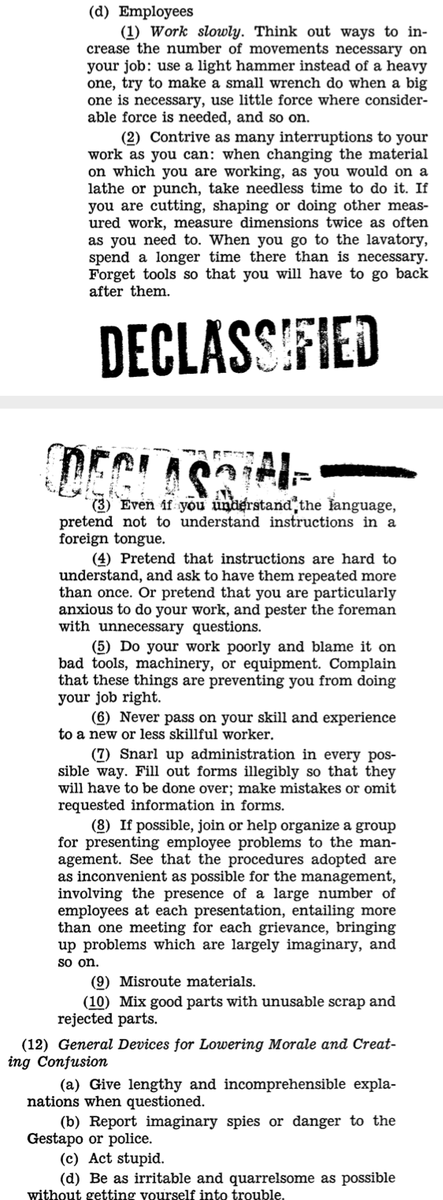
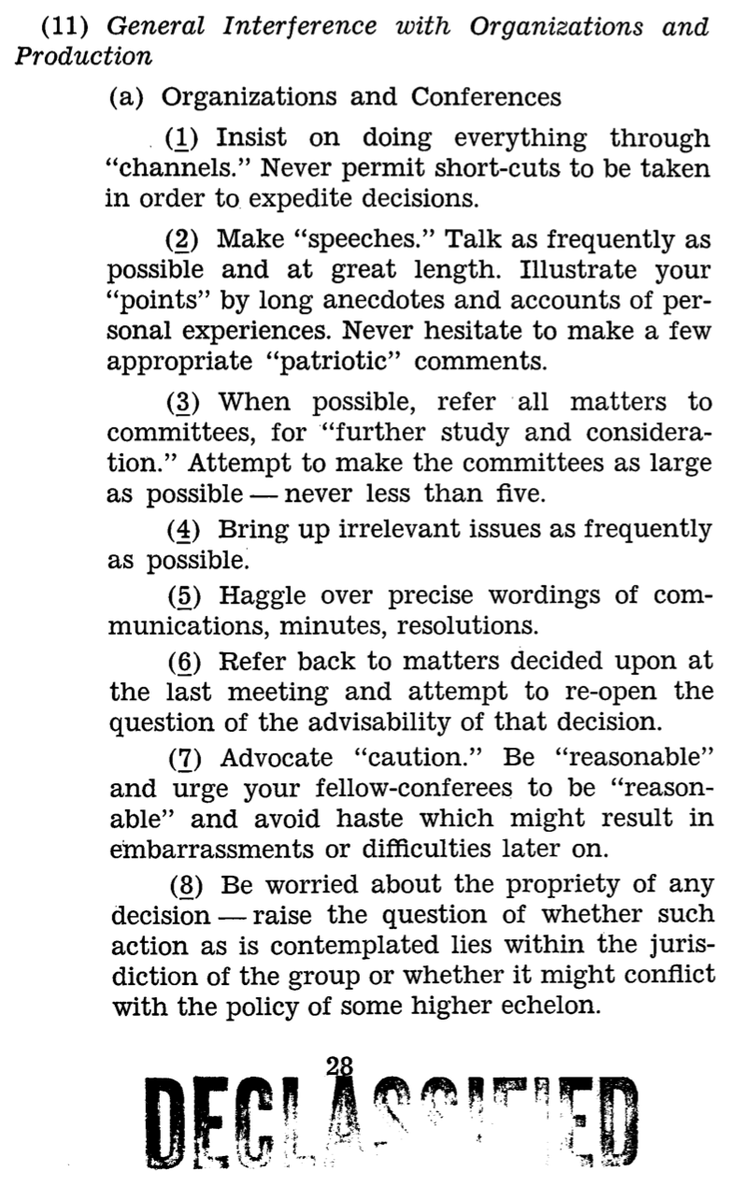
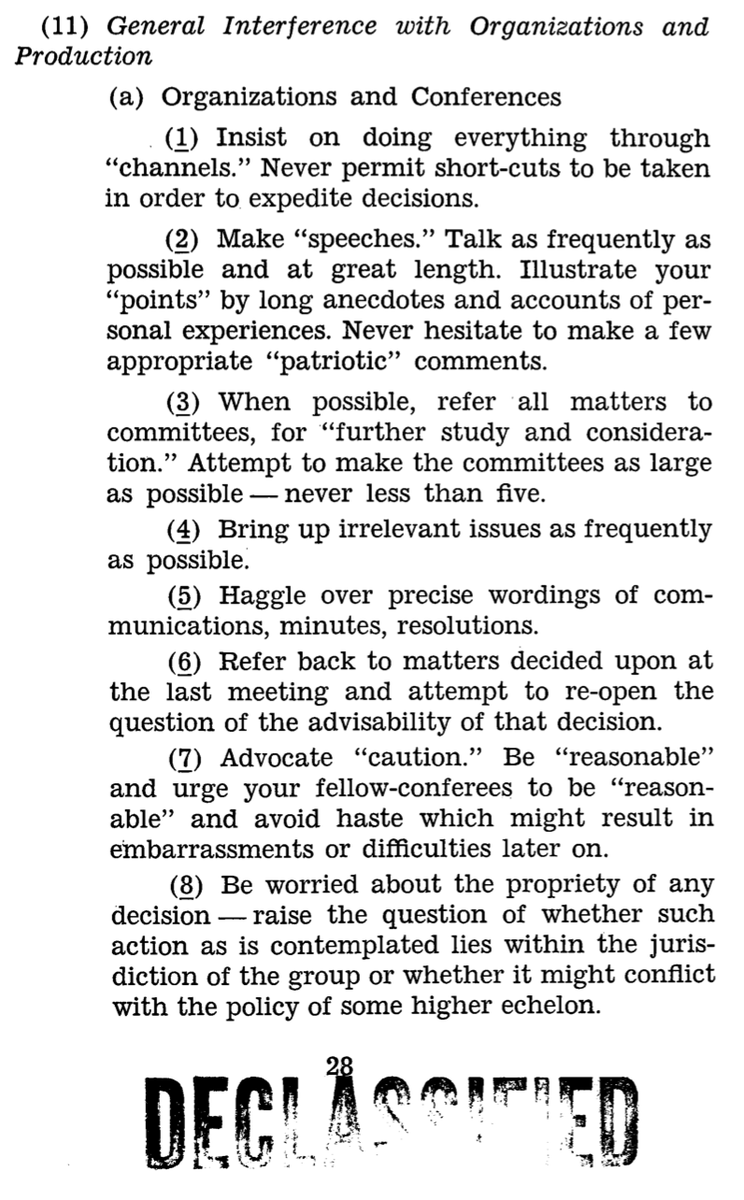
In 1944, the Office of Strategic Services, the predecessor of the CIA, produced a (real) guide to “simple sabotage” that spies and ordinary citizens could use to hurt the Axis powers. It’s remarkable to read given some of the Woke things happening within companies today…

The full declassified guide is here (https://www.gutenberg.org/files/26184/page-images/26184-images.pdf). The first 30 pages are devoted to physical sabotage, but page 32 is where the “wait this is really happening in 2021” starts.

If you’re building a startup, read this — don’t let this happen at your company 🙂

SPACs in 2021

Originally posted as a Twitter thread on February 14, 2021


Why are there so many SPACs?

Answer 1: Great economics for sponsor (average of 20% of money raised upon deSPAC / merging with a target, Eg $400M SPAC = $80M). It’s like a separate carried interest pool for each company and liquid since already public!

Answer 2: Great economics for investors assuming 0% interest rates (get 100% of your money back if you don’t like the deal! Get warrants just in case you do!). There is no reason NOT to invest in every SPAC at IPO if your alternative is a Bank of America checking account.

Answer 3: TINA (There Is No Alternative), especially given investor inability to access private companies.

However, it’s clear there are way more SPACs than targets (b/c answer #1 in particular). In which case the beneficiary will be…investment bankers who raise the SPACs 🙂

How IPOs Work

Originally posted as a Twitter thread on August 28, 2020


There’s been a lot of misinformation about IPOs — particularly around the narrative of “intentional underpricing” and subsequent IPO pops / “money left on the table.” IPOs aren’t perfect, but the problem isn’t the pop — a sideshow caused by quirky supply/demand imbalances.

The things to fix are aggregating the most demand, blurring the lines between private and public for a seamless transition to being public, and more thoughtful lockup releases, while also ensuring that a company is sufficiently well capitalized.

Many are celebrating SPACs and Direct Listings, which both have their place as valuable tools, as the “death” of the IPO *because* of a misunderstanding of what causes a pop. A price without a quantity is not a price: block sales happen at a discount, M&A at a premium.

But today, an IPO remains the best way to raise a large block of primary capital. It *should* improve, but the way to measure improvement is not pop against low float, but on aggregation of the most demand (*all* investors) in a way that sufficiently capitalizes the company.

There’s a lot more data and examples to back this up in this piece which @skupor and I put together. It’s long but hopefully shows exactly the dynamics and game theory in play around how a company goes public and what’s in a price:
https://a16z.com/2020/08/28/in-defense-of-the-ipo/

WFH Productivity: Temporary or Permanent?

Originally posted as a Twitter thread on May 21, 2020


Two ways of thinking about WFH productivity:

”It’s temporary”: there is NOTHING else to do, people stuck in homes, kids cannot be shipped off to school or daycare, therefore MORE work gets done + people always accessible…but upon opening, people will start playing hooky

“It’s permanent”: the tools for WFH are great (think Slack/Zoom), meeting length gets collapsed to the core substance (1 hr -> 30 mins etc), less travel/commute, accountability via more trackability…

For small companies, “it’s permanent” could have a seismic change on their financials given real estate costs as a % of revenues. But IMHO jury still out on productivity gains/losses given unique nature of this forcible SAH (stay at home!), not just WFH, experiment

And clarifying the first point, parents whose kids are stuck at home cannot go to the beach / play hooky because they need to watch the kids 🙂 Versus normal times when they could.

Net Promoter Scores and Sampling Bias

Originally posted as a Twitter thread on November 06, 2019


Net Promoter Score (NPS) is, when used properly, a great metric for many businesses. But many startups are trying to tout high scores, not *accurate scores* which is both dangerous and intellectually dishonest.

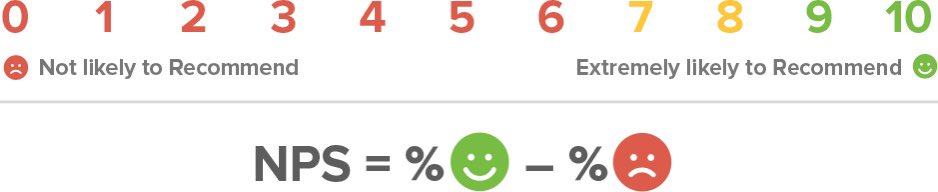
The classic question is “On a scale of 0 to 10, how likely are you to recommend this company’s product or service to a friend or a colleague?” — so if you have no organic traffic but a high NPS, something doesn’t jive / one of those measurements is wrong

Many companies only (whether by accident or on purpose!) survey their satisfied customers, those who made it through a giant funnel…a form of denominator dishonesty that makes it seem like things are rosy when they are not.

10% NPS might sound terrible, but it could mean you surveyed 10 customers and got nine 8s and one 10. NPS *should* be both a leading and lagging indicator of retention and organic growth, but it loses all meaning when it’s gamed to look rosy. Survey everyone! Face the data!

“Silicon Valley Does X”

Originally posted as a Twitter thread on January 08, 2019


“Silicon Valley Does X” — what does it mean? It *DOES NOT* (or should not) mean “same thing HQ’d in high cost of living SF.” It means a true first principles approach to re-inventing a stagnant industry, process, and way of thinking.

The philosophical burden of proof is often described as “he/she who brings the claim supplies the proof” (or this, by Carl Sagan: “extraordinary claims require extraordinary evidence.”) This is *very* relevant for “Silicon Valley Does X.”

There is often little evidence for *current* positions (outside of precedent) and consequently “Silicon Valley Does X” is pilloried for bothering to re-examine and re-think orthodoxy.

Any industry trusting random humans to make uniformly optimal decisions with little or no feedback loop — now THAT is an extraordinary claim, requiring extraordinary evidence! So industries like real estate, medicine, investing, lending, etc

Real estate: “this agent knows the best stager and it will make your house sell for more” …proof?

Medicine: “don’t screen for X, too many false positives” (best way to solve that is to…collect more data! look at longitudinal changes!)

Education: “you can’t learn from a computer screen / credentials are everything”…really?

“Silicon Valley Does X” is about challenging assumptions, and often exposing that those assumptions are themselves not evidence based. And guess what? Sometimes the orthodoxy is right…

…but we should be grateful that there are entrepreneurs willing to risk failure and challenge it.

B2B2C

Originally posted as a Twitter thread on May 18, 2018


The reason B2B2C models are so interesting: when we look at fintech investments, the questions of “how do you get distribution” and “how do you make sure somebody else doesn’t outbid you” are paramount. If you can nail a B2B2C model, you lock down both:
https://a16z.com/2018/05/17/b2b2c-business-models-rampell/

I like to joke that the best way of investing in fintech is to buy Google stock and Facebook stock (or even CreditKarma private stock!) — that’s where all these companies go to acquire customers

It’s because it’s REALLY hard to have an organically adopted product in financial services. Do you rave about your once-every-10-years mortgage? Will your raving be remembered by the friend who needs it in 5 years?

Some companies have solved this (eg @TransferWise). But for others, you need a quasi-proprietary distribution model to prevent all the economic rent from flowing to a FB or GOOG. And B2B2C is uniquely well suited to fintech since it’s often a horizontal layer (see post)

Don’t Just Sell to the CEO!

Originally posted as a Twitter thread on January 13, 2018


There are a broad range of products/services that you CANNOT sell to the CEO or senior exec of a company — too irrelevant to them. You either need to figure out how to position your service against EXISTING top priority to CEO, or you are better off selling “lower” in org

But sell too low, and at a company where the principal-agent problem is at its peak (employees are agents, corporation is the principal), and “saving the company money” or “making the company money” are totally irrelevant.

So for most products and services, you need to find somebody in the “middle” and figure out how to make the agent, not just the ethereal principal, win.

Some of the most valuable companies operate in the “zone of irrelevance” because there is no impetus to switch them out (think: payroll, janitorial services, etc) and costs are not SO high, so not as much margin/competitive pressure

In many cases you need to wait for a fundamental shift to challenge one of these companies, or get very, very creative (and very determined) selling into “the middle.” But it’s ironically much stickier to be in the “zone of irrelevance, yet necessary” for clients