Category Archives: Strategy

Payment Network Effects and Incentives

Originally posted as a Twitter thread on September 27, 2021


There have been many attempts to topple payment network effects by paying users to switch. This almost never works, because (a) more people are motivated by convenience than small amounts of money, and (b) those motivated by money will suck up all the promotional budget ASAP

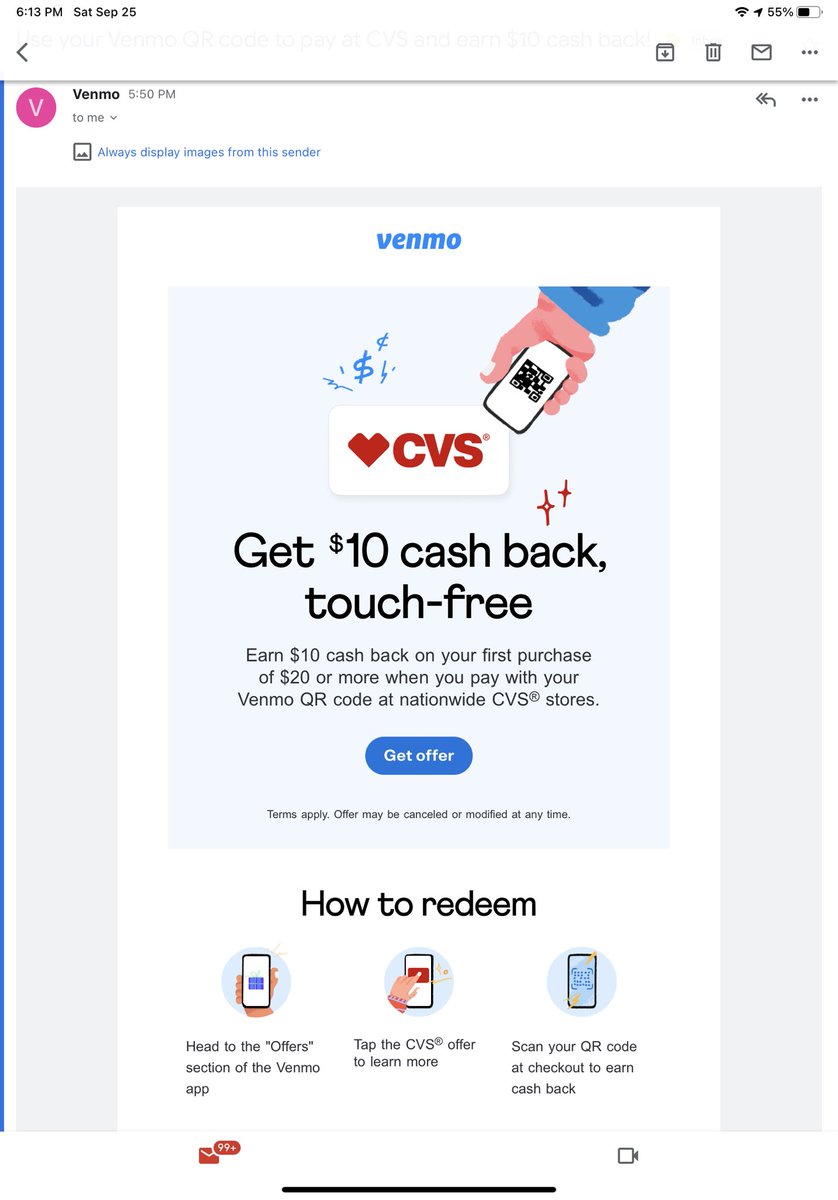
Good case study today is here, with Venmo, straight to my inbox. $10 of $20 at CVS! CVS doesn’t have 50% gross margins, so Venmo is almost certainly paying. But will “normal” people use this? Will it change behavior in a lasting way?

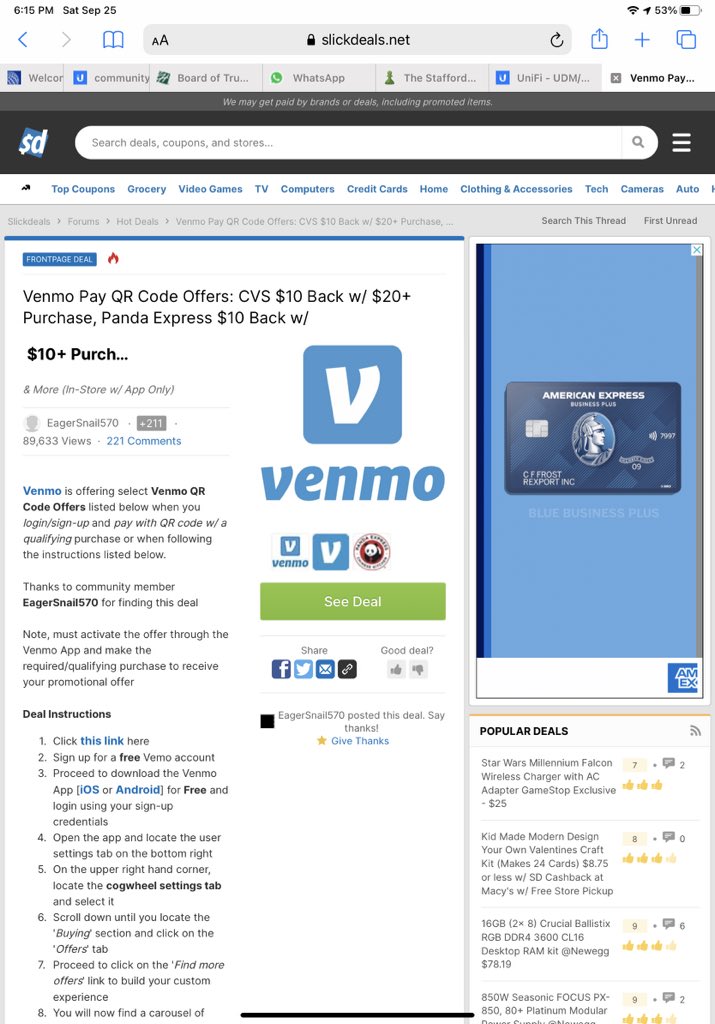
Whenever a promotion like this happens, the “deal hunters” of the internet rejoice! You can even buy a $20 CVS gift card for $10 + sell it on eBay for $15! See here, on Slickdeals…the promotion is capped (100M people can’t use it, that would be $1B!) and gets quickly depleted

PayPal did this with HomeDepot in 2012, in an attempt to jumpstart their offline business. https://www.wsj.com/articles/SB10001424052970203513604577145140658342670

Promotions aplenty (50% off etc), but it didn’t work…at least not in changing behavior. People (the deal seeking people!) pillaged the promotions and moved on.

A good rule of thumb: a new technology will take off “automatically” if it’s 10x better and 1/10th the cost. Payments offline just work, hard to make them 10x better (vs online, where many opportunities since people don’t memorize their credentials…lots of abandoned carts)

So then there’s cost, where you generate merchant excitement with anything that’s 1/10th the cost, but then fail to persuade consumers to adopt it since they lose their rewards. I often describe interchange as a problem of concentrated benefit (banks/V/MA) and diffuse costs…

Saving 2% on your $5 purchase is simply not compelling enough to sign up for a new payment instrument, or switch payment instruments, even though repeated enough times it’s real money. And the merchant might simply try to keep the savings, versus pass on to consumers.

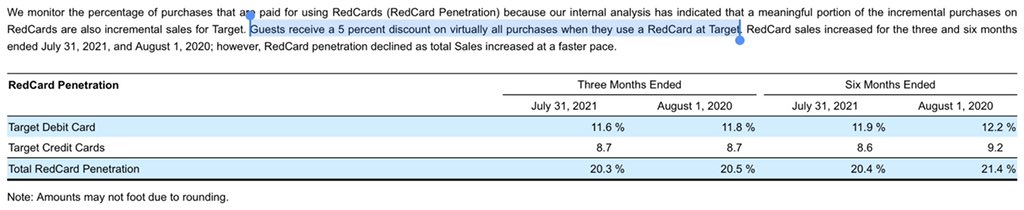
Look at Target. ~$25B in sales, if this were all credit @ ~2% (it’s not) that would be $500M in fees, or a 20% bump to operating income if they eliminated it. Target has something called their RedCard, which now accounts for >20% of sales by…providing 5% (!!) discounts

So Target *did* switch 20% of people over, which is impressive — but would those people stick if the 5% rebate went away? Maybe…but probably not? (NB: Target made $172M last quarter in a profit sharing agreement with TD for the Target Credit Card)

It *is* valuable to become (and pay for) the default payment in a new wallet with repeat usage that’s “set it and forget it.” Uber, Starbucks, United, Amazon…all have “wallets” with stored value, and credentials, that could theoretically be used elsewhere (e.g., AmazonPay).

The reason I find BNPL interesting is, as I stated here, the ability to produce a parallel network that yields more sales and customer utilization “organically”:

https://x.com/arampell/status/1435692945387048964?s=21 https://x.com/arampell/status/1435692945387048964

Changing behavior is tough, and providing discounts and offers generally doesn’t generate the lasting behavior change companies want. Google learned this lesson with Google Checkout, Visa with Visa Checkout, MasterCard with MasterPass, etc.

13/ So the opportunities and questions are: can you *in a lasting way* appeal to convenience vs cost? If so, a one-time incentive *might* be just fine. Otherwise — it’s probably wasted ammunition against the impenetrable fortress of interchange.

Why BNPL is an Early Threat to all of Payments

Originally posted as a Twitter thread on September 08, 2021


Why is “Buy Now, Pay Later” (BNPL) an early threat to trillions of dollars of market cap – Visa (almost $500B), MasterCard ($350B), card issuing banks, acquiring banks/services (Fiserv, FIS, Global Payments, etc)?

2/ Behind every card transaction there are FIVE parties: consumer -> issuing bank -> network (V/MA) -> acquiring bank -> merchant. The middle three get zero data on what items (“SKUs”) are being bought. Short video I made here:

BNPL makes no sense for, say, a $5 transaction at Walgreens. But do you want to get a 2 meter long paper receipt which you need to return that $5 item? Because of the architecture, there’s no way for the issuer to receive that AND the merchant doesn’t want to give it to them

Because the issuer, network, and merchant acquirer do not see SKU-level detail, financing is just “cash advance” and “everything else”
What if a merchant wants to lower the rate for SOME items? (Sell more!) What if a *manufacturer* wants to lower it across merchants? No can do

This what makes BNPL so interesting. It’s a **parallel** network, with SKU level information, that bypasses the issuing bank, card network, and merchant acquirer. It’s just the consumer, the merchant, AND (this is exciting!) a new participant: the product manufacturer!

Let’s say Samsung wants to create an installment payment plan for their new $1000 phone (b/c lower pricing sells more stuff!). How do they do this at, say, Walmart and Target and Amazon? When everyone has a different kind of credit card and those issuers don’t see SKUs? BNPL!

Right now this parallel network is being used for installments / customized financing – the clear product-market need and the hole the “one size fits all because of no SKU-data and five parties” created. But adding SKU-level info and manufacturers is a HUGE unlock for more

There have been many attempts to build a competing payment network (eg MCX: https://en.wikipedia.org/wiki/Merchant_Customer_Exchange) but they failed to address a consumer need. BNPL has both consumer demand and merchant demand, albeit for a subset of transactions

Over time, there’s no reason why any transaction – even the $5 Walgreens one – cannot be run over the BNPL rails, which are signing up merchants and consumers at an aggressive clip. Rather than a financing carrot, it might be a discount carrot, a warranty carrot, etc

Walmart et al created MCX because they hate (understandably so!) paying ~2% interchange fees. But those fees are protected by a very very powerful network effect. Walmart tried playing chicken in Canada — cutting off Visa cards in 2016 — and lost:

https://www.cnbc.com/2016/06/13/walmart-canada-to-stop-accepting-visa-says-fees-too-high.html

So you really need a *ubiquitous parallel network* with *consumer benefit* in order to go cold turkey against the current oligopoly and not lose sales. BNPL is just that. Merchants already use it, consumers already use it, and SKU data passes freely.

As the mobile phone increasingly becomes the consumer wallet, and as merchant payment terminals become smarter, you can also imagine a world where payments (and loans) automatically shift to the lowest cost/highest benefit provider…more here:

Open-loop payments (the V/MA system) are one of the greatest network effects of all time, and have created and *captured* tons of value. The moat is immense. But BNPL and mobile wallets are creating the first market-based (not regulation-based) cracks in the fortress.
FIN

Bureaucracy, Wokeness, and Sabotage

Originally posted as a Twitter thread on July 29, 2021


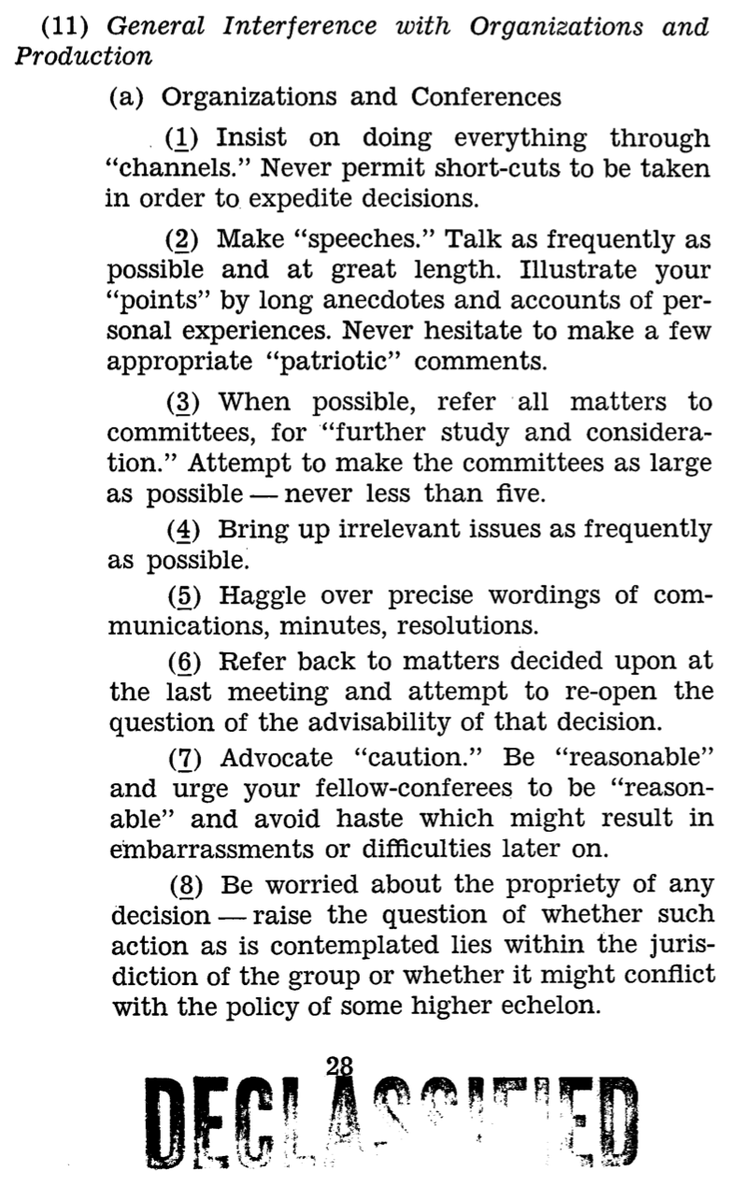
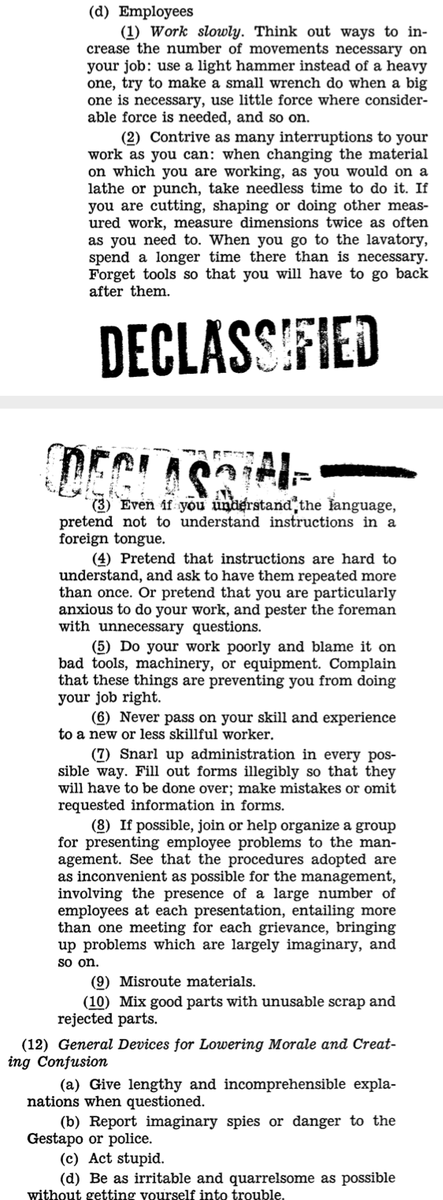
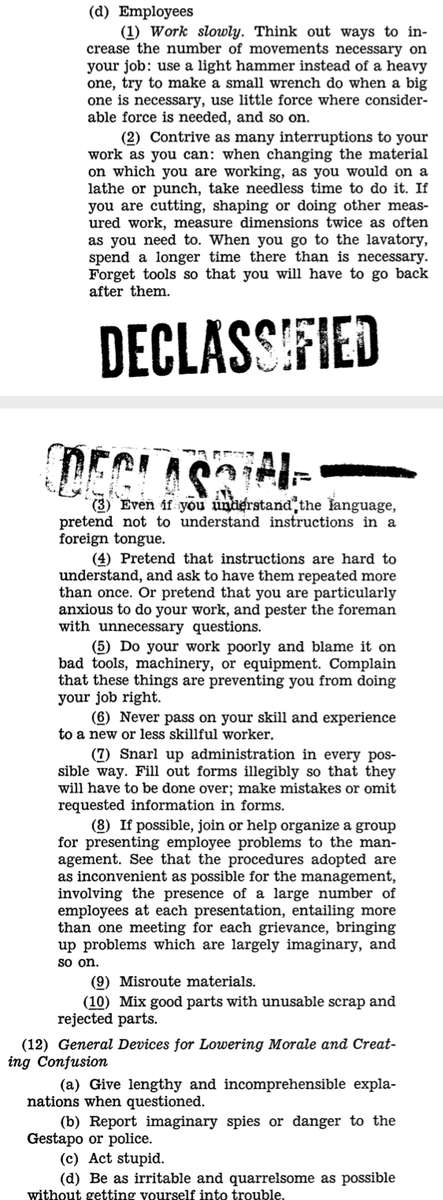
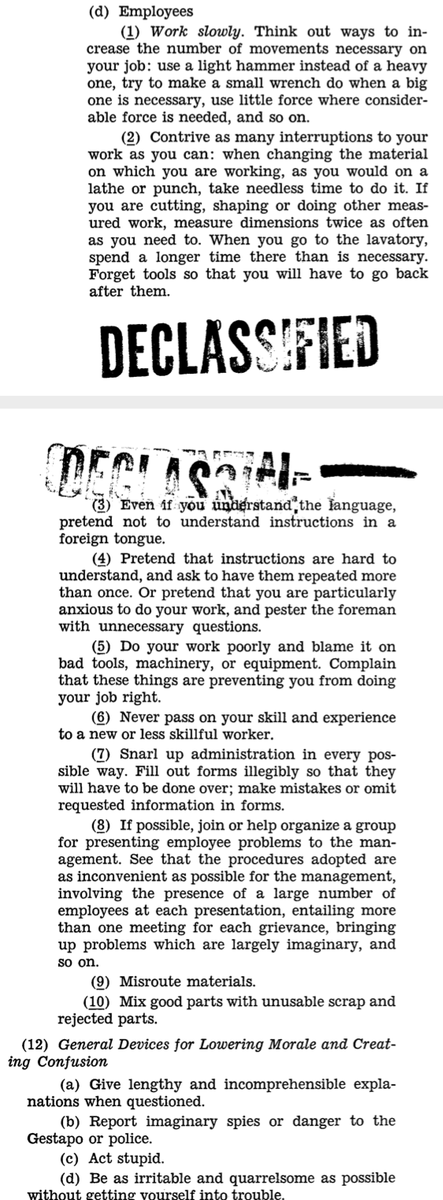
In 1944, the Office of Strategic Services, the predecessor of the CIA, produced a (real) guide to “simple sabotage” that spies and ordinary citizens could use to hurt the Axis powers. It’s remarkable to read given some of the Woke things happening within companies today…

The full declassified guide is here (https://www.gutenberg.org/files/26184/page-images/26184-images.pdf). The first 30 pages are devoted to physical sabotage, but page 32 is where the “wait this is really happening in 2021” starts.

If you’re building a startup, read this — don’t let this happen at your company 🙂

“Silicon Valley Does X”

Originally posted as a Twitter thread on January 08, 2019


“Silicon Valley Does X” — what does it mean? It *DOES NOT* (or should not) mean “same thing HQ’d in high cost of living SF.” It means a true first principles approach to re-inventing a stagnant industry, process, and way of thinking.

The philosophical burden of proof is often described as “he/she who brings the claim supplies the proof” (or this, by Carl Sagan: “extraordinary claims require extraordinary evidence.”) This is *very* relevant for “Silicon Valley Does X.”

There is often little evidence for *current* positions (outside of precedent) and consequently “Silicon Valley Does X” is pilloried for bothering to re-examine and re-think orthodoxy.

Any industry trusting random humans to make uniformly optimal decisions with little or no feedback loop — now THAT is an extraordinary claim, requiring extraordinary evidence! So industries like real estate, medicine, investing, lending, etc

Real estate: “this agent knows the best stager and it will make your house sell for more” …proof?

Medicine: “don’t screen for X, too many false positives” (best way to solve that is to…collect more data! look at longitudinal changes!)

Education: “you can’t learn from a computer screen / credentials are everything”…really?

“Silicon Valley Does X” is about challenging assumptions, and often exposing that those assumptions are themselves not evidence based. And guess what? Sometimes the orthodoxy is right…

…but we should be grateful that there are entrepreneurs willing to risk failure and challenge it.

Don’t Just Sell to the CEO!

Originally posted as a Twitter thread on January 13, 2018


There are a broad range of products/services that you CANNOT sell to the CEO or senior exec of a company — too irrelevant to them. You either need to figure out how to position your service against EXISTING top priority to CEO, or you are better off selling “lower” in org

But sell too low, and at a company where the principal-agent problem is at its peak (employees are agents, corporation is the principal), and “saving the company money” or “making the company money” are totally irrelevant.

So for most products and services, you need to find somebody in the “middle” and figure out how to make the agent, not just the ethereal principal, win.

Some of the most valuable companies operate in the “zone of irrelevance” because there is no impetus to switch them out (think: payroll, janitorial services, etc) and costs are not SO high, so not as much margin/competitive pressure

In many cases you need to wait for a fundamental shift to challenge one of these companies, or get very, very creative (and very determined) selling into “the middle.” But it’s ironically much stickier to be in the “zone of irrelevance, yet necessary” for clients

Distribution v Innovation

The battle between every startup and incumbent comes down to whether the startup gets distribution before the incumbent gets innovation.

The TiVo Problem

In 1999, ReplayTV and TiVo invented the Digital Video Recorder (DVR). It was an incredible innovation — allowing you to “pause” live television.

But TiVo had no value without “content” to pause. That content, by and large, was distributed via cable and satellite TV networks.

And because TiVo was separate from your cable box, using it was far from simple. If you wanted your TiVo to “know” what shows were on (and consequently record them), you’d have to have it connect (via modem/phone line — remember, TVs were not placed near phone jacks) to a TiVo server to download them.

Clearly TiVo had an enormous channel opportunity. What if Comcast, Adelphia, Cox, and other large cable companies simply distributed TiVo to their customers? Wouldn’t that be a home run for TiVo and the cable companies — a new service that would delight customers with a massive new revenue stream to boot? And, integrated with the cable box, the TiVo product itself would get better, too.

But — and this is what I call the TiVo problem — that doesn’t normally work out well, and if you look at your cable box today (with a generic DVR function, I would bet, built-in), you know how this story ends.

If you’re TiVo trying to cut a deal with a Comcast, one of the below normally happens:

  1. You partner with Comcast, but Comcast dominates the economics of the deal, in some cases restricting your cooperation with its competitors. (rare to partner)
  2. You sell your whole company to Comcast, but you’re not selling a company, you’re selling an awesome product…and somebody else might have an awesomer product (or a worse one that is deemed better by the technology team at Comcast). Moreover, if you already have commercial deals with Comcast, Adelphia, Cox, et al…, Comcast won’t value your ex-Comcast revenue (because it will disappear upon acquisition by Comcast!), dramatically reducing your independent valuation. (rare to sell)
  3. You get screwed by Comcast. Comcast builds a crappy version of your product, but because they have the distribution, they can and will beat you. (common)

TiVo did not fail, but it became a patent troll of sorts. It has a market cap of less than $1B today, despite having collected more than $1.6B in patent settlement funds from the “Comcasts” of the world.

The Winning Strategy: Go Boring

Given that the common outcome to the “TiVo problem” is getting clobbered by Comcast, how do you deal with this situation?

The answer is often to “go boring and be patient. This was a big mistake I made at TrialPay, which put relevant offers around the payment flow. We built a great product/service/business on top of payments, but it wasn’t core — merchants didn’t start off looking for or needing our product. They started off looking for what I thought was boring, cheap, commoditized payment processing. Going back to the analogy: Consumers want/need Comcast more than they want/need TiVo. Or at the very least, the chronology starts off with Comcast.

In 2006, I thought “Why build a ‘boring’ commodity payment business like Stripe or Square (that did not yet exist), when we could build the lucrative feature missing from all the commoditized payment processors?” We had insanely better unit economics than they did.

But these payment processors had the customer relationships, and they had the starting product that the customer wanted. Eventually we sold TrialPay to Visa, and I think a lot of value will be created for Visa from that deal, but not nearly as much for TrialPay shareholders had we owned the channel.

This is the flaw with looking at Square and Stripe and calling them commodity players. They have the distribution. They have the engineering talent. They can build their own TiVo. It doesn’t mean they will, but their success hinges on their own product and engineering prowess, not on an improbable deal with an oligopoly or utility.

Being Judged on the Present

There are two ways somebody can interpret this video.

-“I’m much better than that kid at golf! [says a 33 year old]. I have a 12 handicap and can outdrive that joker by 200 yards!”

-“Wow, that’s remarkable for somebody of that age…if he continues like that, he could someday win 14 Majors.”

Both assessments are logically correct. But as a young company selling into enterprises, you will often get the first reaction.

In my experience, a lot of larger corporations (and people who work at them) can generally only see the present — the present capabilities, the present revenue (or trajectory), the present limitations. In startups, you need to see the future. Not as a fortuneteller would (impossible) but to judge teams and ideas on their future potential / adjacencies.

There is a natural lesson here for an entrepreneur — which is to beware showing “leanness” of product when interacting with a large company. Saying “we can/will add that later” unfortunately lacks credibility, because large companies are often incapable of building anything quickly, and hence their employees tend to doubt this statement. “Blockers” in the large organization will try to scrap any deal with a “deficient” startup.

The right way to build a typical startup is “lean.” Overbuilding before product-market fit can be catastrophic; building sophisticated management and operational processes before you need them is normally a vast misallocation of resources and actually prevents learning of what the market wants.

But present your lean startup to a large company and you’ll hear “where’s the beef?” When selling a product to a large company, or even selling your OWN company to a large company, you’ll be thoroughly evaluated on the present — which sometimes is good in, say, M&A when you are on an unsustainably high growth rate. The hard part of a company is generally making the whole thing work; it’s not the sophistication of a set of algorithms, but having the whole product perform at scale with an organization that can support it.

I saw this firsthand at TrialPay, which was, at its simplest level, an advertising technology company. An early potential deal with a large company did not materialize because said company was displeased with our optimization systems, even though we could add a better optimization algorithm in a few days (GitHub shows 329 collaborative filtering projects). But we were judged on the present, and if we had the opportunity to do it over, I would have actually invested those few days to look “fatter” — even if it had no impact on our business.

The Danger and Opportunity of the Intermediate Metric

Are social media companies overvalued? The question is not just a matter of revenue multiples (low or high), but rather whether that revenue is actually generating new sales for advertisers. Google convinced the world to believe in the click, Facebook has done the same with the Like, Twitter with the follower, and Pinterest is planning on unveiling the same with the Pin. Creating these “intermediate” metrics between impression and ultimate purchase is a great move to boost revenue, but must stand up to scrutiny as software eats the marketing funnel. For startups seeking to build a valuable advertising business, creating an intermediate metric is crucial, but so is ensuring that that metric holds up to scrutiny.

Let’s rewind a bit, though. Without commerce, without transactions, there would be no advertising. The point of an advertisement is to generate sales. Full stop. Brand building, goodwill, mindshare, buzz, and a lot of other niceties might come about, but even those are meant to eventually lift sales. Without a transaction at the end of the line, advertising has no raison d’être.

The challenge, though, is that it’s often difficult to draw a straight line between “person sees an advertisement” and “person buys a product.” Impression and transaction are the two endpoints of the advertising-commerce lifecycle.

And, the chronological delta between impression and purchase can be wide. A 15-year-old might be bombarded with BMW advertisements for 10 years before she finally pulls the trigger on a fancy, brand-driven car purchase. Deciding to buy Advil vs. Tylenol might take years of external inputs and supermarket trips.

Enter the intermediate metric, which is anything that falls on the continuum from impression to purchase: clicks (the Internet’s first intermediate metric), likes, bookmarks, views, shares, app downloads, recall, followers, retweets, mentions, pins, etc. Intermediate metrics help publishers (e.g., Google, Facebook, Twitter, Yelp, Pinterest, etc.) attempt to show their impact when sales are not readily measurable — either because of chronological disconnect or because the transaction data is not readily accessible. Or, cynically, and in some instances, because there are no downstream sales — making the intermediate metric the best way to obfuscate while purportedly showing performance.

intermediate metric

Intermediate metrics help advertisers show internal and external stakeholders that they’re doing a great job. It’s hard for Clorox’s marketing team to be given an instruction of “sell 20 percent more bleach this quarter and you get a big quarterly bonus!” A national “must wear white to participate” tomato fight might increase sales of Bleach without Clorox lifting a finger. So many advertisers will compensate and reward their teams for the achievement of intermediate metrics.

  • “Your goal for the quarter is to get 10 million Facebook Likes, and to get a 15 percent increase engagement on Twitter.” (This must increase sales, right?)
  • “Twenty percent of your bonus this quarter will be based on getting 100,000 mobile app downloads.” (Mobile is hot and people are using mobile phones everywhere, so it must drive revenue!)

The greatest intermediate metrics allow for the broadest attribution tracking possible (accounting for marginal intent generation), while being somewhat unique to the medium. At scale, Quora might charge for a promoted corporate answer; Gmail might charge for a bolded email; Waze might charge for a “route added.” These would all be intermediate metrics, knowing that none of these actions yield an immediate purchase but hopefully contribute to one. Without an intermediate metric, there would be a publisher-advertiser marketplace failure, since immediate “transaction” tracking would undercount efficacy and cause metrics-driven advertisers to abandon the platform.

The greatest intermediate metrics allow for the broadest attribution tracking possible while being somewhat unique to the medium.

The smartest thing that Google did was charge for the click, not the sale, because it isn’t Google’s fault if your site converts poorly (or if a sale/action is not relevant, as it is for, say, auto research).

The smartest thing that Facebook did was define the like not just as an intermediate metric, but as a quantum of self-worth. Watching Samsung hit 20 million Likes must have made HTC mighty jealous and want to respond accordingly. When I asked a large restaurant chain where they spend most of their money online, the president said “Facebook. We get a lot of likes, and that must be better than not a lot of Likes.” A click — Google’s classic intermediate metric — isn’t too relevant for a restaurant that doesn’t deliver or allow online transactions. Facebook has a potentially broader audience, yet less transactional intent — so ultimately those likes will need to turn into revenue.

As Twitter goes public, it probably needs a stronger intermediate metric that can resonate with the long tail of advertisers. It might not make sense for regular people to “follow” an advertiser like Oreo in the same way they might follow their favorite moviestar, thus making followers a poor metric; in fact, The Bronx Zoo’s Cobra (an actual snake) has more followers than Oreo. The famous Oreo Superbowl tweet was retweeted only 16,000 times. The most retweeted brand advertisement on Twitter (from Nokia) has yet to top 50,000 retweets. Yet perhaps Oreo was seen by millions of people on Twitter, yielding a spike in supermarket sales, and thus followers and retweets — the intermediate metrics with which pundits seem to be measuring Twitter, are the wrong intermediate metrics.

The danger of intermediate metrics is that they feel quantitative — these are numbers, people! — but they might actually be meaningless. Ironically, both parties, advertisers and publishers, often have a vested interest in separating them from sales — for the short term — lest the music stop. Separation allows for “quantifiable metrics” when sales are just too hard to perfectly measure, so advertisers can keep spending and publishers can keep charging.

If a company’s revenue is based on selling questionable intermediate metrics, be cautious — no matter how quickly that revenue is growing. Sometimes metrics are purely about internal vanity and do not last. As an example, “number of app downloads” feels like a key performance indicator, whereas for many companies (Supercuts has an app?!), “apps” make little sense as a paradigm. Depending on how this intermediate metric (app downloads) stands up against actual incremental sales, the whole app download market could suffer. The same goes for many other intermediate metrics. When advertisers start thinking of the intermediate metric as the final action (the R in ROI = achievement of intermediate metric), the market is inflated.

For any company — whether buying traffic or selling it — intermediate metrics are often a crucial strategy in building a broad revenue model and in having a metrics-driven approach to customer acquisition and retention. But it is unwise to divorce the intermediate metric from the final, and crucial, metric of the transaction — to ignore it, or to exaggerate it, is penny wise and pound foolish. Plenty of startups and established industries (television advertising!) will be obliterated when data finally lights the path from impression to transaction and, in some cases, reveals it to be seldom traveled.