Category Archives: VC

How to Invest in People

 Seed bets are largely people bets, and the way I think about them is a set of simple (but hard to know!) assessments of the entrepreneurs — can they materialize labor and capital, are they going to get to traction on the seed (vs what I call a “slow boil” company), and how prolific/encyclopedic are they in terms of understanding the history and present of the product they are building:

-Materialize Labor: “Who are your first 5 hires?” I always try to ask this question. The best answers are where the person literally has five people ready to jump off their existing ship(s) and join and those people are great…it shows that they are a magnetic attractor of talent. But even without that, do they know whom to hire? Fastest ramp is where the 5+ are already ready to jump and those 5 are themselves great.

-Materialize Capital: another description for “heat” but with more of a future lens — how good of a presenter are they? How do I handicap their future fundraising? (“best sign of future financing = current financing” rule still applies). The no-brainer for investment n is investment n+1 from top firm is in the bag 🙂 It’s one advantage to backing “seniors” in the SV sense.

-Is this a “fast boil” company or a “slow boil” company? In other words, is there a good chance — based both on the entrepreneur, TBH team, and idea/product, that they can get to discernible traction early? This is more of a “next fundraising round” output per unit of time measure, because the hard seeds are the ones where they’ve achieved zero discernible (outside) progress on the capital…which some ideas (and fundraise amounts) are more prone to, but of course this is outdone by “ability to materialize capital” 🙂

-How “deep” are they in the domain? If their exposure is nascent, did they REALLY take the time to learn the history, present, and have a theory for the future of the space? I know we call this the idea maze, but I consider it more a sign of intellectual rigor plus ability and willingness to challenge their beliefs and take input from all sorts of people. Robinhood founders met with and studied every past brokerage. Collisons found the rarest of rare books on how the Visa network was built from the 50s to the present and I believe even sought out and met with Dee Hock, the (at the time) 80-something founder of Visa who had moved to a farm. Brex founders took the time to meet and learn from every payments wunderkind. I see this pattern again and again — and EARLY — in people I consider exceptional. They are able to network to anyone from nothing (e.g. Brex guys from Brazil, Collisons from Ireland) — although this is arguably a more important trait for something where major platform/BD deals are crucial.

-Do they want to learn/win, or do they want to think they’re right?

Similar to the above, I really look for people who want to spar/duel around the best way to accomplish a solution — they are headstrong, which is great, but also want to learn of alternatives — somewhat the manifestation of “strong ideas, weakly held”

-Marathon, not a sprint — they will not give up

what in their past convinces me that, when they’re going through hell, that they’ll keep going? Have they faced adversity? What kind and how? Even if silver-spoon-fed, what motivates them and what have they done that requires incredible tenacity?

-Hire fast, fire fast, decision fast — can they make FAST decisions? Are they decisive or indecisive? Are they careful or careless? What is the most caring/selfless thing they’ve done, and the most sociopathic thing they’ve done?

-Image or impact. How much do they seem to care about how others perceive them? Do they want to be liked? Doing the popular thing requires no leadership, doing the unpopular thing requires massive courage AND leadership to get others to follow. Do they want to have everyone like them and assemble a team for adoration, or to win at all costs?

-Motivation in starting the company. Revenge / Count of Monte Cristo? A very rich person has the dual risks of starting a rich-person-problem company (e.g., wine, second homes, workouts, etc) — and, more problematically, tiring and giving up…it’s easy to quit and retreat back into a life of comfort. The most powerful motivator I have ever seen is not money, it’s revenge. Proving the motherf@&$ers who fired you, humiliated you, doubted you, took your baby away etc wrong AND capitalizing on an opportunity you know best. Renaud with LendingClub->Upgrade, Bloomberg with Salomon Brothers->Bloomberg, Duffield with PeopleSoft/Oracle->Workday, etc.

-do they have some path to get their first five customers? Who wants to run their business on enterprise software written by a company with 9 months of cash? 

anyway, probably a lot to learn here from everyone, so just sharing! Despite the fact that traction is scientific and “entrepreneur assessment” is not, I actually would like to believe that the opposite is true, given that we’re always buying options of future performance which always comes down to the people 🙂

As a reminder, one lens for evaluating entrepreneurs is the Freshman-Sophomore-Junior-Senior one, which translates to (taking the investable case for each!):

-Freshman — almost no “work” experience, potentially completely uncredentialed (autodidact), but brilliant, naive, and where the naïveté is a weapon that allows them to try something that nobody else would attempt (or that others have attempted and failed at, thus dissuading more status-seeking humans)

-Sophomore — highly credentialed, early in career, has followed a more typical “credentialed” path (Harvard/Stanford/Yale/Princeton -> McKinsey/Goldman/Google -> Business School), been at the top of their class/work group.

-Junior — sophomore but now later in career with significant responsibility and management experience, think a VP of Google or Facebook.

-Senior — a successful startup founder (>$100M exit) who is doing it again.

Most venture capital returns have been in the Freshman and Senior buckets. Seniors have the highest “hit” rate provided (per above) they’re doing something in their domain and for the right set of reasons. Freshmen have the most variance — some of the biggest companies (Facebook, Google, Airbnb, Shopify, etc) but arguably the highest failure rate. The issue with sophomore-juniors has historically been inability to violently swerve off a safe path but there are exceptions (e.g., Instagram).

The “Comma MBA” Problem and Local Maxima

The best entrepreneurs constantly “read the room” (or the market) and adjust their presentation style, their mannerisms, their product description, their team, their focus, their advisors — everything. They have the smallest number of axioms (things they accept without questioning). Everything else is subject to questioning, upgrading, and re-synthesis. Particularly since almost invariably they started off at a “local maximum” in terms of talent and advice.

I call this the “comma MBA” problem. One time we had a nice fellow from Canada come pitch us, and on his business card he had his name, followed by “MBA” in the same way a doctor would put “MD.” His slide deck referenced his MBA, his pitch mentioned how everyone is “good at business” because they have business degrees, etc.

There’s nothing wrong with an MBA (well, maybe 😂). But what he thought was a positive was not resonating, and he just…didn’t get that hint. And to show I’m not trying to cast shade at MBAs, one time we had a CEO talk about how amazing his tech team was because of their “.NET” prowess — the technical version of the “comma MBA” problem above.

But let’s take a step back. Imagine that in our MBA friend’s small town, he went to the local business celebrity who seemed very wise, saying “make sure to emphasize the fact that you have an MBA! Otherwise the VCs will not take you seriously!”

Both the good entrepreneur and the bad entrepreneur would seek advice from the same village elder. But the good entrepreneur would quickly learn and adjust from experience — “wow, that guy is wrong — I didn’t get the reaction/feedback I thought I would.”

The bad entrepreneur sticks to the village elder’s advice. The good entrepreneur upgrades his/her advisor when it’s clear that it’s a constraint. We consequently give people the benefit of the doubt when they show up with a metaphorical “comma MBA” mistake; the important thing is ensuring they are always trying to learn and upgrade from their metaphorical village elder and resulting priors. And sometimes the village elder is exceptional, too — but it’s statistically rare.

It’s part of why the founding team is so important. I like to say that there are only two jobs at a startup: selling the thing, and making the thing. That’s it. A very good technical person who knows nothing about sales can be bamboozled by a bad sales guy, and a very good sales guy can be bamboozled by a bad tech person.

Your co-founder ideally serves an “axiomatic” role. If you can’t implicitly trust your co-founder, you’re in trouble. That’s not to say that the co-founder must be the most talented person in the domain! Rather, because the co-founder isn’t angling for a promotion and has no political aspirations, she just wants what’s best for the company and understands how to make the right decisions. (One useful cultural value at a scaling company: “You should always be willing to hire your own boss.”)

You will constantly get bad advice. Your job is to know when to discard the advice, but also when the discard the *people* who are clearly meting out bad advice and not doing what’s best for the company. And ideally you surround yourself with talent where you don’t have to second-guess everything and can instead rely on your team — it’s the best way to scale yourself.

The Pre-Mortem in Product Planning

Original Post: https://x.com/arampell/status/1772734627410571443?s=20

Before you launch a new product, one of the most counterintuitively important things to do is to plan for how to kill or exit the product. FAST.

This isn’t as simple as it sounds…and it’s crucial for companies with multiple products or consulting work.

My company, TrialPay, was the leading company doing “offers” en lieu of payment. I realized we strategically needed to be in the more commodity payment processing space, more background here: http://www.arampell.org/2015/11/04/distribution-v-innovation/

We built this payment business to 9 figures of payment volume, but didn’t have sufficient focus to make it our top priority, and we were nowhere close to being #1 in the space. (Most value accrues to the #1 or MAYBE top 2-3 players).
But our core clients were using it!

This is why a pre-mortem is so important. We used our goodwill and “bundle economics” to cross-sell current customers on what had become a 2nd rate product. If we shut it down, they’d be PISSED and would potentially dump us for our core product!

So what to do? We were honestly stuck. Against the backdrop of massive pressure against our core business, per thread below. We needed to focus on what we were great at.
https://x.com/arampell/status/1562557849128931328?s=20

Our only answer was to find a home / new product for our customers. I called the then CEO of Braintree and basically offered our customers and product for free — he said “what’s the catch?” It’s not every day that a competitor (us) voluntarily capitulates…

But our real competition was FOCUS. It was clear we had lost the battle to be #1 in raw payment processing. Dedicating resources to be a distant #8 was more expensive than getting nothing for this asset.

The next step was to gingerly mention this to our clients without having them ditch us for our core, profitable offers product. This was hard. But we made it work.

Being an entrepreneur means being able to make the best of the hand you are dealt but also knowing when and how to switch tables. And switching tables dispassionately — when you have teams and customers “stuck” to the old table — is hard

This is one of the reasons to be VERY cautious about doing consulting work. Building a custom product for a marquee client sounds great to make ends meet, but you can’t kill it! You’ve just added a liability to your balance sheet. You have to support it…forever!

Theoretically you could kill it, but then good luck selling another product to that company. If you need to do a RIF, and you’ve gotten pre-paid for this software, how do you cut the team supporting this product that represents 0% of your future…?

So always, always think about this hidden “liability” on your business. Before you customize, contract, or test something…have a well thought through plan to KILL your new thing. Bake it into all your processes, contracts, code, culture, etc.

Getting to Five Customers

Originally posted as a Twitter thread on March 06, 2023


When starting a company, can you get to *5 customers*? Who are they? Why will they trust YOU?

As a VC, these are questions I always try to ask (selling B2B). I’ll tell my story of how my company got our first 5, and why 5 seems like a good heuristic of “you’ve got something”

I love the term “productize” — it effectively means turn a “service” or “consulting” project into a repeatable widget. Does a large n of customers need/want the same thing, or *roughly* the same thing with few customizations? Then…it *might* just be productizable

If you get your Uncle or Cousin to use your product, maybe it was a favor…which is a feature (not bug) if it indeed is the SAME product you can sell to a few other strangers. But a lot of times a “few” customers is just a collection of favors and is Fool’s Gold…

Fool’s Gold because it’s just not repeatable and hides brutal market feedback. You can only have so many college roommates, cousins, and uncles. But if you get 5 distinct customers to “agree” on the same set of features, it’s a very good sign and you’re off to the races.

TrialPay started off as something I used for my own freemium software business. “Don’t want to pay $10 for my app? Get it for free if you sign up for Netflix or get a Discover Card or shop at Gap.” It worked great so I decided to turn it into a company…and raise venture $

But a lot of times ideas/companies come in waves — two other companies basically popped up at the same exact time. Identical idea/value prop. Lift Media (@jmurz) and MyOfferPal (later merged/renamed TapJoy). We all pitched the same VCs within weeks in 2006!

I had a key advantage over them in that I still had my software business so could “create” traction — I was my own first customer. Could figure out if things were working. But more importantly, it gave me credibility in “my community” of freemium software developers.

After starting the company, my co-founder @terryangelos and I went to the “Shareware Industry Conference” in Denver…and we signed several customers there, the largest being WinZip. I gave a talk on my results with my own products…so had the credibility and knew this niche

This was so niche that few outside of the industry even knew of this conference…or had the credibility/connections with this somewhat esoteric group of businesses/people. I remember meeting @bradfurber and @allennieman there…at a relatively unknown (but big revs!) company…

But sometimes, particularly when building a “transactional” business (versus “per-seat” where you know # of employees), there are these “diamond in the rough” customers that turn out to be huge. Brad and Allen’s company (Sammsoft) was one of them. Huge client.

My *now* friend @jmurz of Lift Media was super smart, incredibly hard-working, and was building his nearly-identical business…he was my arch-nemesis at the time!!…but we got a big early lead, which later turned into a big fundraising advantage too…

And honestly it was almost entirely because:
A. I had a captive early customer that would do anything I wanted (customer was…me!)
B. I found a bunch of other customers that “looked” like me — no chasm to cross. “I sell $30 Windows software, you sell $30 Windows software”

As we expanded, this was one thing that never ceased to amaze. Companies *across* verticals often have a hard time being the first in their space…getting Skype or Fandango to use us was not really helped by the fact we had WinZip. “Oh, that’s totally different.”

My advice to developing a killer product and go-to-market — and ensuring you don’t end up over-engineering into a void or losing to another competitor — is that you need both a founding team (founders/employees) and a founding *group of customers*

You need some vision, flexibility, and fortitude to make sure YOU are building the product, not your customers — otherwise it’s the Henry Ford “if I asked my customers what they wanted, they would have said a faster horse”

But you also need real market feedback so getting some friendly customers — who are willing to bet on you (kind of crazy to run your business on a money-losing startup!!), ride out some bumps, and give more than an occasional testimonial…is crucial

So sometimes 0->1 is not all that hard (if “1” is your Uncle). Getting 1->5 is actually what’s hard…synthesizing feedback, and building that trust that no 12-months-of-cash-left startup is just “entitled” to. It’s a crucial ingredient to success.

Some ideas on how to do this:
A. Give equity to your early customers or have them invest
B. Have no shame plumbing every connection you can – favors and believers
C. I tend to think the best companies are ones that came out of personal experience / you can be 1st customer

Thanks to @1nternetjack for the idea on this one. And watch this scene from one of the best Simpsons episodes ever, about the perils of *overly* conforming your product to just one customer:

How to Sell Your Company

Original Post here: https://x.com/arampell/status/1610761687547940864

Companies are (almost always) bought, not sold. This means somebody needs to *want to buy* your company. Ideally this happens organically. But how do you, as a founder/CEO, expedite this…particularly when you KNOW you’re hitting a wall?

“Planting an idea”

Inception is one of the greatest movies of all time (watch the clip). The whole premise is about implanting an idea in somebody’s mind…the inception of an idea. “If you’re going to perform inception, you need imagination”

There are probably three types of acquisitions:
A. Acquihire (want team, not business or product)
B. Product/“Trade Sale” (want product or to repurpose product, acquirer has distribution)
C. Business “left-alone” (give existing business more resources to grow faster)

Especially for Acquihires and Product-oriented sales, you need to get to know your prospective “buyers” *far in advance* of “needing” or wanting to sell your company. Two independent variables exist: when they can/want to buy, and when you want to sell…rarely do they align!

Buyers aren’t companies, they’re *people at companies*, and generally people with P&L responsibility. Often somebody climbing the corporate ladder who wants to make a big splash and is anxious to ship something taking way too long internally. Or a new VP who needs a team ASAP.

Almost every large company has a corporate development person/team. Their job is to close deals, not to ideate – once you are “bought” you’re not working for the VP of Corp Dev. You’re working for whatever division and whatever person wanted your product. Focus on GMs/PMs/VPs.

Focusing on product/trade-sales: the key thing is to figure out where 1+1=3, or how your product might fit within the org. At TrialPay we showed ads around transactions — what if PayPal could stick our ads in every purchase receipt? Would generate >$1B…that was our pitch.

The goal is not to approach the company (or person) with “please buy me” — it’s not like a fundraise. That’s massively counterproductive. It’s to propose a BD deal that is just standard operating procedure for your independent company. Which hopefully happens regardless!

You CANNOT PUSH A STRING. This was a lesson I learned very painfully. Do not be aggressive; this isn’t like closing an oversubscribed funding round. Articulate a vision for how your product fits and is a win-win for both, try to get a test/integration/contract in place.

The true “inception” for the more valuable product-oriented acquisitions is “wow, we shouldn’t let this be a BD-deal…we NEED to own this.” *That* is when you can (possibly) sell your company for a lot of money.

Even so — most companies have a culture of “anyone can say no, nobody can say yes” — you need to sell horizontally, deal with people who are threatened (“we can build it ourselves!”), and recognize you’ll be judged “on the present”.

“Being Judged on the Present” is a very big deal (see blog post) — you need to steer things to what your product, or a variant of it, WILL look like. Make a real polished demo. Put real work into it. Your “existing” product or team or tech might be used against you.

This is why “imagination” is so key — your product currently does X, but there are probably 5 giant companies where a few tweaks/changes to it – X’ – could accomplish a major objective for them…how you pitch each might be a little different.

I can’t overstate the fact that relationships matter. You can’t start this process with 3 months of cash. You should be thinking about this even if you plan to conquer the world — get to know key decision makers/GMs at every potential acquirer because…you never know.

And again, my approach wasn’t “I want them to buy me.” It genuinely was “I want this *commercial* deal with this company, because it will be transformative for MY business.” Which was 100% true.

There’s also the reality that sometimes your current “business” scale makes your “product” less appetizing (what does the acquirer do with all the people/processes if they want to repurpose?). This is the hardest part: do you change your business to make it more palatable?

GENERALLY, the answer is NO. Most M&A fails. Again, when you want to sell usually does not align with when they want to buy. But if you really NEED to sell, it’s useful to think through the “anchors” holding you back:
https://x.com/arampell/status/1562557849128931328

“Running a process” to sell a company rarely works if selling team or product, especially when product needs to be repurposed…but if you are already being hotly pursued, then and only then (IMHO) does it make sense to “shop” — “Boy who cried wolf” syndrome is real.

Because again, “when they want to buy” is a real thing — maybe they just bought a giant company and don’t have the budget/fortitude to buy another one. Maybe they whiffed their last quarter’s earnings. Don’t push a string. Hurts your chances when they’re ready to buy.

Sometimes you can help expedite, though: once you already have the relationships, and ideally some product integration in place, you can, say, start a fundraise and ask if they’d like to invest (might make acquisition more expensive down the road, maybe they should buy now!)

In the absence of competition, though, it’s very hard to speed up an in-flight M&A conversation/process. And it WILL suck up most of your time and energy…and distract every member of the team working on it. Limit the circle of knowledge on this — it’s crucial.

“Raise money when you don’t need it” is the normal advice for fundraising. For M&A, I would strongly encourage everyone: “Build relationships and think about this…when you don’t need to sell.” Because one day…you might want to or need to.

And again, this doesn’t mean CEOs should spend most of their time on this. I think ideally it’s 5-10% just focused on capital raising/relationships (inclusive of prospective M&A) as a background process.

Lastly, if you want a good price — much less likely when your growth has stalled. The best (luckiest?) deals I’ve seen done are when the CEO (recognizing an upcoming speedbump) basically “expedites” interest…and when the “wants to sell” and “wants to buy” variables meet 🙂

Private-to-Private M&A

Originally posted as a Twitter thread on October 17, 2022


How we almost merged our company TrialPay, many times, while navigating the “can’t raise cash without growth, can’t grow without raising cash” problem. The embedded thread shows the surviving path, but let me walk you through several that *didn’t* work https://x.com/arampell/status/1562557849128931328

It’s not uncommon during bull markets to have too many competitors on the field for a given space. A “roll-up” can theoretically create more pricing power while eliminating redundant teams, tech platforms, etc…increasing revenue while lowering OpEx! “Synergies” galore 🏦💵

And even without an “over-competed” space, you might have one company with LOTS of cash, and another with lots of product-market fit but unable to raise…so one way to “raise money” is effectively to just merge with a cash-rich competitor. If cash is king, merge with cash!

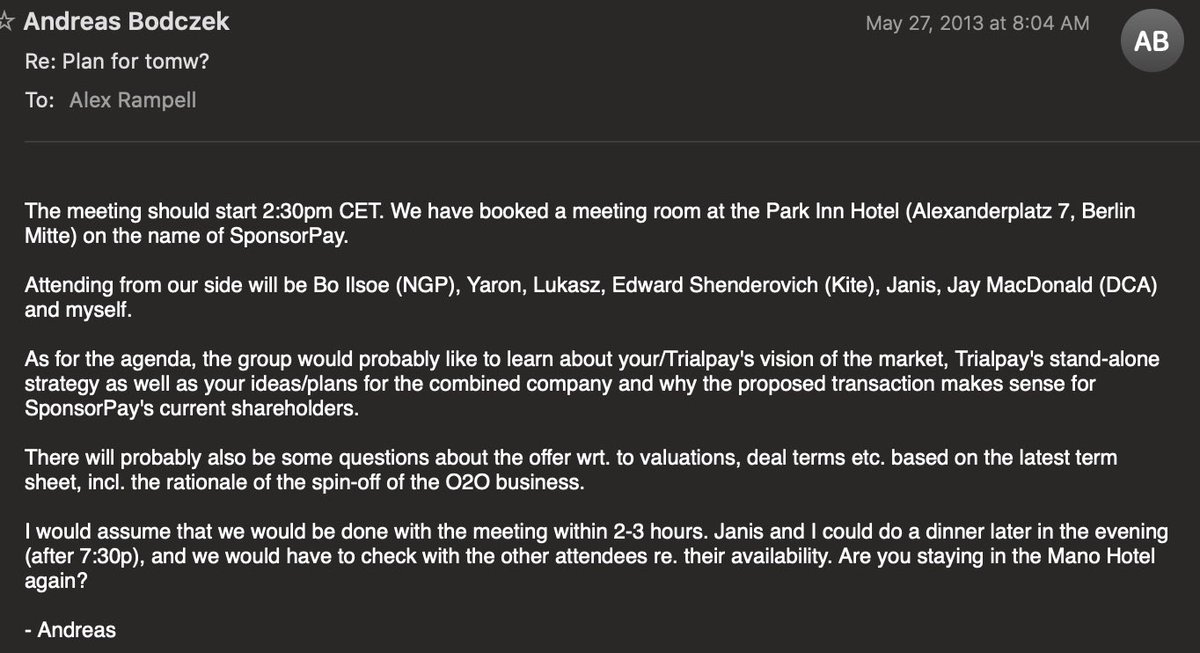
Let’s go back to May 28, 2013. Here I am in the *last* row of the now defunct AirBerlin, flying from LAX to Berlin to meet with SponsorPay regarding a merger. I needed to make a presentation and proposal, which I attempted to do from my seat…despite the reclining guy in front

Image

The problem with private-private mergers is obvious. How do you ascribe relative value to each company? For public companies, there’s a constant voting machine. For private companies, you have an old valuation, cash in bank, burn/revenue, and rosy projections around the future

We had just come off another merger that was almost magical. We bought a company called Lift Media with an identical product, moved all their customers to our platform, only needed one person from their team (not to sound heartless)…so we got all their revenue w/ $0 cost

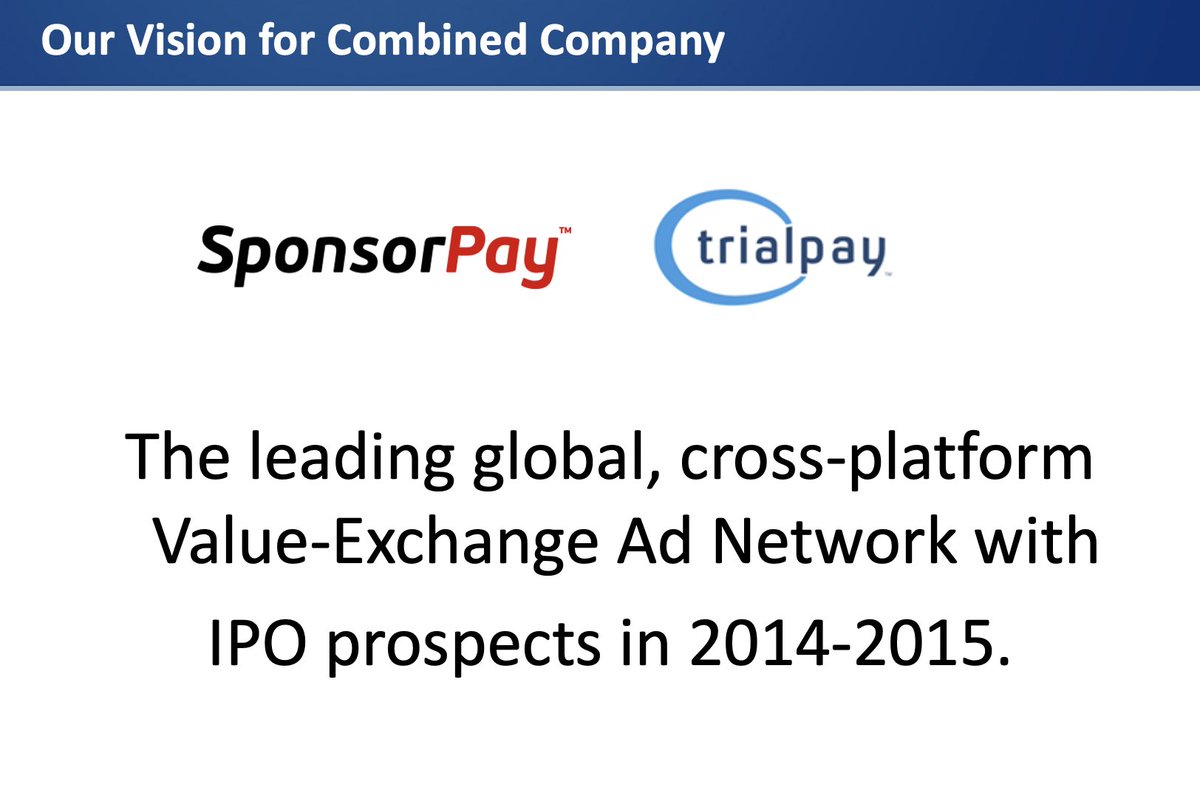
With SponsorPay, we had more cash and more revenue. We were (internally) bearish on our future growth, since we were late to mobile. They were more bullish on their future growth. We both were probably showing a bit more bravado during the negotiations – my opening slide here

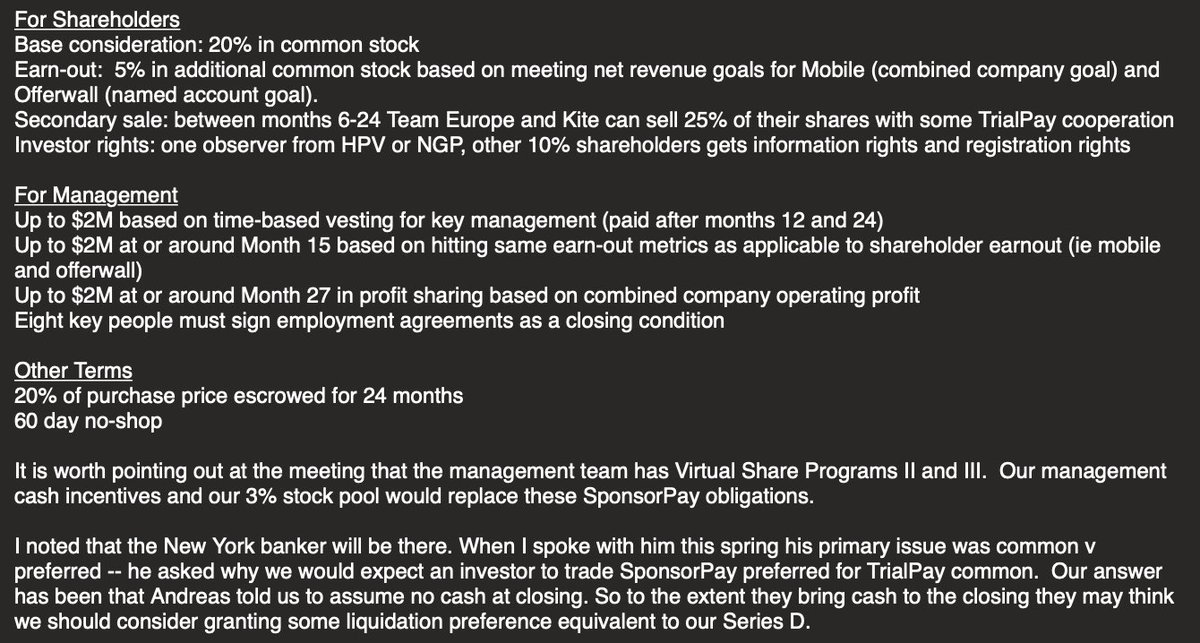
After looking at their financials and our relative cash positions, here’s what we offered (I figure the statute of limitations is up on sharing this stuff since neither company exists anymore! SponsorPay became Fyber became Digital Turbine, so you know how the story ends)

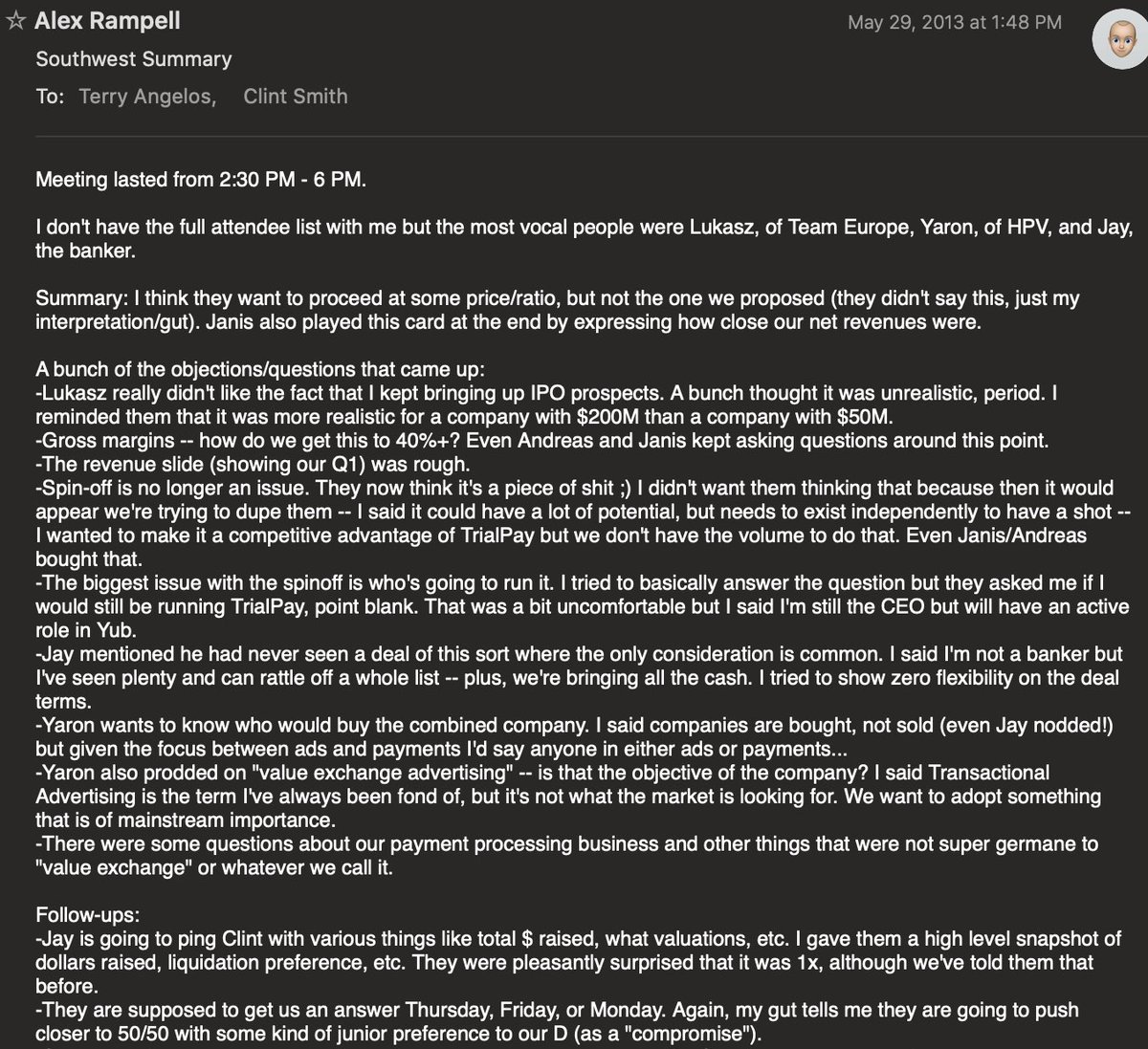
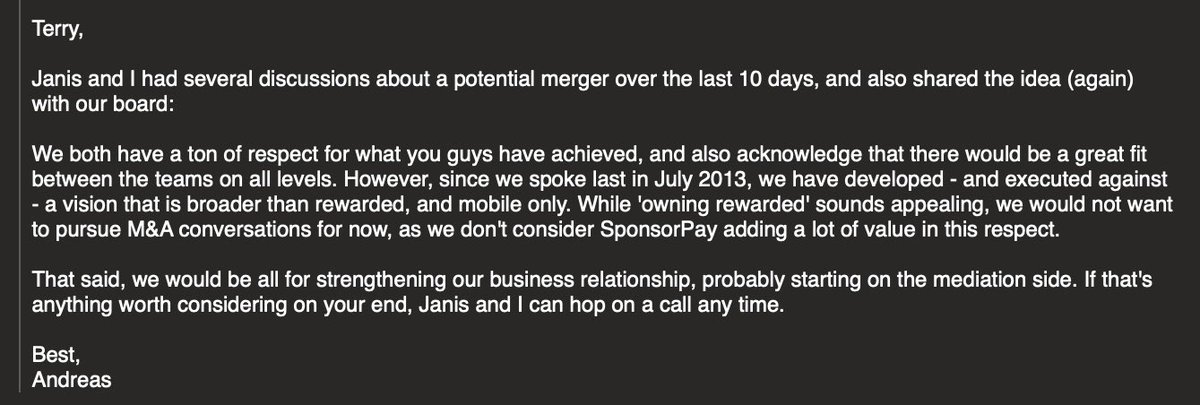
But it was a hard sell. Their investors wanted cash, or at the very least not common stock in our company. We were busy with our spinoff of Yub (see thread in 1). They had hired a banker to try to “shop” our deal. We basically got nowhere, but we didn’t have a sense of urgency

We were also very torn on further diluting our ownership to “double down” on our core strategy by doing a competitive merger. Did it really make sense to give up 20%+ to get more revenue scale but still have 10 other competitors? Like whack-a-mole…with the smallest mole.

I was honest with them that we were busy on our spinoff and likely to see some short term financial pain, and didn’t want to enter the negotiation on “defense” as a result of this. But honestly, my biggest concern was the adage that two turkeys don’t make an eagle

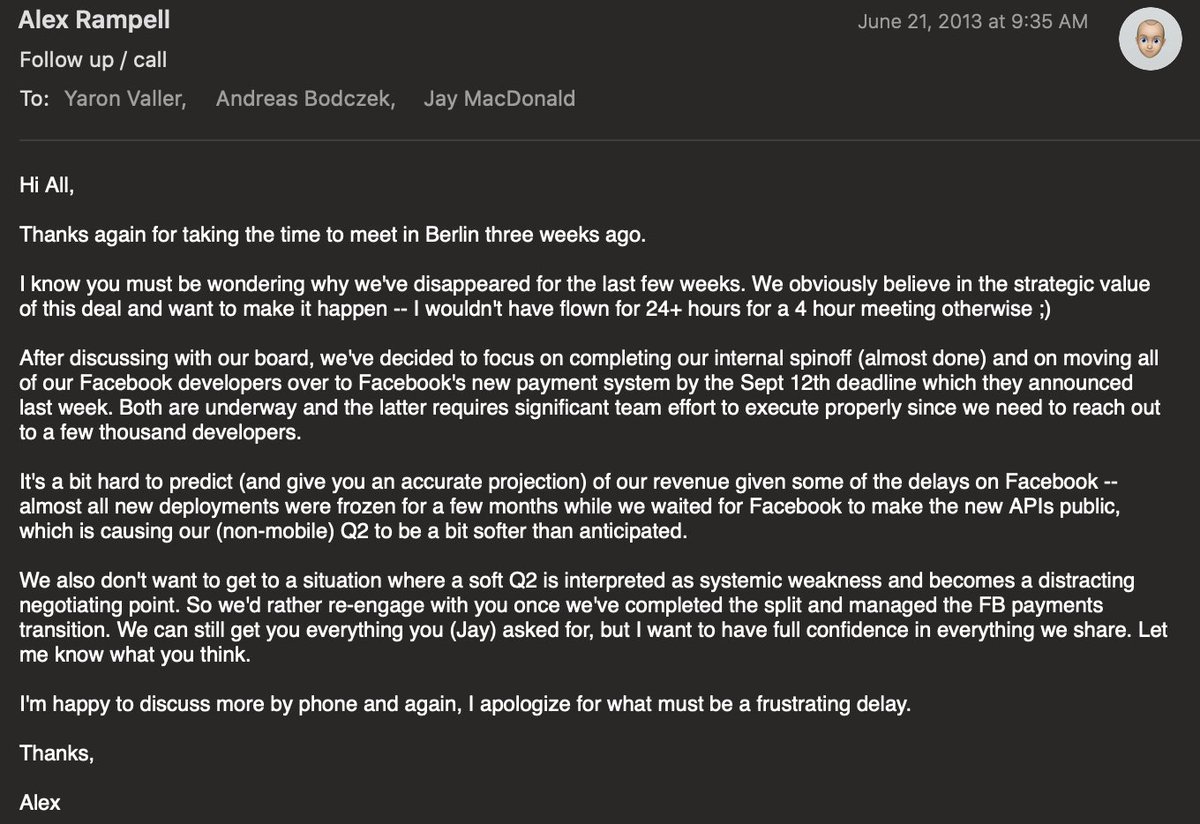
As the year went on, we missed our numbers. They were doing better. We still had more cash. But while we kept opportunistically trying to make this happen, we became further and further apart on price and *strategy*…and after about a year they pulled out, rightfully so.

Image

We were pursuing other deals as well. Accel had a challenged company called GetJar which we looked at buying, but we couldn’t get there. I spent a ton of time with PE firms looking at doing a take-private + merger with a public company, Digital River, that needed new tech

This one (DRIV) was arguably the most insane. Merge our unprofitable company plus tech-forward and differentiated team into a profitable but slow-growing public company, steered by a slash-and-burn PE firm. But valuation was even more challenging in this model.

We prostrated ourself in front of every company adjacent to us but our cash position, once our strong point, was weakening. We even had conversations with “that stock might be valuable!” tech companies (future eagles, with us almost acting as VCs) but we had too much rev/opex

In the end, the path we took was the one I wrote about here: https://x.com/arampell/status/1562557849128931328

But several learnings from this experience of private-to-private M&A, including when I’ve seen it work well.
A. 🦃+🦃 ≠ 🦅. Make sure there’s a *real strategy* you can get behind
B. Don’t waste time. If you are cash rich in a bad market, that’s your value. Move fast.
C. “Optics” converge on irrelevance quickly. “Optics” are a reason not to cut burn, not to eliminate products, etc. You’re merging with a private company, not a BigCo
D. Roll-ups are good if they get you to market leadership, but not if they leave you with high fragmentation
E. To quote The Godfather II (and Sun-Tzu): “Keep your friends close, but your enemies closer.” Being on good, text-message-banter terms with the CEOs of all your competitors is *always* a good idea…particular in an environment like this.

Hope this was helpful. I think we’ll see a lot more private-to-private deals, particularly amongst late stage companies, in this market cycle. Fin.

SPACs in 2021

Originally posted as a Twitter thread on February 14, 2021


Why are there so many SPACs?

Answer 1: Great economics for sponsor (average of 20% of money raised upon deSPAC / merging with a target, Eg $400M SPAC = $80M). It’s like a separate carried interest pool for each company and liquid since already public!

Answer 2: Great economics for investors assuming 0% interest rates (get 100% of your money back if you don’t like the deal! Get warrants just in case you do!). There is no reason NOT to invest in every SPAC at IPO if your alternative is a Bank of America checking account.

Answer 3: TINA (There Is No Alternative), especially given investor inability to access private companies.

However, it’s clear there are way more SPACs than targets (b/c answer #1 in particular). In which case the beneficiary will be…investment bankers who raise the SPACs 🙂

How IPOs Work

Originally posted as a Twitter thread on August 28, 2020


There’s been a lot of misinformation about IPOs — particularly around the narrative of “intentional underpricing” and subsequent IPO pops / “money left on the table.” IPOs aren’t perfect, but the problem isn’t the pop — a sideshow caused by quirky supply/demand imbalances.

The things to fix are aggregating the most demand, blurring the lines between private and public for a seamless transition to being public, and more thoughtful lockup releases, while also ensuring that a company is sufficiently well capitalized.

Many are celebrating SPACs and Direct Listings, which both have their place as valuable tools, as the “death” of the IPO *because* of a misunderstanding of what causes a pop. A price without a quantity is not a price: block sales happen at a discount, M&A at a premium.

But today, an IPO remains the best way to raise a large block of primary capital. It *should* improve, but the way to measure improvement is not pop against low float, but on aggregation of the most demand (*all* investors) in a way that sufficiently capitalizes the company.

There’s a lot more data and examples to back this up in this piece which @skupor and I put together. It’s long but hopefully shows exactly the dynamics and game theory in play around how a company goes public and what’s in a price:
https://a16z.com/2020/08/28/in-defense-of-the-ipo/

“Silicon Valley Does X”

Originally posted as a Twitter thread on January 08, 2019


“Silicon Valley Does X” — what does it mean? It *DOES NOT* (or should not) mean “same thing HQ’d in high cost of living SF.” It means a true first principles approach to re-inventing a stagnant industry, process, and way of thinking.

The philosophical burden of proof is often described as “he/she who brings the claim supplies the proof” (or this, by Carl Sagan: “extraordinary claims require extraordinary evidence.”) This is *very* relevant for “Silicon Valley Does X.”

There is often little evidence for *current* positions (outside of precedent) and consequently “Silicon Valley Does X” is pilloried for bothering to re-examine and re-think orthodoxy.

Any industry trusting random humans to make uniformly optimal decisions with little or no feedback loop — now THAT is an extraordinary claim, requiring extraordinary evidence! So industries like real estate, medicine, investing, lending, etc

Real estate: “this agent knows the best stager and it will make your house sell for more” …proof?

Medicine: “don’t screen for X, too many false positives” (best way to solve that is to…collect more data! look at longitudinal changes!)

Education: “you can’t learn from a computer screen / credentials are everything”…really?

“Silicon Valley Does X” is about challenging assumptions, and often exposing that those assumptions are themselves not evidence based. And guess what? Sometimes the orthodoxy is right…

…but we should be grateful that there are entrepreneurs willing to risk failure and challenge it.