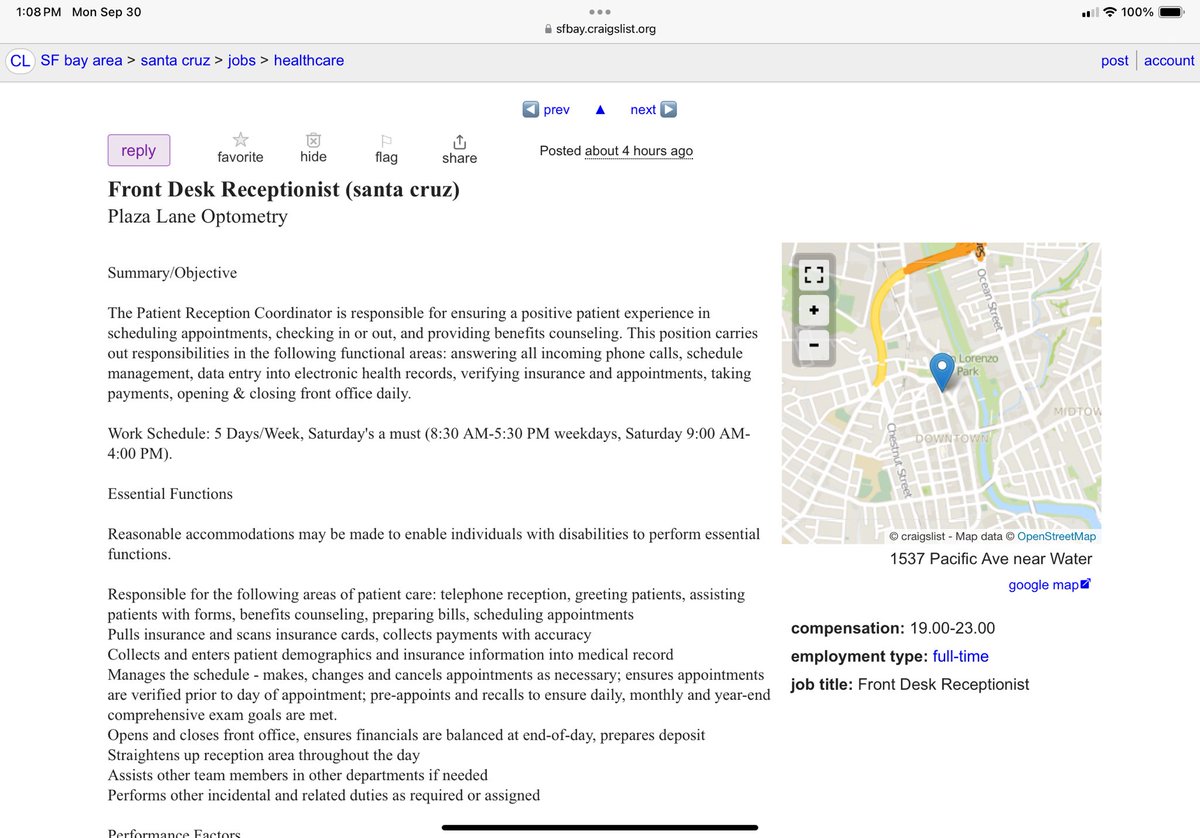
As software “becomes” labor (https://a16z.com/ai-turns-capital-to-labor/), we will see similar hacks to sell software — responding to job postings with software products that do a meaningful percentage of the job’s responsibilities. “I know you’re looking for a ‘Bachelor’s Degree preferred with 5 years of experience X’, but our AI-powered software product can do everything you need, is fully trained, and only costs $20,000/year…and can start tomorrow.”
Try going through Craigslist or Monster for job listings — and notice for each job how many of the responsibilities could be done with AI *in its current form* or where AI will be very soon, particularly with more integrations…here’s a local optometrist:
One of my favorite restaurants where I live uses *zero* system for reservations. You have to call, they’re closed in the morning, and the number is always busy during peak dining times. I asked the owner — why not use an online reservation system? They’re so inexpensive now!
His answer: “We are *always* at capacity. We have never had a day where our tables are not full. This would just be an additional expense, and the employee who answers the phone is needed to greet/seat diners anyway — so the reservation taking has no extra cost.”
I asked him: “What if she retires or quits?”
“Well, then I’d hire somebody else”
“What if a software products could do everything she did, for half the cost, spoke 100 languages, never called in sick, and was never late. Would you hire that ‘product’?”
“That sounds crazy, but I guess?”
We’ve already started to see some of this. AI-powered products focused on specialized “complex workflows” are taking on tasks like the ones seen in the prior Optometrist advertisement. And some technology-laggards are adopting these tools first because (like with my restaurant example) they’ve just avoided tech because it’s felt like an extraneous expense…
When starting a company, can you get to *5 customers*? Who are they? Why will they trust YOU?
As a VC, these are questions I always try to ask (selling B2B). I’ll tell my story of how my company got our first 5, and why 5 seems like a good heuristic of “you’ve got something”
I love the term “productize” — it effectively means turn a “service” or “consulting” project into a repeatable widget. Does a large n of customers need/want the same thing, or *roughly* the same thing with few customizations? Then…it *might* just be productizable
If you get your Uncle or Cousin to use your product, maybe it was a favor…which is a feature (not bug) if it indeed is the SAME product you can sell to a few other strangers. But a lot of times a “few” customers is just a collection of favors and is Fool’s Gold…
Fool’s Gold because it’s just not repeatable and hides brutal market feedback. You can only have so many college roommates, cousins, and uncles. But if you get 5 distinct customers to “agree” on the same set of features, it’s a very good sign and you’re off to the races.
TrialPay started off as something I used for my own freemium software business. “Don’t want to pay $10 for my app? Get it for free if you sign up for Netflix or get a Discover Card or shop at Gap.” It worked great so I decided to turn it into a company…and raise venture $
But a lot of times ideas/companies come in waves — two other companies basically popped up at the same exact time. Identical idea/value prop. Lift Media (@jmurz) and MyOfferPal (later merged/renamed TapJoy). We all pitched the same VCs within weeks in 2006!
I had a key advantage over them in that I still had my software business so could “create” traction — I was my own first customer. Could figure out if things were working. But more importantly, it gave me credibility in “my community” of freemium software developers.
After starting the company, my co-founder @terryangelos and I went to the “Shareware Industry Conference” in Denver…and we signed several customers there, the largest being WinZip. I gave a talk on my results with my own products…so had the credibility and knew this niche
This was so niche that few outside of the industry even knew of this conference…or had the credibility/connections with this somewhat esoteric group of businesses/people. I remember meeting @bradfurber and @allennieman there…at a relatively unknown (but big revs!) company…
But sometimes, particularly when building a “transactional” business (versus “per-seat” where you know # of employees), there are these “diamond in the rough” customers that turn out to be huge. Brad and Allen’s company (Sammsoft) was one of them. Huge client.
My *now* friend @jmurz of Lift Media was super smart, incredibly hard-working, and was building his nearly-identical business…he was my arch-nemesis at the time!!…but we got a big early lead, which later turned into a big fundraising advantage too…
And honestly it was almost entirely because:
A. I had a captive early customer that would do anything I wanted (customer was…me!)
B. I found a bunch of other customers that “looked” like me — no chasm to cross. “I sell $30 Windows software, you sell $30 Windows software”
As we expanded, this was one thing that never ceased to amaze. Companies *across* verticals often have a hard time being the first in their space…getting Skype or Fandango to use us was not really helped by the fact we had WinZip. “Oh, that’s totally different.”
My advice to developing a killer product and go-to-market — and ensuring you don’t end up over-engineering into a void or losing to another competitor — is that you need both a founding team (founders/employees) and a founding *group of customers*
You need some vision, flexibility, and fortitude to make sure YOU are building the product, not your customers — otherwise it’s the Henry Ford “if I asked my customers what they wanted, they would have said a faster horse”
But you also need real market feedback so getting some friendly customers — who are willing to bet on you (kind of crazy to run your business on a money-losing startup!!), ride out some bumps, and give more than an occasional testimonial…is crucial
So sometimes 0->1 is not all that hard (if “1” is your Uncle). Getting 1->5 is actually what’s hard…synthesizing feedback, and building that trust that no 12-months-of-cash-left startup is just “entitled” to. It’s a crucial ingredient to success.
Some ideas on how to do this:
A. Give equity to your early customers or have them invest
B. Have no shame plumbing every connection you can – favors and believers
C. I tend to think the best companies are ones that came out of personal experience / you can be 1st customer
Thanks to @1nternetjack for the idea on this one. And watch this scene from one of the best Simpsons episodes ever, about the perils of *overly* conforming your product to just one customer:
Companies are (almost always) bought, not sold. This means somebody needs to *want to buy* your company. Ideally this happens organically. But how do you, as a founder/CEO, expedite this…particularly when you KNOW you’re hitting a wall?
“Planting an idea”
Inception is one of the greatest movies of all time (watch the clip). The whole premise is about implanting an idea in somebody’s mind…the inception of an idea. “If you’re going to perform inception, you need imagination”
There are probably three types of acquisitions: A. Acquihire (want team, not business or product) B. Product/“Trade Sale” (want product or to repurpose product, acquirer has distribution) C. Business “left-alone” (give existing business more resources to grow faster)
Especially for Acquihires and Product-oriented sales, you need to get to know your prospective “buyers” *far in advance* of “needing” or wanting to sell your company. Two independent variables exist: when they can/want to buy, and when you want to sell…rarely do they align!
Buyers aren’t companies, they’re *people at companies*, and generally people with P&L responsibility. Often somebody climbing the corporate ladder who wants to make a big splash and is anxious to ship something taking way too long internally. Or a new VP who needs a team ASAP.
Almost every large company has a corporate development person/team. Their job is to close deals, not to ideate – once you are “bought” you’re not working for the VP of Corp Dev. You’re working for whatever division and whatever person wanted your product. Focus on GMs/PMs/VPs.
Focusing on product/trade-sales: the key thing is to figure out where 1+1=3, or how your product might fit within the org. At TrialPay we showed ads around transactions — what if PayPal could stick our ads in every purchase receipt? Would generate >$1B…that was our pitch.
The goal is not to approach the company (or person) with “please buy me” — it’s not like a fundraise. That’s massively counterproductive. It’s to propose a BD deal that is just standard operating procedure for your independent company. Which hopefully happens regardless!
You CANNOT PUSH A STRING. This was a lesson I learned very painfully. Do not be aggressive; this isn’t like closing an oversubscribed funding round. Articulate a vision for how your product fits and is a win-win for both, try to get a test/integration/contract in place.
The true “inception” for the more valuable product-oriented acquisitions is “wow, we shouldn’t let this be a BD-deal…we NEED to own this.” *That* is when you can (possibly) sell your company for a lot of money.
Even so — most companies have a culture of “anyone can say no, nobody can say yes” — you need to sell horizontally, deal with people who are threatened (“we can build it ourselves!”), and recognize you’ll be judged “on the present”.
“Being Judged on the Present” is a very big deal (see blog post) — you need to steer things to what your product, or a variant of it, WILL look like. Make a real polished demo. Put real work into it. Your “existing” product or team or tech might be used against you.
This is why “imagination” is so key — your product currently does X, but there are probably 5 giant companies where a few tweaks/changes to it – X’ – could accomplish a major objective for them…how you pitch each might be a little different.
I can’t overstate the fact that relationships matter. You can’t start this process with 3 months of cash. You should be thinking about this even if you plan to conquer the world — get to know key decision makers/GMs at every potential acquirer because…you never know.
And again, my approach wasn’t “I want them to buy me.” It genuinely was “I want this *commercial* deal with this company, because it will be transformative for MY business.” Which was 100% true.
There’s also the reality that sometimes your current “business” scale makes your “product” less appetizing (what does the acquirer do with all the people/processes if they want to repurpose?). This is the hardest part: do you change your business to make it more palatable?
GENERALLY, the answer is NO. Most M&A fails. Again, when you want to sell usually does not align with when they want to buy. But if you really NEED to sell, it’s useful to think through the “anchors” holding you back: https://x.com/arampell/status/1562557849128931328
“Running a process” to sell a company rarely works if selling team or product, especially when product needs to be repurposed…but if you are already being hotly pursued, then and only then (IMHO) does it make sense to “shop” — “Boy who cried wolf” syndrome is real.
Because again, “when they want to buy” is a real thing — maybe they just bought a giant company and don’t have the budget/fortitude to buy another one. Maybe they whiffed their last quarter’s earnings. Don’t push a string. Hurts your chances when they’re ready to buy.
Sometimes you can help expedite, though: once you already have the relationships, and ideally some product integration in place, you can, say, start a fundraise and ask if they’d like to invest (might make acquisition more expensive down the road, maybe they should buy now!)
In the absence of competition, though, it’s very hard to speed up an in-flight M&A conversation/process. And it WILL suck up most of your time and energy…and distract every member of the team working on it. Limit the circle of knowledge on this — it’s crucial.
“Raise money when you don’t need it” is the normal advice for fundraising. For M&A, I would strongly encourage everyone: “Build relationships and think about this…when you don’t need to sell.” Because one day…you might want to or need to.
And again, this doesn’t mean CEOs should spend most of their time on this. I think ideally it’s 5-10% just focused on capital raising/relationships (inclusive of prospective M&A) as a background process.
Lastly, if you want a good price — much less likely when your growth has stalled. The best (luckiest?) deals I’ve seen done are when the CEO (recognizing an upcoming speedbump) basically “expedites” interest…and when the “wants to sell” and “wants to buy” variables meet 🙂
Originally posted as a Twitter thread on August 24, 2022
How a company I co-founded (TrialPay) once exited the Catch 22 of “can’t raise cash without growth; can’t grow without raising cash” which is potentially the most “unsolvable” (Kobayashi Maru) situation a VC-backed company can face
First, a refresher. There are basically three outcomes for a VC-backed company:
-go public/get bought
-go out of business
-become a zombie
Let me explain the third one…because you might be thinking “wait, you mean become marginally profitable forever? That’s good!”
Most businesses generate profits + are valued at the present value of those future profits. VC businesses: more valued as call options — “if this thing works, it could be huge!” — which is why a day 0 company with just a PowerPoint presentation is “worth” $50M sometimes
Once things go south, a doom loop can happen:
-best employees don’t believe in the equity and leave
-you need to pay people more to stay, amplifying burn
-customers get nervous
-AND company with immature product can’t (always) cut to profitability…so still burning money
And again, cutting to profitability with almost zero cash cushion might mean never being able to restart growth (esp having lost the best talent in the co), and then the opportunity costs of the founders kick in…why stay? Particularly with albatross of a “stale” cap table
Now to my story re TrialPay. As a payment company servicing digital goods, it was pretty bad when all of the major platforms (eg Facebook, Apple etc) decided to “own” payments. We went from $25M revs (2010)->$70M (‘11)->$77M (‘12)…to $55M (‘13). Not good, esp when market⬆️
Many of our most talented people started leaving. We had gone through M&A conversations with every major strategic buyer and twice been left at the altar — very hard to come back once you have that Scarlet letter. We executed a big RIF, downsized office space, etc…the usual.
But we did three unorthodox things that uniquely turned things around and yielded a 9-figure exit:
A. Promoted aggressively from within
B. Spun-out a company (dividended it out to shareholders) which later had its own exit
C. Sold some of our IP
Promoted from within: companies compensate people with cash, equity, and title/responsibility. We were low on cash, nobody believed in our equity, so we started taking junior people and making them VPs+ — a huge amount of responsibility they wouldn’t and couldn’t get elsewhere
Generally speaking, people want career/title progression, and don’t like leaving a company to take a “lower” job elsewhere…which is a nice realization if you are bleeding talent. Responsibility can really motivate fresh people.
next: Spinning out a company. We did an IRS Section 355 tax free spin out — which basically means we took one product, wrapped it into a new company, mirrored the cap table but flattened preference stack and removed most liq pref, added a new big option pool, and spun it out
This was almost alchemy. On one hand we had people who wanted to stay at the mothership if they had more title/responsibility; on the other were engineers and product people who wanted a true high growth startup again, not a colossal shrinking turnaround
At TrialPay we had this $6M/year project/team to build an “offline affiliate network” using credit card rails which TrialPay could then use for offers (eg “get Zynga coins for free if you shop at Starbucks”). It was a great idea but only yielding cost, no revenue
So this is what we spun out.
But with lower cost because we gave people big equity packages at an exciting new startup with a very low valuation and no preference overhang.
So it was better than zero sum: we reduced burn at TrialPay (costs spun out), implemented more startup-like packages at our spin-out (less cash, more equity — with an easier path to exit for that equity) — so the burn of NewCo was lower than the same team had been at TrialPay
Sure enough, within ~6 months a company (Coupons Inc) bought our spin-out for $30M, and there was lots of interest since it was a lean engineering-centric organization. It wasn’t a home run but everyone (including TrialPay employees, since we mirrored cap table) made money
Many of the would-be acquirers had passed on buying TrialPay since we were losing too much money and were too big with too many things (they wanted us for X, not X + Y + Z). But spinning off a key strategic asset changed that.
Finally, at TrialPay we sold a license to our core software to Visa, an existing investor in the biz. This provided a meaningful amount of cash to TrialPay (we turned a profit that year), further shoring up our balance sheet, and a small team went to Visa to help implement
This gave birth to the Visa Commerce Network, but since it was still reliant on many parts of TrialPay, Visa decided to buy the whole company of TrialPay later that year, ending a daunting 2 year battle of “can’t grow without capital; can’t raise capital without growth”
It was a very trying experience, and I distinctly remember @bhorowitz taking the time (as a non-investor who barely knew me in 2013!) to give my co-founders and me guidance and counsel as we navigated between rocks and hard places. Hope this helps others in the same boat. FIN
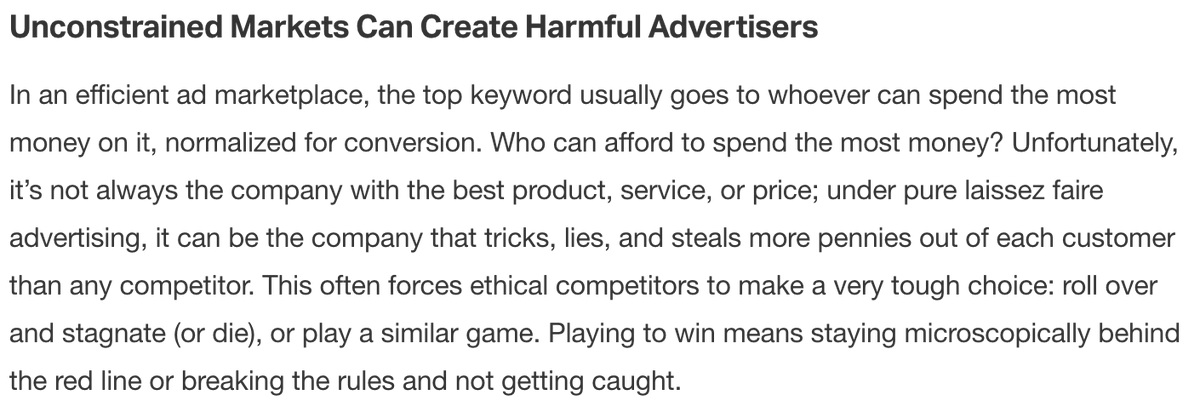
Government and platform (yes, some platforms have that much power) regulators do customers *and* entrepreneurs a favor with smart regulation, because it forces companies to compete on who can do the best job for the *customer*