Category Archives: Strategy

Push v Pull

What makes email, Facebook, and Google so valuable? Answer: Visiting them is largely unprompted, notwithstanding the synapses that fire in your brain that make you check your email, your Facebook feed, or decide to research something on Google. In other words, people pull content themselves, rather than having that content be pushed — or foisted — upon them.

The best way of looking at consumer web applications is as a complex stack of “pulls” and “pushes.” Lest these terms be confused with an earlier generation of push: a “pull” is an unsolicited action by a consumer, whereas a “push” is a solicitation by a seller/producer.  The consumer ultimately “pulls” from a mobile phone or computer. Everything else is “pushed” to the consumer, through ads, e-mails or other marketing efforts from companies eager to get business and traffic.

The greatest trick that Facebook ever “pulled” was transforming itself from a push platform (dependent on email to woo users back) into a de facto pull platform.  Facebook touts that 50%+ of its users log-in every day, and my guess is that the vast majority do so with no prompting. Push is still valuable but simply complements the massive pull that Facebook has developed.

Why is Pull so essential for a web company? The intersecting forces of human psychology and economics.

First, psychology: consider how most people hate being “sold” to. “Being sold to” is a form of push. Consumers get hundreds of unsolicited offers and emails pushed to them every week. They learn to tune these solicitations out, especially if they are not in a buying mindset. Relevance is a function of offer-consumer fit paramaterized by time.

Second, economics: A pull platform doesn’t need to spend any money to reach or acquire customers; a push platform does. Facebook’s marketing spend per user has to be the lowest of any company known to man. Granted, Facebook is intrinsically viral and laden with network effects, but the unprompted pull phenomenon has been crucial to Facebook’s dominance.

The value of pull is not just for consumer companies. Any Business-to-Business company knows the value of “demand generation”: catalyzing a “pull” by customers. The quickest and cheapest sales cycles start with a pull by the prospective customer.

For any web company, fostering Pull is essential to creating value and engagement.  There is no shortage of great applications and amazing technologies which stagnate due to a lack of pull.  But the greatest economic achievement of being a “pull” platform is in becoming the mechanism by which “push” companies must engage with audiences, paying handsomely to do so. This expectation is why a company like Twitter can be valued in the billions with minimal revenue.

Here are some ways of thinking about fostering pull:

Plan Around Events

Groupon Now is Groupon’s attempt to add Pull to its traditionally Push service. I want to eat, where do I go? Groupon. Every human desire has a natural pull tendency. Being the “first responder” to a human desire is incredibly valuable.

Find Offline Analogies

Most forms of pull fit a predefined social pattern, per the comment on “human desire” above. Before Google, people used phone books (unprompted) to find services. Before email, people would check their postal mailbox, generally at a given time (after the mail was delivered).

Answer Recurring Questions

There are certain types of content that consumers will invariably pull (or want pushed to them). These types of content generally answer recurring questions of a consumer. How much did I spend Receipts, bank websites)?  Where am I going (Google Maps)?  How do I get there (Kayak)? What’s wrong with me (webMD)?

Build Brand and Familiarity

Once one of the above is satisfied, brand and credential storage foster pull. A frictionless and “known” experience catalyze pull for transactional activities. While Amazon, as the largest spender on Google, does a fair amount of push, they also benefit from a tremendous amount of pull when consumers decide to shop. This is a combination of the brand but also their accumulation of user/payment credentials.

There is no substitute for pull in establishing success for a web company; the key is producing something sufficiently valuable in repeat interactions. Reid Hoffman has notedthat “social networks do best when they tap into one of the seven deadly sins.” It’s no coincidence that people have, unprompted, “pulled” those sins since the dawn of humanity.
Say Goodbye to the Long Tail of Product Resellers (online)

The 1980s and 1990s witnessed the slow death of the “mom and pop” general store, replaced by superstores like Walmart that sold everything from butter to guns.  Regardless of one’s position on this trend, it makes classic economic sense: by buying in bulk, Walmart commands better prices with suppliers, and then passes on lower prices to consumers. (Walmart has even been accused of “predatory” pricing to drive mom and pop stores out of business, raising prices after their disappearance.) By aggregating every product under the sun, Walmart can lure consumers in to buy staples (sometimes sold at/below cost), and cross-sell them other impulse items.

There’s one primary reason why Walmart hasn’t completely taken over the world: geography.  Walmart.com is a drop in the bucket compared to Walmart’s offline retail presence (remember that people spend far more money offline than online). Some communities keep Walmart out, New York City being one such example. And some people just live far away from Walmart.

But nobody can keep UPS or Federal Express trucks away, and the Walmart effect is going to be even more extreme online. This time Amazon is the big gorilla.

Consumers traditionally shop at retailer A versus B based on the intersecting calculus of five variables:

Price (actual price to consumer + “friction” in ordering process)
Geography (proximity to consumer)
Selection (do they have X in my size, or sell rare item Y?)
Service/Brand (do I trust/like them?)
Experience (is it easy/designed to shop for X?)

Internet commerce has witnessed incredible price transparency, where the Walmart effect can play out without any pesky geographical barrier for most items that UPS will ship; this explains why there are 41,000 shoe stores offline in the US but maybe only 5 of scale online.  That leaves Selection, Service, and Experience.  Selection explains why a small site like SquashGear.com is likely thriving, and Service shows how Zappos got to $1B in sales.

The danger is that when a niche becomes big, it will simply be invaded by Amazon, the Internet’s Walmart. I’m pretty certain that if Squash becomes the number one sport in America, Amazon will “go big” and put squashgear.com out of business by squeezing better prices out of suppliers and providing lower prices to consumers, combined with a world-class logistics engine.

If you’re an entrepreneur itching to get into e-commerce, remember that you can’t compete on geography (unless you’re cloning an existing retailer in a region where there is no Amazon), and you can’t compete purely on price.  But here’s what you can do:

Cultivate a better shopping experience: BlueNile is simply a better place to shop for engagement rings. Zappos is a better place to shop for shoes. In some cases, what makes Amazon.com great (every shopping experience is the same) is also its greatest weakness.  Some things are designed to be bought differently.

De-Commoditize: If you’re just another reseller of a generic commodity, you better have a pretty clear advantage outside of price…but these are often tough to come by.  Diapers.com is one of very few companies that has out-Amazoned Amazon. If there’s something unique you can add to the order (e.g., proprietary software that consumers can use with the commodity good) it makes it easier to differentiate and provide value to the consumer in excess of a nominally higher price. For example, a vitamin reseller might be wise to develop a smartphone app to remind consumers of pill times…and bundle it with every order.

Build a marketplace for buyers and sellers, don’t be a reseller. Etsy, eBay, IronPlanet, Copart, Elance and others have built great value by focusing on the defensible art of the network effect.  This area is far from played out, and there are many marketplaces waiting to be created for verticals from babysitting to piano lessons. The best marketplaces tend to be for frequently purchased items with a diverse quantity of sellers and few repeated interactions.  For example, you want to eat at different restaurants, but typically go to the same piano teacher for years, so it’s easy to see why OpenTable might be bigger than a piano lesson marketplace.

Distributed commerce: Who can beat Amazon on price? The companies whose products are sold on Amazon!  Outside of the Kindle, Amazon is merely a reseller — marking up the price of others’ products, so those “others” could theoretically beat Amazon in selling direct to consumer.  But most manufacturing companies do not do a very good job selling products direct to consumer, and hate to risk channel conflict.  And consumers prefer to shop at supermarkets, not “silo” markets.  Imagine a world of decentralized commerce — where you can shop at any number of manufacturers within the context of one meta-shopping cart or wallet.  It might be a pipe-dream, but it’s a huge opportunity that could beat Amazon on price and selection if the experience and service components could be filled in.

Preempting Search

Google: 65.8%
Yahoo: 17.1%
Microsoft: 11%
Ask: 3.8%
AOL: 2.3%
(Search Engine Market Share, source: Comscore, August 2010)

Outside of a tectonic shift in search results/quality – think how offering 100x more email storage encouraged people to switch webmail companies back in 2004 — people are not going to ditch Google as their primary search engine. And Google isn’t taking any chances – by paying Dell $1B for their search toolbar to be pre-installed on new Dell PCs, or pushing Android (who’s the default search engine?), they are doing their part to make current habits continue and lock down their whole “supply chain.”

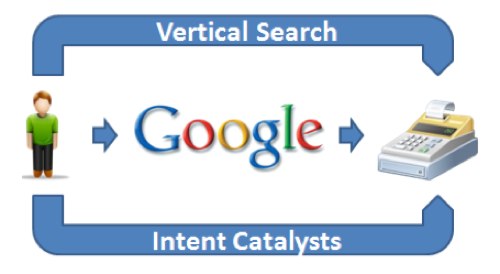
For Google’s enemies, the best way of hurting the search goliath is not to build a better search engine, but rather to give people a reason to stop searching for a wide class of goods and services by preempting search on Google. Given Google’s dependence on harvesting “transactional intent” for its revenue, the key is to move transaction initiation off of Google. The ComScore search marketshare numbers at the top are somewhat meaningless; Google could lose massive revenue while their overall search share, for non-transactional search, stays strong or even grows.

What can preempt Google search — or at least the money-making parts of it? There are two things for Google to worry about: Vertical Search and Intent Generation. Vertical Search will nip away at vulnerable parts of Google in the same way that Etsy, Copart or IronPlanet has nipped eBay – think OpenTable for restaurants, Kayak for travel, Amazon (yes, Amazon) for traditional e-commerce, etc. And Intent Generation catches people further up the funnel, before they search, and delivers them what they want, and gets them to purchase, before they start searching. Intent generation can also spawn impulse purchases and overcome inertia to get people to buy more quickly.

Intent Generation is perhaps the more dangerous, because it is stealing purchases from Google’s clutches – bypassing any kind of search.

Vertical Search

Amazon: if everyone in the world signs up for Amazon Prime (unlimited, free 2-day shipping) and becomes a loyal Amazon customer, who would search for anything shopping-related on Google? We’re a long way from this happening, but imagine Amazon as the “e-commerce search engine” and Google as the “random stuff I’m looking for when not buying” search engine. I believe the long-tail of ecommerce resellers will deteriorate due to economies of scale and lack of geographical differentiation (e.g., 40,000 offline shoe stores, but only 5 of scale online), thereby making Google less relevant for a whole category of searches, and benefiting Amazon as the largest, broadest ecommerce company.

ZocDoc, OpenTable, and Yelp: Since becoming an OpenTable convert and Yelp user, I have not searched once for a restaurant on Google, and I bet these two companies are quickly taking away searches from Google for the dining category. I’m a big believer in ZocDoc, and if that can become the Expedia of medicine (long way to go for that to happen), Google could lose another category.

Kayak and Expedia: Expedia is a great example of what Google needs to avoid. If you’re looking for a hotel in Phoenix, you probably head straight to Expedia, Kayak, or another online travel agency (OTA). Google doesn’t have much to lose here because it’s never had a foothold in travel search, but its purchase of ITA is very strategic as a way of reversing that.

Intent Generation and Catalysis

Groupon: for “impulse” purchases, things like Groupon are pushing offers to consumers rather than relying on consumers to pull (search). The half-million or so Gap Groupons sold on 8/19/2010 represent half a million customers who won’t be searching for Gap, much less any other clothing retailer, on 8/20/2010. Groupon snatched these customers (and their discretionary clothing spend) before they got a chance to search. Some of this is accretive and not preemptive, but consumers only have finite income and a million Groupons every day will have a substantial impact on Google.

Facebook: With more traffic than Google, Facebook only has an estimated 5% of the revenue of its rival. Social recommendations, a catalyst for Groupon’s success, can help preempt search, but these tend to further curate intent rather than harvest it, as Google does. The holy grail is the ability to show the perfect advertisement at the perfect time (precognition, like in Minority Report), something Facebook has a better chance of doing than anyone. The popularity of gaming on Facebook is another angle we have seen be effective – encouraging people to buy something (e.g., a new sweater at Gap) in order to get credits in a game. This is both an example of intent generation and intent catalysis; perhaps you knew you were going to buy a sweater eventually, but you decide to buy it today, and buy it from Gap and not Macy’s, in order to deck out your virtual restaurant on Restaurant City.

Payment Companies: By knowing how much you spend and where, payment companies have tremendous opportunity to change future behavior, generating and catalyzing intent. American Express recently sent me a very nice coupon/gift certificate for Barneys. A month later, when I thought about going shopping, I went straight to Barneys, and didn’t search elsewhere. It preempted my search and changed my behavior. Unlike Groupon, which offers great deals to everyone, payment companies have nonpareil data to use in targeting offers to consumers, and furthermore allowing merchants to target specific consumers. PayPal, American Express, or a resurgent Google Checkout could fundamentally change the nature of ecommerce through intent generation in the same way that Catalina Marketing has altered the CPG and supermarket industries.

With Bing, Microsoft has made a laudable attempt to out-Google Google, but Google has thousands of engineers who can quickly out-Bing Bing. The battle for search is over for now — Google won — but the battle for the underlying revenue is just heating up.