”It’s temporary”: there is NOTHING else to do, people stuck in homes, kids cannot be shipped off to school or daycare, therefore MORE work gets done + people always accessible…but upon opening, people will start playing hooky
“It’s permanent”: the tools for WFH are great (think Slack/Zoom), meeting length gets collapsed to the core substance (1 hr -> 30 mins etc), less travel/commute, accountability via more trackability…
For small companies, “it’s permanent” could have a seismic change on their financials given real estate costs as a % of revenues. But IMHO jury still out on productivity gains/losses given unique nature of this forcible SAH (stay at home!), not just WFH, experiment
And clarifying the first point, parents whose kids are stuck at home cannot go to the beach / play hooky because they need to watch the kids 🙂 Versus normal times when they could.
Originally posted as a Twitter thread on November 06, 2019
Net Promoter Score (NPS) is, when used properly, a great metric for many businesses. But many startups are trying to tout high scores, not *accurate scores* which is both dangerous and intellectually dishonest.
The classic question is “On a scale of 0 to 10, how likely are you to recommend this company’s product or service to a friend or a colleague?” — so if you have no organic traffic but a high NPS, something doesn’t jive / one of those measurements is wrong
Many companies only (whether by accident or on purpose!) survey their satisfied customers, those who made it through a giant funnel…a form of denominator dishonesty that makes it seem like things are rosy when they are not.
10% NPS might sound terrible, but it could mean you surveyed 10 customers and got nine 8s and one 10. NPS *should* be both a leading and lagging indicator of retention and organic growth, but it loses all meaning when it’s gamed to look rosy. Survey everyone! Face the data!
Originally posted as a Twitter thread on October 27, 2019
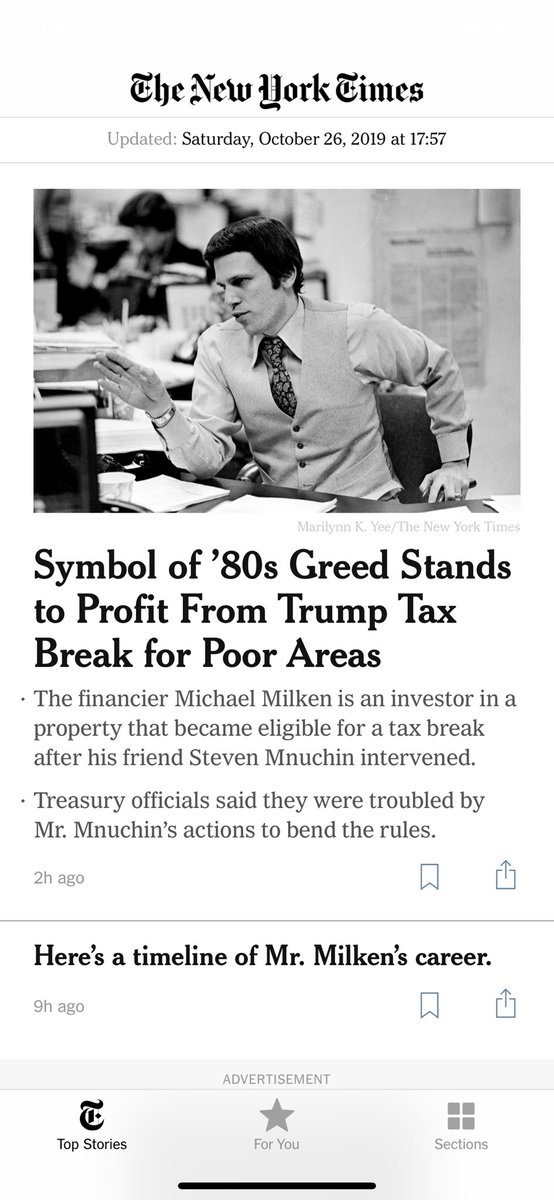
This is the top “story” in the NYT app right now. Such a ridiculously sensationalist headline — confusing correlation and causation isn’t enough, might as well figure out how to present a broad policy (Opportunity Zones) through the cartoon-like representation of a “villain”
“Symbol of 80s Excess Stands to Benefit from Flu Shot”
“Man Who Once Met Putin Benefits from Opportunity Zones, Raising Questions of Russian Influence”
“Mnuchin’s High School Girlfriend, Fluent Russian Speaker, Owns Property in Turkey, Raising Questions on Kurdish Policy”
“Grandchildren of Symbol of 1890s Greed, John Rockefeller, Stand to Benefit from Vaccine Developed by Salk”
Originally posted as a Twitter thread on September 18, 2019
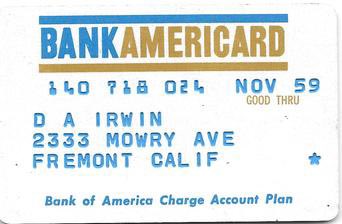
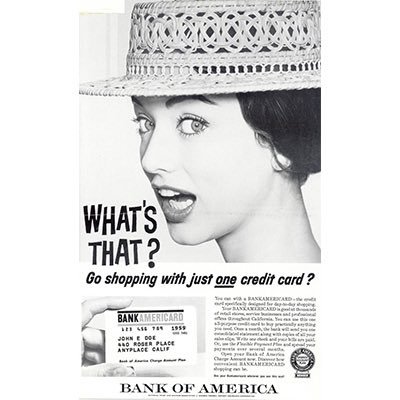
September 18th marks the 61st anniversary of the most valuable network effect of all time: the credit card. How did we get here? Read on. And read @opinion_joe ‘s book “Piece of the Action” for more…
The epicenter of the revolution was Fresno, California. Facebook started with the contained network of Harvard students; the humble credit card started with 60,000 people in Fresno and a prominent company called Bank of America, then a California-only bank.
There was no application. 60,000 people just got a BankAmericard in the mail on September 18, 1958, ready to use.
There were “charge cards” like Diner’s Club before the BankAmericard Fresno drop, but there was no “credit” being extended. And you could go to a bank and get a loan, or get an installment loan for a specific purchase, but in person.
The credit card came out of Bank of America’s corporate think tank, called the “Customer Services Research Department,” run by a 41 year old man named Joe Williams.
Consumers were used to paying on credit, but each line of credit was either specific to a merchant (e.g., Sears), or a burdensome process requiring a new loan (in person) from the bank.
Williams thought the credit card — a multi-merchant product — would fix that. It really had two purposes: convenience and lending.
Fresno at the time had about 250,000 people, and *45% of all Fresno families* were Bank of America customers.
Credit card fees were set at 6% for merchants, and consumers — who just randomly got this card without applying — got between $300 and $500 in instant credit.
The brilliance of the 60,000 person drop is that Williams had effectively started with the chicken, in the classic chicken/egg cold start problem. On day 1, cardholders simply *existed* which permitted BoA to sign up all merchants who didn’t have existing proprietary programs
So Williams started in a seemingly random, highly concentrated town, immediately enlisted existing customers, and focused on fast-moving, small merchants — not the giants like Sears — all backed by a massive advertising campaign.
More than 300 merchants in the city signed up, the first being Florsheim Shoes (still around!).
Within 3 months, BoA was expanding concentrically — to Modesto to the north and Bakersfield to the south, and within a year San Francisco, Sacramento, and Los Angeles. Within 13 months of Fresno, there were 2 million cards issued and 20,000 merchants onboarded.
After the Fresno drop, other banks followed. Chase Manhattan was 5 months later on the east coast.
Williams assumed that collections would be a breeze, that late payments would never cross 4%, and that existing bank credit systems would work. Instead, less than 2 years after Fresno, Joe Williams quit BoA due to a series of disasters. The credit card almost died then+there
Delinquencies were over 20%. Fraud was out of control as criminals figured out how to replicate cards. Merchants (harbinger of things to come) hated paying 6% and the first battles over fees began. Some of them stole from the bank or customers, too.
And more broadly — and this is now illegal — simply giving people cards without having them apply, and without them understanding the consequences of wanton spending, created far more bad debt than BoA had ever seen (on a customer % basis).
The huge losses and mounting pressure almost caused BoA to kill the card program altogether. The founder was ousted. Instead, BoA persevered, and just a few years later BankAmericard turned a profit and grew like a rocketship, transforming how people pay and borrow.
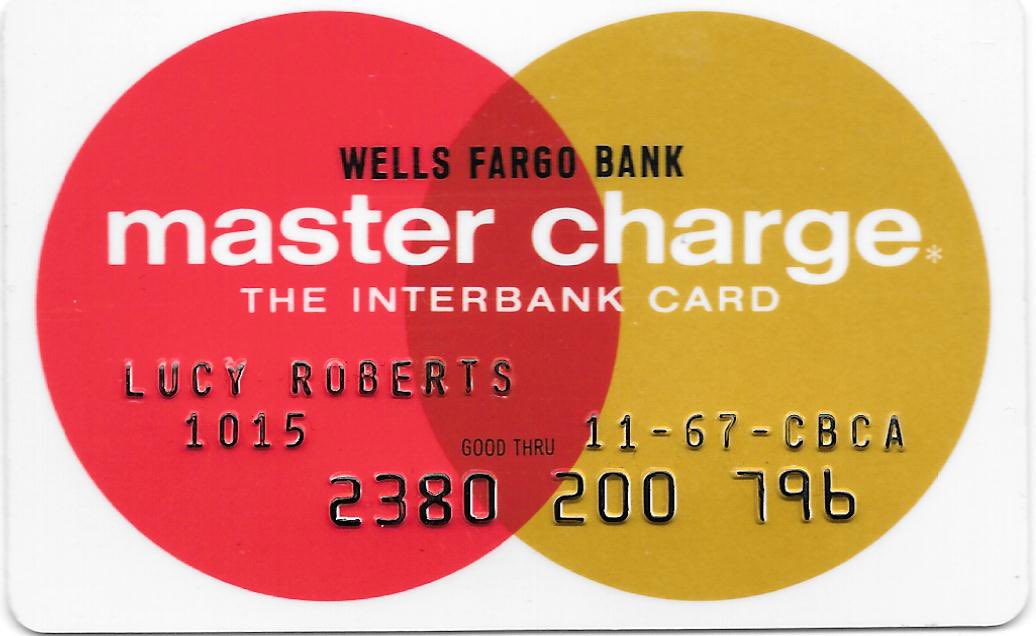
Eventually, BankAmericard became a non-profit consortium called Visa — uniting many banks with competing credit cards. A competing consortium called MasterCharge, later MasterCard, did the same with another set of banks.
Credit cards and payment cards are arguably the most valuable network in the world, with at least $1T of publicly traded market cap (Visa, MasterCard, the banks who issue them, etc)…all starting off in a little town called Fresno, on a random day in September of 1958.
More on how credit cards work today and their history:
Originally posted as a Twitter thread on August 07, 2019
Controlling currency used to mean controlling payments. You print the money as the sovereign; all payments are transacted with that paper. But non-paper payments have changed that and yielded geopolitical risk…
David Ricardo coined the term “comparative advantage” — why trade makes sense. But there’s this issue of geopolitical risk. Growing *zero* food within Country X might be a bad idea if there is a war of anything that interrupts logistics…
So it’s been well-understood, as a matter of national security, that it makes sense to have self-sufficiency in several areas in case trade breaks down
Which brings us back to how currency now has little to do with payments. Governments have very little control over how commerce and payment networks work, or rather, the ability to *keep* them working
The two largest payment networks are in San Francisco (Visa) and Purchase, New York (MasterCard). They are the routers for a huge and growing amount of commerce in *all* countries but they are domiciled in the US, subject to its laws
It’s going to be interesting to see, as paper money goes away and commerce is transacted entirely via payment networks such as these, how governments react. It’s not clear to me that they really understand what’s happening
Now if I’m the UK or France, I might think — hmm, what if that happens to me? In 10 years, things affecting the *commerce* supply, for lack of a better word, will be more influential than anything governments have done in “currency”
China is the only major (non-US) country to have thought this through, as they have their own payment network, China UnionPay, which can interoperate outside of China. But I suspect and expect this to be a bigger deal going forward…
And generally speaking, any network that has an outsize impact on the economy of another country will start being scrutinized more under national security guidelines OR be required to have separate instances that can operate independent of the parent…
For example, imagine that everyone in China took an Uber to work (pre Didi merger). Geopolitical risk having “key economic factor” based in San Francisco — chaos if Uber or the US government cut that off
Food supplies, petroleum, and products of war were the original “national security” risks that couldn’t be subject to plain old free trade. In the 21st century and beyond: NETWORKS.
Fin.
Credit card hack: rather than saving restaurant receipts to make sure I was charged correctly, code the tip. Eg if one’s digit on total is an odd number, cents on the total should be $.57, if even it should be $.42. Leave tip so total adds up to $.42 or $.57 every time.
So when bill comes, if you have a “non-matching” number, you get cheated and can lodge a protest with CC company. And of course the restaurant is supposed to keep your signed receipt as proof, so you don’t have to 🙂
I find that I get cheated every now and then, but don’t want to carry and reconcile receipts at the end of the month nor even think about it. Much easier way!
Clarifying: when your credit card *statement* comes, look for “non-matching” totals (per your own algorithm; mine is not $.42 and $.57, keeping it secret!) and then lodge a complaint if off
So why don’t consumers do this? It’s WAAAY too complicated for, in this case, an average of $271 per month. Add in the paradox of choice (refinance with whom?), getting stuff notarized, getting both spouses to sign, and hidden fees…and it’s easier to do nothing
Roboadvisors have been around for a while focused on investing assets and optimizing portfolios, but I believe the bigger opportunity is on roboadvising debt — and this has potentially the gravest impact to banks who *make money on friction* (which is all banks!)
There are lots of refinance companies out there, but the biggest opportunity is to do it all automagically for consumers whenever savings can be had (including shifting unsecured debt into secured debt). Refinance as a service, not leadgen to open yet another account
Banks are effectively the biggest “managed marketplaces” out there, between depositors and borrowers. Both sides are getting screwed over by a giant take rate protected by friction (too hard to switch) — with banks earning healthy spreads and record profits
Educational institutions bundle an education (knowledge) and a credential. The means of getting an education keep getting cheaper — at the limit, it’s just consumption of (free) knowledge — and it’s therefore the credential that’s getting more expensive.
Why did all these rich and famous people cheat and bribe their kids into school? To help them get an education, or to help them get a credential?
Ancient Credentials are not only backwards looking, and a poor substitute for accomplishment, but they are increasingly irrelevant in a world of real time feedback and measurement.
“But would you see a doctor without an MD credential from a top school?” We should care about what you know, how well you practice it, and other relevant metrics
But when those things aren’t easily available or normalized, we instead care about a document, often appropriately enough written in a dead language (Latin) about some past achievement.
6/ Which, coming full circle with today’s indictments, often means nothing.
Originally posted as a Twitter thread on January 08, 2019
“Silicon Valley Does X” — what does it mean? It *DOES NOT* (or should not) mean “same thing HQ’d in high cost of living SF.” It means a true first principles approach to re-inventing a stagnant industry, process, and way of thinking.
The philosophical burden of proof is often described as “he/she who brings the claim supplies the proof” (or this, by Carl Sagan: “extraordinary claims require extraordinary evidence.”) This is *very* relevant for “Silicon Valley Does X.”
There is often little evidence for *current* positions (outside of precedent) and consequently “Silicon Valley Does X” is pilloried for bothering to re-examine and re-think orthodoxy.
Any industry trusting random humans to make uniformly optimal decisions with little or no feedback loop — now THAT is an extraordinary claim, requiring extraordinary evidence! So industries like real estate, medicine, investing, lending, etc
Real estate: “this agent knows the best stager and it will make your house sell for more” …proof?
Medicine: “don’t screen for X, too many false positives” (best way to solve that is to…collect more data! look at longitudinal changes!)
Education: “you can’t learn from a computer screen / credentials are everything”…really?
“Silicon Valley Does X” is about challenging assumptions, and often exposing that those assumptions are themselves not evidence based. And guess what? Sometimes the orthodoxy is right…
…but we should be grateful that there are entrepreneurs willing to risk failure and challenge it.
Originally posted as a Twitter thread on September 19, 2018
Visa today has a $328B market cap, bigger than virtually every bank on earth (JPM at $384B is the only one bigger). And yet it started out as a non-profit owned BY banks. How did it become more valuable than its “parents”? https://x.com/VisaNews/status/1042078029114048518
Since Visa intermediates rates between banks (“interchange” between card issuers and merchant acquirers) and clears transactions between issuing banks and acquiring banks, it is the ultimate “central ledger” or platform for finance.
It was originally part of Bank of America, called BankAmericard. But to syndicate this platform beyond BoA, it became a consortium — Visa. Independence (to ensure the central platform didn’t take too much economic rent!) was ensured via non-profit ownership structure
…that is, until 2008 when it went public in the largest US IPO of all time. It reorganized from a non-profit to a for-profit, partially to avoid anti-trust issues (all of the banks get together and decide what to charge merchants…imagine the airlines doing this!)
To me, this is a great example of where/how decentralized networks can preserve true independence (value accrues to network participants vs central player) — and why protocol design, if you will, trumps legal design
Visa is a great and incredibly valuable company. The “protocol” is one of transactional authorization/settlement/clearance. But it was enshrined in a once not-for-profit central actor who today has more value than all but one network participant
Despite a lot of “private blockchain” nonsense out there, this is a great example of how Visa could have or should have been constructed by banks way back when to ensure perpetual independence and inability to capture value as central ledger.
Protocol design matters. And a well thought through protocol is more valuable and protective than lawyers, contracts, and even governments — it will survive all of them.